
How to Overcome Bullying and Racism: A Guide for Kids
Bullying can hurt far beyond the moment it happens, especially when racism or identity attacks are involved. Through the story of Nia Brooks, young readers can learn how to tell the truth, seek help, challenge false shame, manage anger, recognize real friendship and remember that another person's hatred does not determine their worth.
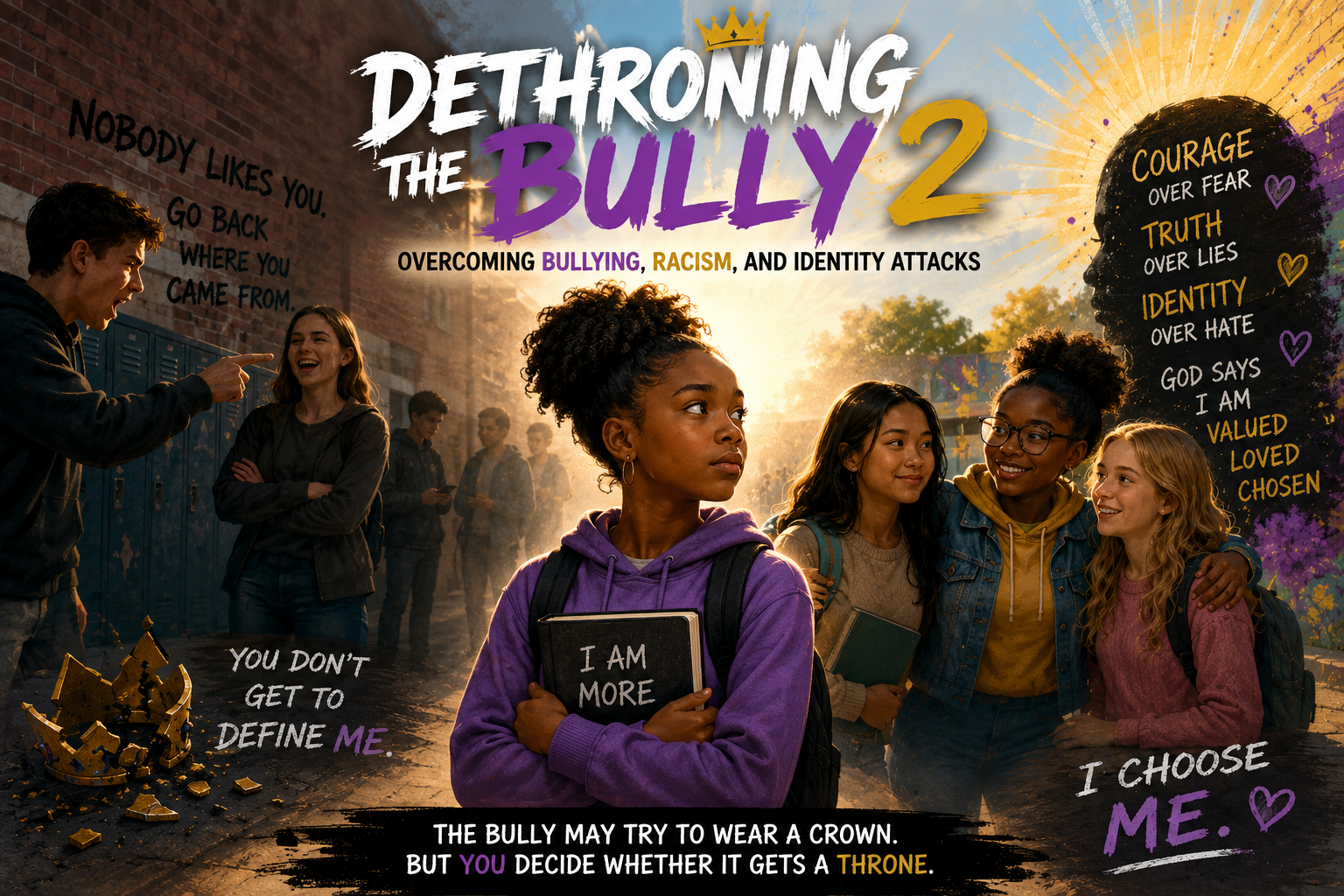
How to Overcome Bullying and Racism: Helping Kids Protect Their Identity and Find Their Voice
Bullying can happen in seconds.
The effects can last much longer.
A cruel comment in a hallway, a racial slur on the walk to school, a humiliating group chat or an attack on someone's appearance can follow a child long after the person who caused the harm has walked away.
That is especially true when bullying targets something deeply connected to identity, such as:
- Race
- Skin color
- Hair
- Culture
- Body
- Family
- Faith
- Disability
- Accent
- Background
For children and teens, those attacks can create questions that go far beyond the original incident.
Why did they choose me?
Does everyone think that about me?
Should I tell someone?
Will reporting it make things worse?
What if nobody believes me?
Should I fight back?
How do I stop thinking about it?
These are some of the questions explored through Nia Brooks in Dethroning the Bully 2: Overcoming Bullying, Racism, and Identity Attacks.
Nia is a young Black girl who is targeted with a racist slur by a student she barely knows.
The story does not end at the insult.
Instead, it follows what happens afterward: the fear, anger, silence, rumors, school investigation, friendships, questions about identity and the slow process of refusing to let one person's cruelty become the definition of who she is.
Bullying Often Attacks Identity
A bully may target something visible because it is easy to identify.
But the insult is not proof that anything is wrong with the person being targeted.
In Nia's story, the boy who insults her knows almost nothing about her.
He does not know her dreams.
He does not know her personality.
He does not know her family.
He does not know her faith.
He does not know the things she loves or the person she hopes to become.
He sees one part of her identity and chooses to weaponize it.
That distinction matters for children to understand.
Someone else's prejudice reveals something about their thinking. It does not establish your worth.
1. Tell the Truth About What Happened
Children sometimes hesitate to report bullying because they fear being called dramatic, weak or responsible for getting someone else in trouble.
But reporting what happened is not the same as causing what happened.
If bullying or racism occurs, document the facts as clearly as possible:
- Date
- Time
- Location
- What happened
- Exact words you remember
- Who was present
- What happened afterward
Do not exaggerate.
Do not guess about what the other person was thinking.
Tell what you know.
A powerful lesson in Nia's story is simple:
The truth is enough.
2. Tell a Trusted Adult
Children should not be expected to manage serious bullying by themselves.
A trusted adult may include a:
- Parent
- Guardian
- Teacher
- School counselor
- Principal
- Coach
- Pastor
- Youth leader
- Relative
If the first adult does not help, tell another.
Seeking help is not weakness.
It is using the support system around you.
3. Save Evidence
When bullying happens online, evidence can disappear quickly.
Save:
- Screenshots
- Messages
- Photos
- Usernames
- Dates
- URLs when relevant
Do not keep harmful material in order to repeatedly look at it.
Preserve what is necessary for reporting, then let responsible adults help determine the next step.
4. Understand That Reporting Is Not Revenge
A child may feel guilty if the bully receives consequences.
They may think:
Did I get them suspended?
But there is an important difference between reporting someone's behavior and deciding the consequence.
The child reports what happened.
The school or responsible authority decides how to respond.
Accountability is not the same as revenge.
5. Silence Can Hurt Too
Sometimes the most painful part of bullying is discovering that other people saw what happened and said nothing.
Witnesses may freeze.
They may be afraid.
They may not know what to say.
But silence can leave the person being targeted feeling completely alone.
A bystander does not need a perfect speech.
Simple responses can help:
- "Stop."
- "That's not okay."
- "That's not funny."
A witness can also move toward the person being targeted, find an adult or remain with them afterward.
Courage does not always mean reacting perfectly in the moment.
Sometimes courage is deciding what you will do differently next time.
6. Separate What You Know From What You Fear
After bullying, the mind can continue the attack long after the bully has stopped speaking.
A child may begin thinking:
Everybody agrees with them.
Nobody will help me.
It will happen again.
Maybe something really is wrong with me.
One helpful strategy is creating two lists:
What I Know
Write facts that can be supported.
For example:
- My parents know.
- My teacher knows.
- My friend supports me.
- I can ask for help.
- I did nothing wrong.
What I Fear
Write the thoughts that feel frightening but are not established facts.
This teaches an important lesson:
A thought can feel true without being true.
7. Do Not Carry Someone Else's Shame
Racist bullying can create a strange emotional reversal.
The person expressing prejudice has the ugly belief, but the person being targeted may begin carrying the ugly feeling.
Children need help separating those two things.
The cruelty belongs to the person who chose it.
The shame does not belong to the child who was targeted.
8. Recognize Real Friendship
Real friendship often becomes clearer during difficult moments.
A true friend may:
- Sit beside you
- Listen
- Walk with you
- Defend you appropriately
- Tell an adult
- Refuse to spread rumors
- Respect what you want shared
- Stay when things become uncomfortable
Support does not always arrive through dramatic speeches.
Sometimes it looks like someone simply refusing to let you sit alone.
9. Do Not Let Rumors Rewrite the Story
After a bullying incident, rumors can travel faster than facts.
Someone may say:
They were only joking.
You got them in trouble.
You're too sensitive.
It wasn't that serious.
Children should understand that someone else's interpretation does not erase what actually happened.
They can return to the facts.
They do not have to argue with everyone.
10. Handle Anger Without Becoming the Bully
Anger after mistreatment is understandable.
But anger can create a dangerous temptation:
If they hurt me, I want to hurt them back.
That can lead to:
- Threatening messages
- Public humiliation
- Revenge posts
- Fighting
- Rumor spreading
- Harassment
One of the strongest lessons in Nia's journey is the difference between accountability and revenge.
Accountability says: What you did was wrong.
Revenge says: Because you hurt me, I need you to hurt too.
Children can learn to pursue the first without becoming trapped in the second.
11. Protect Your Digital Response
When angry, do not immediately press send.
Take screenshots of harmful messages for evidence when necessary.
Then involve a trusted adult rather than creating a new harmful message that can also be screenshotted and shared.
Online retaliation can turn one incident into several.
12. Remember Who You Were Before the Bullying
One of the cruelest effects of identity-based bullying is that it can make a child begin examining themselves through the bully's eyes.
Nia eventually realizes that nothing about her became more valuable after she began healing.
She had always been valuable.
The difference was that she had to remember it.
Children can ask:
- What do I love about myself?
- What am I good at?
- What dreams do I have?
- What does my family love about me?
- What has God said about my value?
- What qualities make me who I am?
A bully does not receive authority to rewrite those answers.
13. Identity Is Bigger Than the Attack
A racist insult reduces a human being to one characteristic.
Healthy identity expands the picture again.
A child is not merely:
the kid who got bullied.
They may also be:
- Creative
- Funny
- Intelligent
- Athletic
- Compassionate
- Faithful
- Curious
- Talented
- Loyal
- Brave
- Still growing
The event may become part of their story.
It does not have to become their entire identity.
14. An Apology Does Not Control Your Healing
Sometimes a bully apologizes.
Sometimes they do not.
Sometimes the apology is sincere.
Sometimes it is incomplete.
A child should understand that healing does not require pretending the harm never happened.
Accepting an apology, forgiving, rebuilding trust and becoming friends again are not necessarily identical decisions.
Healthy boundaries can remain.
15. Dethrone the Bully
The title Dethroning the Bully represents something deeper than defeating another person.
A bully gains a throne when their words begin ruling how someone sees themselves.
The throne may look like:
- Fear
- Shame
- Self-hatred
- Constant anxiety
- Revenge
- Isolation
- Believing the insult
Dethroning the bully means refusing to give those words permanent authority.
It means saying:
What happened mattered. But it does not get to become the ruler of who I am.
16. Kingdom Identity Can Challenge False Shame
For faith-centered families, Scripture can provide another foundation for identity.
The question becomes not only:
What did the bully say about me?
but:
What does God say about me?
That shift can help young readers separate human cruelty from spiritual identity.
Dethroning the Bully 2 includes Kingdom Guided Principles and Scripture sections throughout the story so children can connect practical responses to faith, truth, courage and identity.
17. Children Can Become Protectors Without Becoming Aggressors
Healing sometimes changes how a young person responds when they see someone else being targeted.
They recognize the body language.
They recognize the silence.
They recognize the attempt to disappear.
A child who has experienced bullying can eventually become someone who says:
Are you okay?
Come sit with us.
Let's tell somebody.
You don't have to handle this alone.
That is a very different kind of strength from retaliation.
What Should a Child Do If Bullying or Racism Happens?
A practical response can include:
1. Get to a safe place.
2. Tell a trusted adult.
3. Write down exactly what happened.
4. Save relevant evidence.
5. Do not retaliate physically or online.
6. Ask what happens next.
7. Tell another adult if the first person does not help.
8. Stay near supportive people if retaliation is a concern.
9. Remember that being targeted does not make the insult true.
These principles are also incorporated into the Young Warrior Toolkit at the end of Dethroning the Bully 2.
What Should a Child Do If They Witness Bullying?
If it is safe:
- Say something simple such as "Stop" or "That's not okay."
- Move toward the person being targeted.
- Get an adult.
- Do not join the laughter.
- Do not forward humiliating content.
- Check on the person afterward.
Witnesses do not have to become superheroes.
They simply have to refuse to become part of the audience cruelty depends on.
The Goal Is Not to Create Fear
Children should learn about bullying without being taught to expect hostility everywhere.
The objective is preparation.
They should know:
- What bullying looks like
- What racism can look like
- How to report it
- How to preserve evidence
- Who can help
- How to respond safely
- How to resist retaliation
- How to protect identity
Preparation can replace helplessness with practical options.
A Story About What Happens After the Hurt
Dethroning the Bully 2: Overcoming Bullying, Racism, and Identity Attacks follows Nia Brooks after she is targeted with a racist slur at school.
Across ten chapters, the story explores:
- The initial racist attack
- Understanding that she did not deserve it
- The pain of bystander silence
- Fear and intrusive thoughts
- Reporting the truth
- Real friendship
- Anger without retaliation
- Rebuilding identity
- Facing the bully again
- Becoming stronger without pretending the incident never happened
The book concludes with a Young Warrior Toolkit that gives young readers practical steps for responding when bullying or racism happens to them or when they witness it happening to someone else.
The central message is captured in the book's closing idea:
The bully may try to wear a crown. But you decide whether it gets a throne.
That is what dethroning the bully ultimately means.
Not pretending the hurt never happened.
Not becoming cruel in return.
But refusing to allow another person's hatred to rule your identity.
Dethroning the Bully 2: Overcoming Bullying, Racism, and Identity Attacks is written by Delvin Hale and published under Illustrious Capital.
Enjoying the Academy?
Join AurumVault Insider for new practical guides, digital tools, and marketplace releases.
No spam. Unsubscribe anytime. Privacy
By subscribing, you agree to receive AurumVault Insider emails. You can unsubscribe at any time.
Continue your journey
Keep reading
End-of-Life Planning Checklist: What to Organize Before Your Family Needs It
End-of-life planning is about more than writing a will. A well-organized plan can help your family locate important information, understand your preferences, contact the right people, and make difficult moments less confusing.
PRIORITIZE, ORGANIZE, DISCIPLINE
Most people don't fail to become who they're meant to be from lack of ambition — they fail from chasing too much at once with no sequence. This piece breaks down the three-part framework: prioritize what matters, organize it into structure, then discipline yourself to sustain it.
How to Use AI for Bible Study, Prayer & Leadership
Where AI genuinely helps with Bible study, prayer, and leadership — and where it can't replace the Holy Spirit, community, or the real work of faith.