
How to Pitch a Documentary to Netflix, Hulu or a Streaming Platform
A strong documentary pitch is more than a good story. Filmmakers need a professional package that explains the concept, proves access, defines the audience, addresses rights and production readiness, and shows how the project could move from idea to screen.
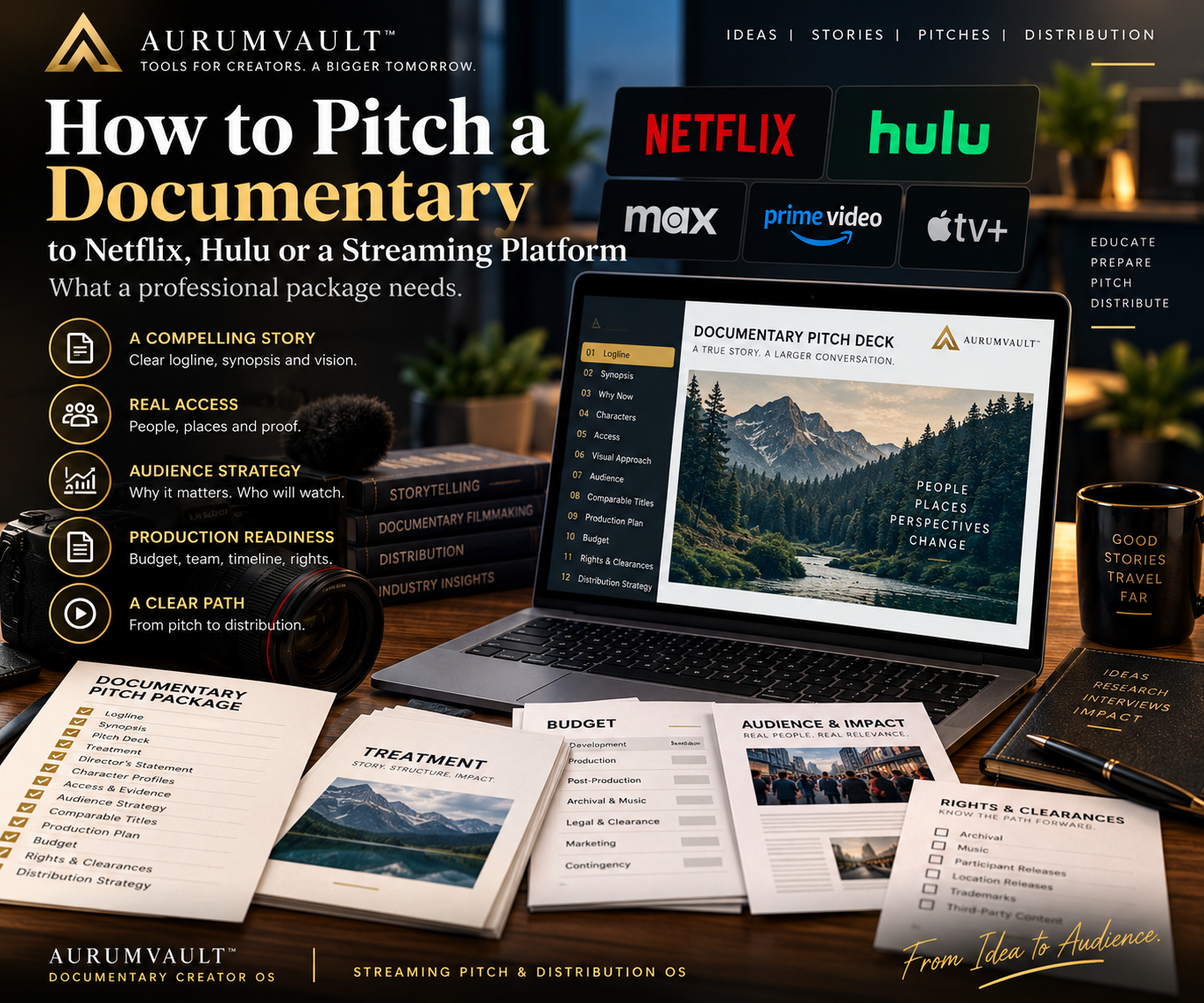
How to Pitch a Documentary to Netflix, Hulu or a Streaming Platform: What a Professional Package Needs
A compelling documentary idea is not automatically a compelling documentary pitch.
A filmmaker may have an extraordinary subject, rare access, powerful footage, a timely issue, or an unforgettable central character and still struggle to move the project forward.
Why?
Because buyers, producers, distributors, financiers, sales agents, and streaming partners are not evaluating only the idea.
They are evaluating the project.
That means the story, the access, the filmmaker, the audience, the rights position, the production plan, the commercial logic, the materials already created, and the path from concept to finished film.
If you want to understand how to pitch a documentary, the first lesson is simple:
Do not pitch only the story. Pitch the evidence that you can actually make and position the film.
That is why a professional documentary package matters.
What Does It Mean to Pitch a Documentary?
Pitching a documentary means presenting the project in a way that allows another party to quickly understand:
- what the film is about,
- why the story matters,
- why it should be made now,
- who the central characters are,
- what access the filmmakers have,
- what makes the project distinctive,
- what stage of production it has reached,
- who the intended audience is,
- what support is being requested,
- and why the project may be commercially or culturally relevant.
The recipient may be a producer, financier, sales agent, distributor, broadcaster, production company, studio, network, or streaming platform.
The exact process differs depending on who is receiving the pitch.
Many major entertainment companies do not operate as open submission portals for unsolicited ideas. Filmmakers often reach buyers through established producers, representatives, sales agents, distributors, production companies, markets, festivals, labs, industry relationships, or other recognized submission channels.
That makes preparation even more important.
When access to a decision-maker becomes available, the filmmaker should already have a package that looks like a serious project rather than an unfinished idea.
1. Start With a Clear Documentary Logline
Your logline should communicate the core story quickly.
It is not a complete synopsis.
It is the shortest useful version of the documentary.
A strong documentary logline usually communicates some combination of:
- the central subject,
- the conflict or question,
- the stakes,
- the setting,
- and the reason the story is compelling.
For example, instead of:
> A documentary about small businesses struggling with technology.
A stronger direction might be:
> As neighborhood businesses race to adopt artificial intelligence, three owners confront the promise, cost, and unexpected consequences of automating the companies they spent decades building.
The second version creates movement, tension, characters, and stakes.
Your logline should make someone want the next page.
2. Write a Strong Short Synopsis
After the logline comes the short synopsis.
This usually gives the reader enough information to understand the documentary without reading a full treatment.
A useful synopsis should explain:
- the central subject,
- the primary characters or participants,
- the major conflict or question,
- the journey the film follows,
- and what makes the outcome worth watching.
Avoid turning the synopsis into a biography, research paper, or broad explanation of the issue.
Documentaries still need story.
Even issue-driven films become more engaging when viewers understand whose experience they are following and what is at stake.
3. Explain Why This Documentary Needs to Exist Now
Timing matters.
Streaming buyers and distributors regularly evaluate whether a project connects to a conversation, audience, cultural moment, emerging issue, anniversary, trend, event, or underserved subject.
Your pitch should answer:
Why this story? Why now?
That does not mean every documentary needs to chase breaking news.
A timeless story can still have urgency.
But the filmmaker should be able to explain why audiences should care about this film now rather than five years from now.
Possible drivers include:
- cultural change,
- technological disruption,
- political or economic shifts,
- major anniversaries,
- new public awareness,
- newly available evidence,
- unprecedented access,
- a changing industry,
- or an emerging human story.
4. Prove Your Access
Access can be one of the most valuable assets in a documentary pitch.
Anyone can have an idea about a famous person, controversial industry, historical event, company, sports team, community, crime, movement, or cultural phenomenon.
Far fewer filmmakers can actually obtain meaningful access.
Your package should explain what you already have access to.
Examples might include:
- principal participants,
- exclusive interviews,
- archival material,
- private collections,
- locations,
- organizations,
- families,
- witnesses,
- experts,
- behind-the-scenes environments,
- or ongoing events.
If access is still being negotiated, say so accurately.
Do not imply that you have secured access, rights, interviews, or cooperation that you do not actually have.
Credibility matters.
5. Introduce the Main Characters
People drive documentaries.
Even a film centered around a large issue often becomes memorable because of the individuals through whom the audience experiences it.
For each major participant, briefly explain:
- who they are,
- why they matter to the story,
- what they want,
- what they may lose,
- what perspective they provide,
- and how they change or reveal the larger subject.
Avoid generic descriptions.
Instead of:
> John is an entrepreneur.
Try to show why John matters specifically to this film.
What makes his experience essential?
Why would an audience follow him for 90 minutes or across several episodes?
6. Define the Documentary Format
The pitch package should make the format clear.
Is this:
- a feature documentary,
- a limited documentary series,
- an episodic unscripted series,
- an investigative film,
- an observational documentary,
- a historical documentary,
- a biographical documentary,
- a sports documentary,
- a music documentary,
- a true-crime project,
- or another nonfiction format?
For episodic projects, explain the proposed number and approximate length of episodes.
If the story requires multiple episodes, demonstrate why.
Do not stretch a feature-length idea into a series simply because series formats may appear commercially attractive.
The story should justify the format.
7. Create a Professional Documentary Pitch Deck
The pitch deck is one of the central documents in a professional package.
Its purpose is not to put every fact about the film onto slides.
It should make the project understandable, memorable, and visually coherent.
A documentary deck may include sections such as:
- title,
- logline,
- short synopsis,
- why now,
- key characters,
- filmmaker vision,
- access,
- story structure,
- visual approach,
- episode breakdown if applicable,
- audience,
- comparable titles,
- production status,
- team,
- distribution strategy,
- and contact information.
The deck should visually match the tone of the documentary.
A serious investigative film should not look like a generic startup presentation.
A music documentary should not feel identical to a historical archival project.
Design is part of storytelling.
8. Prepare a Documentary Treatment
A treatment gives more depth than the pitch deck.
It explains how the documentary unfolds and what the viewing experience may feel like.
Depending on the project, a treatment may cover:
- opening sequence,
- narrative arc,
- major story beats,
- key characters,
- settings,
- archival elements,
- interviews,
- visual language,
- tone,
- themes,
- and the anticipated ending or direction of the story.
Documentaries evolve during production, so a treatment does not need to pretend the future is fully known.
But the reader should understand that the filmmaker has a narrative plan.
9. Include a Director's or Creator's Statement
Why are you the person to tell this story?
A strong creator statement can explain:
- your connection to the subject,
- why you care about the story,
- the perspective you bring,
- your creative approach,
- and what you want viewers to experience.
This section should be personal without becoming self-indulgent.
The goal is to strengthen confidence in the filmmaker's point of view.
10. Show the Visual Approach
Streaming is visual storytelling.
Your package should communicate what viewers will actually see.
Possible elements include:
- observational footage,
- cinematic interviews,
- archival photography,
- archival video,
- animation,
- recreations,
- graphics,
- maps,
- vérité footage,
- location photography,
- news material,
- social media content,
- or other visual sources.
A deck filled with generic stock photography can weaken the impression of a distinctive documentary.
Whenever possible, use real project imagery, authorized archival references, location photography, character images, or carefully selected visual references that communicate the intended tone.
11. Prepare a Sizzle Reel or Teaser When Appropriate
A strong video sample can make the project much easier to understand.
Depending on the stage of development, filmmakers may prepare:
- a short teaser,
- a sizzle reel,
- sample scenes,
- an extended trailer,
- or selected footage.
The goal is not always to summarize the entire documentary.
A good teaser can prove several things quickly:
- access,
- character strength,
- visual quality,
- tone,
- emotional stakes,
- and the filmmaker's ability to execute.
A weak teaser can also hurt the pitch, so do not rush to create one simply because you believe every project needs video.
12. Define Your Audience
Saying that a documentary is "for everyone" is rarely a strong audience strategy.
Your package should identify realistic audience groups.
Consider:
- demographic audiences,
- interest communities,
- professional communities,
- cultural audiences,
- geographic audiences,
- educational audiences,
- advocacy communities,
- fan bases,
- or existing communities connected to the subject.
Then explain why those groups would care.
Audience definition becomes particularly valuable when it can be connected to an actual distribution or marketing strategy.
13. Research Comparable Titles
Comparable films and series help industry readers understand the commercial and creative neighborhood of your project.
Do not simply list famous documentaries.
Choose comparisons strategically.
A comparable title might demonstrate:
- tone,
- subject matter,
- audience,
- storytelling format,
- production scale,
- visual approach,
- or marketplace precedent.
Your pitch should still explain what differentiates your documentary.
If your project sounds identical to an existing hit, the obvious question becomes why another version is necessary.
14. Explain the Production Status
Be specific about where the documentary currently stands.
Examples include:
- concept development,
- research,
- access negotiations,
- pre-production,
- principal photography,
- post-production,
- rough cut,
- picture lock,
- or completed film seeking distribution.
Also identify what has already been completed.
This might include:
- interviews filmed,
- archival research completed,
- participants secured,
- footage captured,
- rights discussions initiated,
- production partners attached,
- or financing raised.
Clarity makes the project easier to evaluate.
15. Build a Realistic Budget
A documentary budget communicates production seriousness.
It should reflect the actual demands of the project.
Possible budget categories include:
- development,
- research,
- producers,
- director,
- production crew,
- equipment,
- travel,
- locations,
- archival licensing,
- music,
- insurance,
- legal review,
- post-production,
- editing,
- sound,
- color,
- graphics,
- deliverables,
- marketing materials,
- and contingency.
An unrealistic budget can damage confidence even when the creative concept is strong.
16. Explain What You Are Asking For
A pitch should have an objective.
Are you seeking:
- development financing,
- production financing,
- finishing funds,
- a production partner,
- executive producers,
- distribution representation,
- a sales agent,
- broadcaster interest,
- streaming acquisition,
- licensing,
- or another specific relationship?
Do not make the recipient guess what you want.
The requested next step should be clear.
17. Address Rights and Chain of Title
Rights questions can become critical in documentary development and distribution.
Depending on the project, relevant considerations may include:
- archival footage,
- photographs,
- music,
- artwork,
- participant releases,
- location releases,
- trademarks,
- underlying works,
- life rights discussions,
- third-party material,
- and other intellectual property issues.
The specific legal requirements depend on the documentary and jurisdiction, so filmmakers should work with qualified legal professionals where appropriate.
From a pitching perspective, the important principle is that a filmmaker should understand what materials the project depends on and what has or has not been secured.
Do not describe rights as cleared when they are not.
18. Keep a Rights and Evidence Record
As a documentary grows, rights information can become scattered across emails, agreements, folders, releases, invoices, licenses, and correspondence.
Create a central record.
For each important asset, record information such as:
- asset or material,
- owner or source,
- permission status,
- license terms,
- geographic rights,
- media rights,
- duration,
- restrictions,
- expiration if applicable,
- and supporting agreement.
This becomes particularly important later in production and distribution.
19. Prepare the Production Team Section
Introduce the people attached to the project.
This might include:
- director,
- producer,
- executive producer,
- cinematographer,
- editor,
- researcher,
- production company,
- advisors,
- or other key collaborators.
Keep biographies relevant.
Highlight experience that increases confidence in the team's ability to execute this specific documentary.
20. Build a Distribution Strategy Before the Film Is Finished
Distribution should not begin as an afterthought after the final export is complete.
Think about potential pathways while the project is still being developed.
Possible paths can include:
- festivals,
- broadcasters,
- streaming platforms,
- sales agents,
- distributors,
- educational licensing,
- international sales,
- transactional platforms,
- community screenings,
- direct distribution,
- or hybrid strategies.
The appropriate path depends on the project.
A film designed for global entertainment audiences may have a different strategy from a specialized educational documentary.
Can You Pitch a Documentary Directly to Netflix or Hulu?
This is where many first-time filmmakers misunderstand the process.
Having a documentary idea does not mean you can simply email a major streaming platform and expect an acquisition executive to review an unsolicited pitch.
Major entertainment buyers commonly work through established industry relationships and recognized channels.
Depending on the project, that may mean approaching:
- established producers,
- production companies,
- agents or managers,
- entertainment attorneys,
- distributors,
- sales agents,
- film markets,
- festivals,
- pitch forums,
- development programs,
- or other industry intermediaries.
Submission and acquisition practices can change, so filmmakers should verify the current policies of any specific platform or company before submitting materials.
The strategic lesson is important:
Do not build your entire plan around getting a direct email address for Netflix. Build a project package strong enough that credible industry partners want to carry it into the room.
What Should Be in a Professional Documentary Pitch Package?
Use this checklist as a starting point:
- [ ] Documentary title
- [ ] Logline
- [ ] Short synopsis
- [ ] Why now
- [ ] Main characters
- [ ] Access statement
- [ ] Format and runtime
- [ ] Pitch deck
- [ ] Documentary treatment
- [ ] Creator/director statement
- [ ] Visual approach
- [ ] Sizzle reel or sample footage, if appropriate
- [ ] Audience profile
- [ ] Comparable titles
- [ ] Production status
- [ ] Budget
- [ ] Financing status
- [ ] Team biographies
- [ ] Rights overview
- [ ] Distribution strategy
- [ ] Specific ask
- [ ] Contact information
Not every recipient requires every document at the first interaction.
The value of preparing the complete package is that you can respond professionally when an opportunity advances.
Common Documentary Pitching Mistakes
Mistake 1: Pitching Only the Topic
"A documentary about homelessness" is a subject, not yet a documentary pitch.
Who are we following?
What happens?
What changes?
What access do you have?
What makes your version unique?
Mistake 2: Having No Evidence of Access
A major subject may sound exciting until the buyer learns that none of the central participants have agreed to appear.
Be transparent about access.
Mistake 3: Making the Deck Too Long
The pitch deck should encourage conversation, not exhaust the recipient before the meeting begins.
Put deeper material into supporting documents.
Mistake 4: Ignoring the Audience
Creative passion matters, but buyers also need to understand who may watch the project.
Mistake 5: Ignoring Rights Until the End
Rights problems can become expensive and disruptive later.
Start organizing them early.
Mistake 6: Claiming Relationships You Do Not Have
Do not imply that a platform, celebrity, participant, distributor, investor, or production partner is attached unless the relationship actually exists and can be described accurately.
Mistake 7: Asking for Everything at Once
Know the immediate objective of each pitch.
A development producer meeting may require a different ask than a finished-film distribution conversation.
Build the Package Before You Need the Meeting
The worst time to begin assembling a professional pitch package is after someone asks to see it.
A filmmaker who has already organized the project can respond quickly and confidently.
That is where structured production systems can help.
The Documentary Creator OS from AurumVault is designed to help creators organize the documentary development process, while the Streaming Pitch & Distribution OS focuses on preparing the project for pitching, positioning, and distribution conversations.
Rather than keeping the logline in one document, rights information in another folder, distribution research in a spreadsheet, and pitch notes in email, creators can build a more structured operating process around the project.
The objective is not simply to make the paperwork look professional.
It is to make the documentary itself easier to evaluate, develop, pitch, and move forward.
The Professional Pitch Mindset
A serious documentary pitch should communicate five things:
STORY — There is a compelling narrative worth watching.
ACCESS — The filmmaker can realistically tell the story.
EXECUTION — The team understands how the film will be made.
AUDIENCE — There is a credible reason people will watch it.
READINESS — The project is organized enough to move into the next stage.
Those five areas are more important than trying to make a deck look expensive.
A beautifully designed presentation cannot rescue a project that has no access, unclear rights, no narrative structure, or no identifiable audience.
Final Takeaway
If you are learning how to pitch a documentary, do not begin by asking how to reach Netflix, Hulu, or another streaming platform.
Begin by asking whether the documentary is ready to survive professional scrutiny once the opportunity arrives.
Can you explain the story in one sentence?
Can you prove meaningful access?
Can you show the characters and stakes?
Can you explain why the film matters now?
Can you show what it will look and feel like?
Can you explain the audience?
Can you identify the rights issues?
Can you describe the production status and budget?
Can you explain exactly what you are asking for?
If those answers are organized into a credible professional package, you are no longer pitching only an idea.
You are presenting a documentary project.
And that is the level at which serious producers, financiers, distributors, and streaming partners can begin evaluating what happens next.
Educational notice: This article provides general educational and organizational information and is not legal, financial, representation, acquisition, or distribution advice. Submission policies, acquisition practices, rights requirements, and industry procedures vary among companies and can change over time. Filmmakers should verify current submission policies directly with the relevant company or authorized representative and seek qualified legal or industry advice where appropriate.
Enjoying the Academy?
Join AurumVault Insider for new practical guides, digital tools, and marketplace releases.
No spam. Unsubscribe anytime. Privacy
By subscribing, you agree to receive AurumVault Insider emails. You can unsubscribe at any time.
Continue your journey
Keep reading
Reality Show Pitch Deck Checklist: What Producers Expect
A strong reality show idea is only the beginning. Producers need to understand the premise, cast, format, repeatable episode engine, audience, visual identity, access, production feasibility, and why the concept can sustain a series. This checklist breaks down what belongs in a professional reality show pitch deck.
How to Pitch a Reality Show to Networks and Streaming Platforms
A great reality show idea is only the beginning. To attract producers, networks or streaming buyers, creators need to turn the idea into a clear format, compelling cast, repeatable episode engine and professional pitch package. This guide walks through the process from concept development to the pitch meeting.