
AI Agent Risk Management for Small Businesses: 2026 Guide
AI agents can increasingly access systems, send communications, modify records, influence spending and make operational decisions. This guide explains how small businesses can document and control that authority while building stronger risk and insurance readiness.
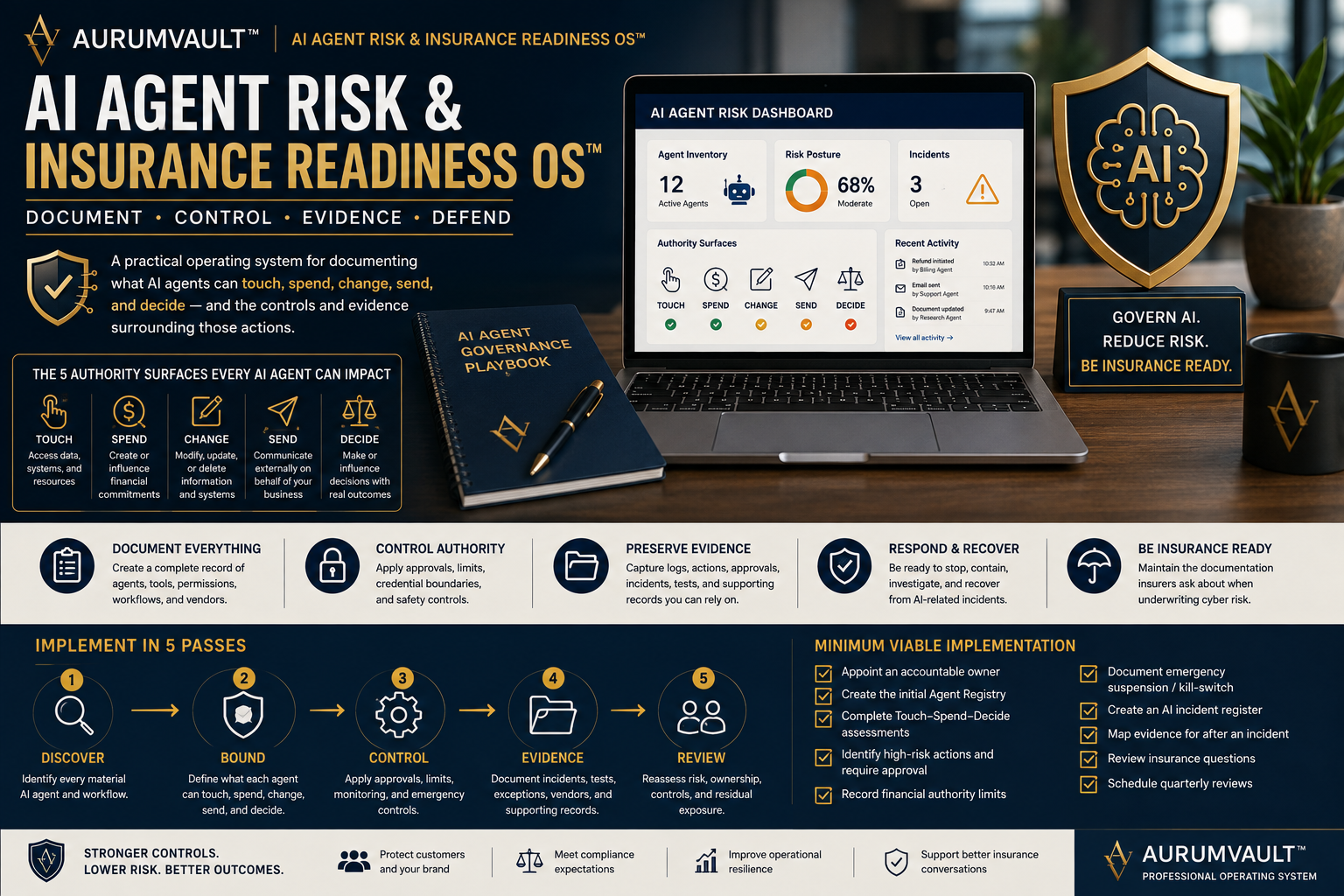
AI Agent Risk Management for Small Businesses: The 2026 Readiness Guide
AI agents are moving beyond answering questions and generating content. They can increasingly interact with business systems, communicate with customers, update records, use connected tools, influence purchases and perform multi-step workflows.
That creates an important question for business owners: How much authority should an AI agent actually have?
AI agent risk management is about understanding what each agent can access and do, limiting that authority appropriately, monitoring consequential actions and preserving evidence when something goes wrong.
What Is AI Agent Risk Management?
AI agent risk management is the process of identifying, controlling, monitoring and documenting risks created when AI systems interact with real business operations.
The risk changes substantially when an AI system moves from recommending an action to actually performing it.
An AI assistant that drafts a customer email creates a different level of exposure than an AI agent that can send that email without human review.
The Five AI Agent Authority Surfaces
A practical way to evaluate an AI agent is to examine five areas of authority: Touch, Spend, Change, Send and Decide.
Touch
What information, accounts, systems, credentials or business assets can the AI agent access?
Spend
Can the agent create or influence purchases, refunds, advertising spend, credits, subscriptions or other financial commitments?
Change
What records, files, permissions, configurations, prices or systems can the agent modify or delete?
Send
What can the AI agent communicate externally on behalf of the business?
Decide
What judgments can the agent convert into actual business outcomes?
These five authority surfaces help businesses evaluate AI based on what it can actually do rather than simply what the technology is called.
Why AI Agent Risk Is Different
AI agents may use tools, interpret information, execute workflows and determine which actions to take next.
Potential risks include excessive permissions, incorrect transactions, unauthorized communications, sensitive-data exposure, credential misuse, destructive system changes, vendor failures, prompt injection and cascading automation failures.
The goal is not to assume an AI agent will never make a mistake. The goal is to make sure its authority is bounded, failures can be detected, harmful actions can be interrupted and important events can be reconstructed afterward.
Create an AI Agent Registry
Document every material AI agent operating within the business.
Record information such as the agent name, business owner, technical owner, purpose, vendor or model, deployment environment, systems accessed, data sensitivity, business criticality, autonomy level and review date.
A business cannot reliably govern an AI agent it does not know exists.
Establish Levels of AI Authority
Not every AI agent needs the same level of autonomy.
A practical model can include Observe, Draft, Execute With Approval, Bounded Execute and Elevated Autonomy.
Businesses should increase authority only when there is a legitimate business need and appropriate controls exist for the additional risk.
Set Financial Limits
AI agents with financial authority deserve additional controls.
Consider per-transaction limits, daily limits, monthly limits, approval thresholds, restrictions on new payees, unusual transaction monitoring and emergency financial freezes.
Small automated transactions can become material when repeated at scale.
Require Human Approval for Consequential Actions
Human approval may be appropriate before an AI agent can issue a large refund, make a significant purchase, delete important records, change permissions, deploy production code, publish sensitive communications, modify financial information or create contractual commitments.
Approval should be tied to specific actions rather than becoming unlimited future permission.
Prevent AI Agents From Increasing Their Own Authority
An AI agent generally should not independently change the mechanisms defining its own authority.
That includes permissions, credentials, financial limits, approval requirements, monitoring controls and security policies.
Separating authority from the agent being governed can reduce uncontrolled privilege expansion.
Protect AI Agent Credentials
AI agents frequently operate through API keys, OAuth permissions, service accounts, browser sessions, tokens and other machine identities.
Businesses should document credential ownership, accessible systems, permission scopes, expiration, rotation procedures and revocation methods.
Prepare an AI Kill Switch
Businesses should know how to rapidly stop an AI agent when necessary.
Emergency controls can include disabling the agent runtime, revoking API credentials, stopping outbound communications, freezing financial authority, disabling integrations and blocking production deployment.
These controls should be tested periodically rather than merely documented.
Prepare for AI Incidents and Near Misses
Maintain an AI incident and near-miss process.
Potential incidents can include unauthorized access, incorrect transactions, data exposure, inappropriate communications, credential misuse, unauthorized changes, harmful decisions or vendor failures.
Near misses should also be documented because they can reveal whether safeguards are working.
Preserve Evidence
Useful operational evidence can include discovery timestamps, agent information, workflow information, tool actions, API events, approval records, authentication logs, transaction records, external communications, containment actions, credential revocation records, financial impact and corrective actions.
Evidence should focus on relevant operational facts and records.
Consider Prompt Injection Risk
AI agents can encounter instructions embedded in emails, webpages, documents, support tickets, files and tool outputs.
Untrusted external content should not be able to silently expand an agent's authority or bypass important controls.
Watch for Agent-to-Agent Risk
Multi-agent systems introduce another challenge when one agent asks another agent to perform an action.
The executing agent should independently determine whether the requested action is permitted rather than automatically inheriting authority from the requesting agent.
Review AI Vendors
Businesses should understand what information an AI vendor receives, its data-retention practices, authentication controls, audit logs, permission scoping, human approval capabilities, credential handling, incident notification procedures, subprocessors, contractual limitations, evidence export capabilities and service-disable procedures.
Prepare for Insurance and Risk Conversations
Businesses using action-taking AI agents may benefit from discussing their changing technology environment with appropriate insurance, legal, cybersecurity and risk professionals.
Useful documentation can identify which agents take actions, access sensitive information, influence financial transactions, communicate externally, modify production systems, require human approval, generate logs and can be rapidly disabled.
Readiness documentation does not guarantee insurance coverage. Its purpose is to create an organized record of AI usage, controls, risks and evidence for appropriate professional discussions.
A 30-60-90 Day AI Agent Risk Plan
Days 1-30: Discover and Contain
Identify production AI agents, assign owners, document authority, remove obvious excessive access and establish emergency stop procedures.
Days 31-60: Control and Document
Implement approval gates and limits, establish incident records, organize evidence, review vendors and test emergency controls.
Days 61-90: Validate and Govern
Review residual risks, establish executive oversight, prepare appropriate insurance or risk discussions and create a recurring review schedule.
AI Agent Risk Management Checklist
Before allowing an AI agent to perform consequential production actions, confirm that an accountable owner is assigned, purpose and scope are documented, systems and data are mapped, Touch-Spend-Change-Send-Decide authority has been assessed, high-risk actions are identified, authority limits are configured, human approval exists where required, credentials follow least-privilege principles, logging is available, emergency suspension has been tested, recovery procedures are documented and vendor risk has been reviewed.
Build Your AI Agent Risk Readiness System
The AI Agent Risk & Insurance Readiness OS is designed to help small businesses and agencies organize AI-agent authority, risks, controls, incidents, reviews and supporting evidence.
Instead of relying on an informal understanding of what AI agents can do, businesses can create a documented operating record around their real-world authority.
Document. Control. Evidence. Defend.
Final Takeaway
A useful principle for AI agent governance is simple: An AI agent should never have more practical authority than the business can explain, monitor, interrupt, investigate and defend.
As businesses give AI systems more operational responsibility, documentation, controls, evidence and tested response procedures become increasingly important.
Important notice: This article and associated resources are provided for educational and organizational purposes and are not legal, insurance, cybersecurity, accounting, regulatory or compliance advice.
Enjoying the Academy?
Join AurumVault Insider for new practical guides, digital tools, and marketplace releases.
No spam. Unsubscribe anytime. Privacy
By subscribing, you agree to receive AurumVault Insider emails. You can unsubscribe at any time.