
Customer Security Questionnaire Guide: How to Answer Enterprise Security Reviews in 2026
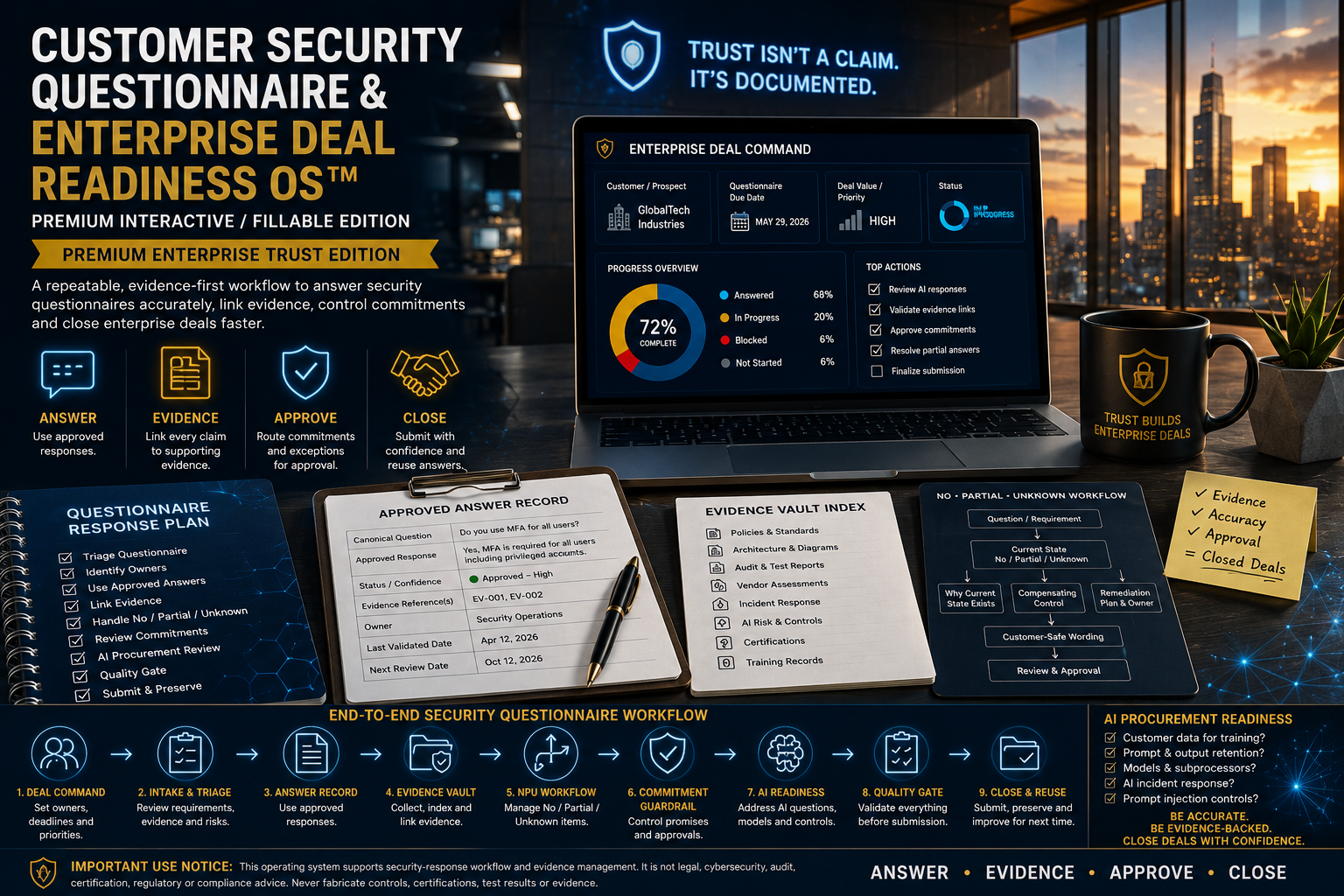
Enterprise customers often require detailed security questionnaires before signing a contract. A strong response process should do more than fill in answers quickly. It should identify owners, reuse validated responses, link claims to evidence, document gaps honestly, control contractual promises and review AI-specific questions before submission.
Customer Security Questionnaire Guide: How to Answer Enterprise Security Reviews in 2026
Winning an enterprise customer can create an unexpected obstacle late in the sales process.
The prospect likes the product.
The commercial terms look promising.
Then a security questionnaire arrives.
It may contain dozens or hundreds of questions covering cybersecurity, privacy, infrastructure, business continuity, incident response, certifications, vendors, artificial intelligence and contractual commitments.
Suddenly, a sales opportunity becomes a cross-functional research project.
For growing SaaS companies, agencies, technology providers and AI businesses, learning how to handle a customer security questionnaire can directly affect enterprise deal velocity.
The objective is not simply to answer quickly.
The objective is to answer accurately, support important claims with evidence and avoid making promises the organization cannot actually keep.
What Is a Customer Security Questionnaire?
A customer security questionnaire is a due-diligence document used by a prospective or existing customer to evaluate the security practices of a vendor or service provider.
Questions can cover areas such as:
- Information security governance
- Access control
- Authentication
- Encryption
- Vulnerability management
- Incident response
- Business continuity
- Disaster recovery
- Data retention
- Privacy
- Third-party vendors
- Employee security
- Certifications
- Artificial intelligence
- Contractual security commitments
For enterprise buyers, the questionnaire can become part of the process for deciding whether a vendor introduces acceptable risk.
Why Security Questionnaires Slow Down Enterprise Deals
The difficulty is rarely the questionnaire itself.
The problem is usually finding reliable answers.
One question may require the security team.
Another may require engineering.
Another may involve legal.
Another may depend on an old audit report.
Another may ask whether a particular certification exists.
Another may ask about an AI feature nobody previously documented for customer procurement.
Without a structured process, answers end up spread across email, Slack messages, old questionnaires, spreadsheets and individual memories.
That creates delays and inconsistency.
The Four-Part Security Response Principle
A useful enterprise security workflow can be summarized as:
ANSWER → EVIDENCE → APPROVE → CLOSE
Answer
Provide an accurate response based on the organization's current state.
Evidence
Identify the record, policy, report, configuration or other evidence supporting the statement where appropriate.
Approve
Route sensitive commitments or high-impact responses to the appropriate owner.
Close
Complete the questionnaire, preserve the final submission and capture reusable information for future deals.
Step 1: Create an Enterprise Deal Command Record
Before answering individual questions, establish the basic deal context.
Record information such as:
- Customer or prospect
- Deal owner
- Security owner
- Questionnaire due date
- Deal value or strategic priority
- Current blocker
This helps teams prioritize work rather than treating every questionnaire as an isolated document.
A high-value enterprise opportunity due tomorrow should not be managed the same way as a low-priority assessment with a flexible deadline.
Step 2: Triage the Questionnaire
Do not immediately begin answering from question one.
First, assess what you received.
Record:
- Questionnaire or portal name
- Total question count
- Requested frameworks
- Requested certifications
- Requested evidence
- Whether AI-specific questions are present
- Whether legal or contractual commitments are present
This triage stage reveals which internal teams may need to participate.
Step 3: Separate Questions From Commitments
Not every question is simply asking for information.
Some questions can create a commercial or contractual commitment.
For example, a customer might ask whether your company will:
- Notify them within a specified number of hours after an incident
- Maintain a particular certification
- Perform testing on a certain schedule
- Store data only in a specified region
- Maintain particular recovery objectives
- Support specific security controls indefinitely
These should not automatically be answered by whoever is completing the questionnaire.
They may require legal, security, engineering, finance or executive review.
Step 4: Build an Approved Answer Library
Organizations repeatedly receive similar security questions.
Instead of rewriting answers from scratch every time, create an approved-answer record.
For each recurring question, maintain:
- Canonical question
- Approved response
- Response status or confidence
- Evidence references
- Owner
- Last validated date
- Expiration or next-review date
This can significantly reduce response time while improving consistency.
Why Approved Answers Need Expiration Dates
Security environments change.
A statement that was accurate six months ago may no longer be accurate today.
Examples include:
- New cloud providers
- Updated encryption configurations
- Changed backup procedures
- New AI functionality
- New subprocessors
- Expired certifications
- Updated policies
For that reason, reusable answers should not become permanent truths.
Assign validation and review dates.
Step 5: Create an Evidence Vault
A strong security response program does not rely solely on written answers.
Create an organized evidence inventory.
For each evidence item, record:
- Evidence item name
- Document or system owner
- What claim it supports
- Version or date
- Whether it can be shared with customers
- Restrictions or NDA notes
This matters because not every piece of security evidence should automatically be sent externally.
Examples of Security Evidence
Depending on the organization and question, evidence might include:
- Security policies
- Architecture documentation
- Access-control records
- Audit reports
- Penetration-test summaries
- Vulnerability-management records
- Security training records
- Backup-test evidence
- Incident-response documentation
- Business-continuity records
- Vendor assessments
- Certifications
The evidence should support the claim actually being made.
Step 6: Never Fabricate Certifications or Controls
One of the most important principles in security questionnaires is simple:
Do not invent a stronger security posture than the organization actually has.
If you do not hold a certification, do not imply that you do.
If a control is partially implemented, do not describe it as universally deployed.
If the answer is unknown, investigate rather than guessing.
An inaccurate response can create more risk than an honest limitation.
Step 7: Manage No, Partial and Unknown Answers
Not every answer will be Yes.
A professional response workflow should include a process for:
- No
- Partial
- Unknown
For these items, record:
- Question or requirement
- Current state
- Why the current state exists
- Approved compensating control
- Remediation owner
- Target date
- Customer-safe wording
This turns an uncomfortable answer into a managed business issue.
How to Handle a Partial Control
Suppose a customer asks whether MFA is required everywhere.
Your organization uses MFA broadly but has one legacy administrative system where rollout is incomplete.
An inaccurate answer would be:
Yes, MFA is required everywhere.
A more responsible workflow documents the actual scope, any compensating control and the remediation plan if appropriate.
Accuracy builds more durable trust than overstatement.
How to Handle Unknown Answers
Unknown does not mean failure.
It means the organization has not yet validated the answer.
Assign an owner to investigate.
Possible sources might include:
- Security
- Engineering
- IT
- Legal
- Compliance
- Vendor management
- Finance
- Operations
Once validated, move the answer into the approved library if it is likely to recur.
Step 8: Create Customer-Safe Wording
Internal security language and customer-facing language do not always need to be identical.
A technical team might describe an issue using internal shorthand that would confuse a customer.
The goal is not to hide facts.
The goal is to communicate them clearly and accurately.
Customer-safe wording should remain truthful while avoiding unnecessary ambiguity or unsupported claims.
Step 9: Use a Commitment Guardrail
Some enterprise questionnaires quietly become contract negotiations.
A customer may request a security commitment that sounds reasonable but carries engineering or operational cost.
Before agreeing, record:
- Requested customer commitment
- Whether it is already supported operationally
- Required approver
- Cost or engineering impact
- Approved wording
- Expiration or renegotiation trigger
This helps prevent a questionnaire response from creating an accidental long-term obligation.
Why Security Teams Should Not Approve Every Promise Alone
A security team may understand the control but not the commercial or engineering consequence of committing to it.
For example, agreeing to a customer-specific data-retention period might affect:
- Product architecture
- Storage systems
- Engineering workload
- Customer support
- Legal obligations
- Costs
Important commitments should therefore have appropriate ownership and approval.
Step 10: Prepare for AI Procurement Questions
Enterprise customers are increasingly asking vendors about artificial intelligence.
If your product uses AI features or models, procurement reviews may ask questions such as:
- Which AI feature is in scope?
- Is customer data used for model training?
- How are prompts retained?
- How are outputs retained?
- Which models are used?
- Which subprocessors participate?
- What AI incident-response process exists?
- What controls address prompt injection or abuse?
These questions should be prepared before the enterprise buyer asks them.
Document AI Features Clearly
Maintain a record for each relevant AI capability.
Document:
- Feature or model
- Business purpose
- Data involved
- Training usage
- Prompt retention
- Output retention
- Model providers
- Subprocessors
- Incident-response process
- Abuse controls
Avoid vague statements such as 'we use secure AI.'
Enterprise buyers generally need specific operational information.
Step 11: Understand Customer Data and Model Training
One common enterprise AI question is whether customer data is used for model training.
Do not answer from assumption.
Verify the actual product architecture, vendor configuration and contractual terms.
If different features behave differently, document those distinctions.
Step 12: Document Prompt and Output Retention
AI systems may involve prompts, outputs, logs and other records.
Customers may want to know:
- Whether prompts are stored
- How long they are retained
- Whether outputs are retained
- Why retention occurs
- Who can access the records
- Whether third-party providers retain them
Maintain an approved answer grounded in the actual architecture.
Step 13: Track Models and Subprocessors
An AI feature may involve more organizations than the customer realizes.
Depending on the implementation, there may be:
- Model providers
- Hosting providers
- Observability vendors
- Security providers
- Data-processing vendors
Maintain an accurate understanding of which third parties participate in the relevant service.
Step 14: Prepare AI Incident Response
Customers may ask what happens if an AI system creates a security, privacy or operational incident.
Your organization should understand:
- How AI-related incidents are identified
- Who owns escalation
- How features can be disabled
- How evidence is preserved
- How customers are notified when appropriate
- How corrective actions are tracked
The answer should reflect the real incident-management process.
Step 15: Address Prompt Injection and Abuse Controls
AI procurement questionnaires may increasingly include questions about prompt injection, misuse and abuse resistance.
Possible controls could involve:
- Tool restrictions
- Permission boundaries
- Input handling
- Output filtering
- Human approval
- Logging
- Rate limits
- Monitoring
- Red-team testing
Only describe controls that actually exist.
Step 16: Create a Final Submission Quality Gate
Before sending the questionnaire, conduct a final review.
Confirm that:
- All answers have been fact-checked
- Evidence links have been validated
- No unsupported certification claims remain
- No unapproved contractual promises remain
- AI answers have been reviewed
- A final approver is identified
- Submission date is recorded
This last checkpoint helps prevent avoidable mistakes from reaching the customer.
Why Evidence Links Should Be Validated
An evidence reference is not useful if:
- The file no longer exists
- The customer cannot access it
- The version is outdated
- It supports a different claim
- Sharing is restricted
Validate evidence before submission rather than assuming an old link still works.
Track Questionnaire Deadlines Like Sales Deadlines
Security reviews are part of the enterprise sales process.
Treat the questionnaire due date as a deal milestone.
Track:
- Date received
- Due date
- Owner
- Current completion status
- Blockers
- Approval status
- Final submission
This gives sales leadership visibility into whether security review is delaying the opportunity.
Create a Reusable Enterprise Trust Library
Over time, completed questionnaires can become organizational knowledge.
Instead of leaving answers inside old portals, extract reusable information into a managed library containing:
- Approved responses
- Evidence
- Ownership
- Validation dates
- Certifications
- AI answers
- Common exceptions
- Customer-safe wording
This turns every completed questionnaire into preparation for the next one.
Do Not Blindly Copy Previous Answers
Reusing answers is useful.
Blindly copying them is risky.
Before reuse, verify:
- Is the answer still current?
- Is the evidence still current?
- Has the architecture changed?
- Has the vendor changed?
- Has the certification expired?
- Has AI functionality changed?
Reuse should save time without sacrificing accuracy.
Security Questionnaire Workflow for Small Teams
A small company does not need an enormous governance department to improve its process.
A practical sequence is:
RECEIVE → TRIAGE → ASSIGN → ANSWER → VERIFY → EVIDENCE → APPROVE → SUBMIT → REUSE
Receive
Record the new customer questionnaire.
Triage
Identify frameworks, evidence requirements, AI questions and contractual commitments.
Assign
Route questions to accountable owners.
Answer
Use approved responses when current and appropriate.
Verify
Investigate unknown or uncertain answers.
Evidence
Link important claims to support.
Approve
Review sensitive commitments and exceptions.
Submit
Complete a final quality gate.
Reuse
Capture validated answers for future deals.
Common Security Questionnaire Mistakes
Mistake 1: Letting Sales Guess Technical Answers
Sales teams should not be forced to invent security responses simply to move a deal forward.
Mistake 2: Saying Yes to Everything
A fast Yes can create a long-term operational or contractual problem.
Mistake 3: Reusing Outdated Answers
Security environments change.
Validate reusable responses periodically.
Mistake 4: Claiming Certifications You Do Not Have
Never imply certification, audit or testing status that cannot be supported.
Mistake 5: Losing Evidence
Keep supporting documents organized and versioned.
Mistake 6: Ignoring AI Questions Until the Deal Arrives
Prepare AI procurement answers before enterprise customers request them.
Mistake 7: Making Engineering Commitments in a Questionnaire
Route significant promises through appropriate approval.
Mistake 8: Hiding Partial Controls
Document scope honestly and explain compensating controls where appropriate.
How Better Security Responses Can Support Enterprise Sales
Security questionnaires are often viewed only as a burden.
But a mature process can also become a trust advantage.
A company that can quickly provide consistent, evidence-backed answers may appear more prepared than a vendor that requires weeks to reconstruct its security posture for every prospect.
That does not mean answering faster at the expense of accuracy.
It means building the operational readiness that makes accurate answers easier to produce.
Build an Enterprise Deal Readiness System
The Customer Security Questionnaire & Enterprise Deal Readiness OS™ is designed to help organizations organize security-response work before questionnaires become deal blockers.
The premium interactive system includes workflows for:
- Enterprise deal command
- Questionnaire intake and triage
- Approved answer records
- Evidence-vault intake
- No, Partial and Unknown responses
- Customer-safe wording
- Commitment guardrails
- AI procurement readiness
- Prompt-injection and abuse-control documentation
- Final submission quality review
Its operating principle is:
ANSWER → EVIDENCE → APPROVE → CLOSE
Who Is This Workflow For?
The process can be useful for:
- SaaS companies
- AI companies
- Technology vendors
- Agencies
- B2B service providers
- Startups pursuing enterprise customers
- Security teams
- Sales engineers
- Operations teams
- Founders handling security reviews themselves
Enterprise Security Questionnaire Checklist
Before submitting a customer security questionnaire, confirm:
- Deal owner is identified
- Security owner is identified
- Due date is recorded
- Questionnaire is triaged
- Requested frameworks are identified
- Requested evidence is identified
- AI-specific questions are identified
- Legal commitments are identified
- Reusable answers are current
- Evidence references are valid
- Partial controls are described accurately
- Unknown answers have been investigated
- Compensating controls are approved where relevant
- Customer-safe wording is accurate
- Contractual commitments have approval
- AI responses have been reviewed
- No unsupported certification claims remain
- Final approver is identified
- Final submission is preserved
Final Takeaway
A customer security questionnaire should not become an emergency every time an enterprise prospect sends one.
The better long-term strategy is to build a reusable security-response system.
Know who owns the deal.
Triage the questionnaire.
Reuse validated answers.
Link claims to evidence.
Document gaps honestly.
Control contractual promises.
Prepare AI procurement responses.
Review everything before submission.
Then preserve what you learned for the next customer.
The objective is not simply to complete another questionnaire.
It is to build an enterprise trust operation capable of supporting bigger deals without sacrificing accuracy.
Important notice: This article and the Customer Security Questionnaire & Enterprise Deal Readiness OS™ support security-response workflow and evidence management. They are not legal, cybersecurity, audit, certification, regulatory or compliance advice. Never fabricate controls, certifications, test results or evidence.
Enjoying the Academy?
Join AurumVault Insider for new practical guides, digital tools, and marketplace releases.
No spam. Unsubscribe anytime. Privacy
By subscribing, you agree to receive AurumVault Insider emails. You can unsubscribe at any time.