
Creator Sponsorship Rates: How Much Should Brands Pay You in 2026?
Follower count alone does not determine what a creator sponsorship is worth. Engagement, audience quality, content requirements, usage rights, exclusivity, production complexity and campaign scope can all affect pricing. This guide explains how creators can build more thoughtful sponsorship rates and negotiate brand partnerships professionally.
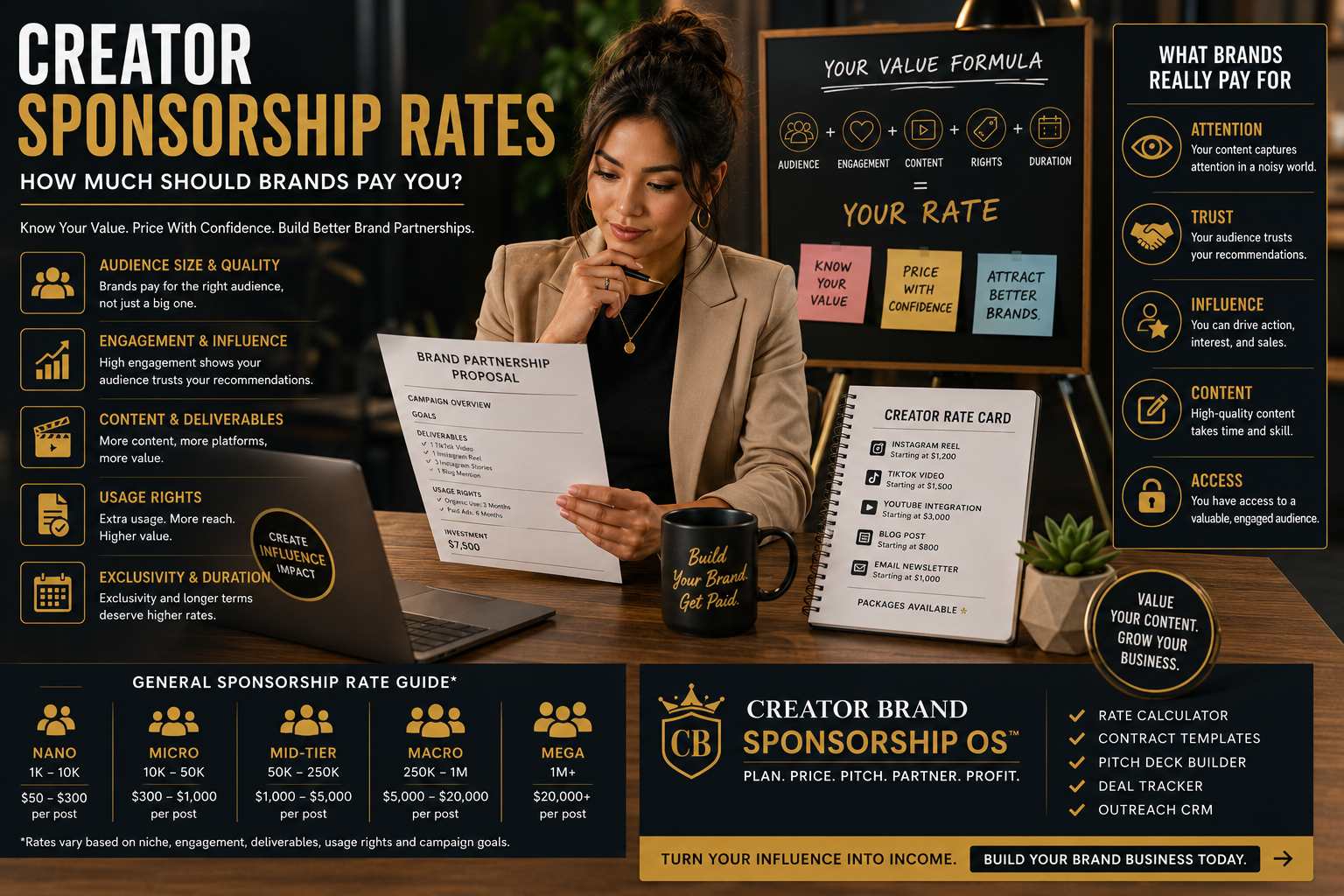
Creator Sponsorship Rates: How Much Should Brands Pay You?
One of the hardest questions for a growing creator to answer is surprisingly simple:
How much should I charge a brand?
Charge too little and you may undervalue your audience, production work and commercial rights.
Charge too much without being able to explain the value and you may struggle to close partnerships.
The solution is not finding one magical price per follower.
Professional creator sponsorship rates are influenced by multiple factors, including audience quality, engagement, platform, deliverables, production requirements, usage rights, exclusivity and campaign duration.
In 2026, creators should increasingly think like media businesses rather than simply social-media accounts.
Here is how to approach sponsorship pricing more strategically.
What Are Creator Sponsorship Rates?
A creator sponsorship rate is the amount a creator charges a company for agreed promotional services or content.
A sponsorship might involve:
- Instagram posts
- Instagram Reels
- Instagram Stories
- TikTok videos
- YouTube integrations
- Dedicated YouTube videos
- Livestreams
- Newsletter placements
- Podcast mentions
- Product photography
- User-generated content
- Event appearances
- Multi-platform campaigns
The price should reflect what the creator is actually being asked to deliver and what rights the brand receives.
There Is No Universal Creator Rate
Two creators with the same follower count can reasonably quote different prices.
Why?
One may have a highly engaged niche audience that closely matches the advertiser's customer.
Another may have a larger percentage of inactive followers.
One creator may produce simple phone videos.
Another may deliver professionally edited commercial-quality content.
One agreement may permit a single organic post.
Another may allow the company to use the creator's image in paid advertising for months.
Those are not equivalent deals.
The 10 Factors That Can Affect Sponsorship Pricing
Before quoting a sponsorship, evaluate the complete campaign.
1. Audience Size
Follower or subscriber count remains one signal of potential reach.
Creators are often informally grouped into categories such as nano, micro, mid-tier and larger creators.
However, follower count should be treated as one input rather than the entire pricing model.
2. Engagement
Brands may evaluate whether people actually interact with your content.
Useful signals can include:
- Views
- Likes
- Comments
- Shares
- Saves
- Clicks
- Watch time
A smaller responsive audience can sometimes provide more campaign value than a larger passive audience.
3. Audience Quality
A brand may care deeply about who follows you.
Relevant audience characteristics can include:
- Location
- Age
- Interests
- Purchasing behavior
- Profession
- Niche relevance
A creator whose audience closely matches the company's target customer may have significant strategic value.
4. Platform
Not every deliverable requires the same amount of work or produces the same value.
A temporary Story placement is different from a professionally produced YouTube integration.
Pricing should reflect the actual platform and format being purchased.
5. Content Production
Consider how much work is required before agreeing to a price.
Production can involve:
- Research
- Scripting
- Filming
- Photography
- Lighting
- Editing
- Graphics
- Voiceover
- Locations
- Props
- Assistants
- Revisions
A sponsorship fee should not ignore the cost of producing the content itself.
6. Number of Deliverables
A campaign requesting one video is different from one requesting:
- Two videos
- Five Stories
- Three photographs
- A link placement
- Newsletter inclusion
- Cross-platform posting
Itemize the deliverables before calculating the final quote.
7. Usage Rights
This is one of the most important sponsorship concepts creators should understand.
A company paying you to publish content on your account does not necessarily mean every possible commercial use of that content should be included automatically.
A brand may request permission to reuse content on:
- Its website
- Social channels
- Ecommerce pages
- Retail materials
- Paid advertisements
Expanded commercial usage can justify additional compensation depending on the agreement.
8. Paid Advertising Rights
A brand may want to turn creator content into advertising.
That can substantially change the commercial value of the content.
Clarify:
- Where ads may run
- How long the rights last
- Which content is covered
- Whether the creator's name or likeness is used
- Whether renewal requires additional payment
Do not treat indefinite advertising rights as a minor contract detail.
9. Exclusivity
A company may prevent you from working with competitors for a period of time.
That restriction can cost you other business opportunities.
The broader the category and the longer the restriction, the more carefully exclusivity should be priced and negotiated.
10. Campaign Duration
A one-time post and a six-month ambassador relationship are different business arrangements.
Longer campaigns can include recurring deliverables, usage periods, category restrictions and reporting requirements.
Price the complete commitment.
Why Price-Per-Follower Formulas Are Limited
You may encounter formulas that estimate creator pricing using follower count.
They can provide a rough starting point, but they should not be treated as universal market rates.
Imagine two creators each have 50,000 followers.
Creator A produces one organic short-form video.
Creator B creates a professionally produced video that the advertiser can reuse in paid campaigns for six months and agrees not to work with competing brands.
Charging the same amount simply because both have 50,000 followers would ignore major differences in commercial value.
A Better Sponsorship Pricing Framework
Instead of asking only:
How much should I charge for a post?
Think about sponsorship pricing in layers.
A practical framework is:
BASE CREATION FEE + DISTRIBUTION VALUE + USAGE RIGHTS + EXCLUSIVITY + ADDITIONAL DELIVERABLES + PRODUCTION COSTS
This does not automatically determine the correct dollar amount.
It gives you a more professional way to identify what the brand is purchasing.
Base Creation Fee
Your base fee compensates you for creating the agreed content.
Consider:
- Concept development
- Preparation
- Filming
- Editing
- Creative expertise
- Equipment
- Time
Do not assume content creation itself has no value simply because you already own the equipment.
Distribution Value
When content is posted to your audience, the advertiser is receiving access to a distribution channel you built.
That audience took time to develop.
Factors such as average views, engagement and audience relevance can help you evaluate that value.
Usage Rights Fee
If the company wants to use your content outside the original sponsored placement, treat that request separately.
Specify:
- Media
- Territory when relevant
- Duration
- Organic versus paid use
- Renewal terms
Avoid ambiguous language such as unlimited use unless you fully understand and intentionally accept what it means.
Exclusivity Fee
Suppose a sportswear company wants you to avoid working with competing sportswear brands for six months.
That restriction may prevent future sponsorship revenue.
Exclusivity therefore has economic value.
Consider both duration and how broadly the competitor category is defined.
Additional Deliverables
If a brand adds another Reel, Story, photo set or platform, update the scope.
Scope expansion should not quietly become free work.
Document what is included in the original agreement and what constitutes an additional deliverable.
What About Nano and Micro Creators?
Smaller creators should not assume brands will only work with massive accounts.
Nano and micro creators can offer advantages such as:
- Niche audiences
- Strong communities
- Local influence
- Specialized expertise
- Authentic audience relationships
For certain campaigns, audience relevance may matter more than enormous reach.
How Should a Beginner Set Sponsorship Rates?
If you have never completed a sponsorship, start by gathering your actual performance data.
Document:
- Followers
- Average views
- Engagement
- Audience demographics
- Top-performing content
- Previous conversions if available
- Production capabilities
Then define your basic deliverables.
For example:
Short-Form Video Package
- One original video
- One agreed revision round
- Organic posting to one platform
- Defined posting period
Then price optional rights separately.
This creates a much stronger foundation than inventing a number every time a company emails you.
Build a Creator Rate Card
A professional rate card can make sponsorship conversations easier.
It may include:
- Creator name
- Niche
- Audience overview
- Platforms
- Core deliverables
- Starting rates or custom-quote language
- Package options
- Contact information
Do not overload the document.
Its purpose is to make the commercial offer easier to understand.
Rate Card vs Media Kit
These documents serve related but different purposes.
A media kit sells the creator.
It can communicate:
- Brand
- Audience
- Reach
- Engagement
- Previous partnerships
- Content style
- Results
A rate card focuses more directly on purchasable services and pricing.
Some creators combine them, while others keep them separate.
Should You Publish Your Sponsorship Rates?
There are advantages and disadvantages.
Publishing rates can filter out advertisers with unrealistic budgets and reduce repetitive conversations.
Keeping rates private can provide more flexibility when campaigns vary significantly in scope.
A middle approach is showing starting at pricing while requiring a custom quote for usage rights, exclusivity and larger campaigns.
Ask the Brand for Its Budget
You do not always have to name the first number.
When a company contacts you, you can ask about:
- Campaign budget
- Deliverables
- Timeline
- Platforms
- Usage rights
- Exclusivity
- Revision requirements
Knowing the scope before quoting helps prevent underpricing a campaign whose requirements were initially unclear.
Questions to Ask Before Giving a Sponsorship Quote
Before providing your final rate, ask:
1. What deliverables are required?
2. Which platforms are involved?
3. When must the content be delivered?
4. How many revisions are expected?
5. Does the content need to remain live for a defined period?
6. Will the company reuse the content?
7. Will the content be used in paid advertising?
8. How long are usage rights requested?
9. Is exclusivity required?
10. Are there required talking points?
11. Are raw files required?
12. What reporting is expected?
13. What is the payment schedule?
You cannot price a campaign accurately when you do not understand what you are agreeing to provide.
Watch for Perpetual Usage Rights
One clause creators should examine carefully is perpetual or indefinite usage.
Imagine creating a sponsored video today and discovering years later that your face is still being used in advertising.
That may or may not be acceptable to you.
The important point is that you understand the agreement before signing it.
When appropriate, creators may negotiate defined usage periods with renewal options rather than automatically granting unlimited rights.
Watch for Broad Exclusivity
Exclusivity language should also be specific.
A restriction against promoting one clearly defined competitor for 30 days is very different from being prohibited from working with an entire industry for a year.
Ask:
- Which companies count as competitors?
- Which products are restricted?
- How long does the restriction last?
- Which platforms are covered?
The more opportunities you give up, the more significant the clause becomes.
Understand Revision Limits
Without a revision policy, one sponsored video can turn into repeated rounds of editing.
Define how many revisions are included.
Also distinguish between reasonable revisions and a complete change in creative direction after production has already occurred.
Define Payment Terms
A professional sponsorship agreement should make payment expectations clear.
Important details can include:
- Total fee
- Deposit when applicable
- Invoice date
- Payment deadline
- Payment method
- Late-payment provisions when appropriate
Do not rely solely on informal direct messages for consequential sponsorship arrangements.
Sponsorship Packages Can Increase Deal Value
Instead of quoting only individual posts, creators can build packages.
For example:
Starter Partnership
- One short-form video
- Story support
Campaign Package
- Two short-form videos
- Multiple Stories
- Link placement
- Defined organic usage
Ambassador Package
- Recurring monthly content
- Multiple platforms
- Defined campaign term
- Custom usage and exclusivity terms
Packages can help brands visualize a broader relationship.
Do Not Promise Results You Cannot Guarantee
Creators can report historical performance.
You can say:
- Average video views
- Historical engagement
- Previous campaign results
But avoid guaranteeing a specific number of sales, clicks or conversions unless you have a legitimate contractual reason and the ability to support that commitment.
Marketing performance can vary.
Track Every Sponsorship
Once sponsorship activity grows, spreadsheets, emails and direct messages can become difficult to manage.
Track:
- Brand
- Contact
- Campaign
- Deliverables
- Quote
- Negotiated fee
- Contract status
- Content deadline
- Posting date
- Usage rights
- Exclusivity
- Invoice
- Payment status
- Performance
- Renewal opportunity
This turns sponsorships into an operating system rather than a collection of conversations.
Measure Your Results
After a campaign, record available performance data.
Depending on the platform and campaign, this could include:
- Reach
- Views
- Watch time
- Engagement
- Saves
- Shares
- Link clicks
- Conversions when available
Historical results can strengthen future negotiations.
Build Sponsorship Case Studies
A successful partnership can become evidence for the next brand.
A simple case study might show:
Objective: Introduce a new product.
Deliverables: Two videos and three Stories.
Performance: Verified campaign metrics.
Outcome: Documented results where available.
Use real numbers rather than inflated claims.
When Should You Raise Your Sponsorship Rates?
Consider reviewing rates when meaningful changes occur, such as:
- Audience growth
- Higher average views
- Better engagement
- Improved production quality
- Increased demand from brands
- Strong campaign results
- Greater niche authority
- More limited availability
Do not assume rates must remain unchanged forever.
Your creator business evolves.
Followers Are Not Your Only Asset
A creator's commercial value can include more than audience size.
You may offer:
- Creative ability
- On-camera talent
- Production expertise
- Niche credibility
- Audience trust
- Photography
- Editing
- Storytelling
- Distribution
- Licensing value
Thinking this way changes the question from:
What is one post worth?
To:
What exactly is this brand purchasing from my creator business?
That is a much stronger negotiating position.
Build a Professional Sponsorship System
As brand opportunities grow, creators need more than a rate calculator.
They need a system for managing the entire partnership lifecycle.
That is the purpose of the Creator Brand Sponsorship OS™.
The system is designed to help creators organize the business side of sponsorships, including areas such as:
- Brand opportunities
- Campaign planning
- Sponsorship pricing
- Deliverables
- Rate-card development
- Usage rights
- Exclusivity
- Negotiations
- Outreach
- Contracts and approvals
- Campaign tracking
- Payment tracking
- Performance documentation
- Partnership follow-up
Instead of treating every sponsorship like a new experiment, creators can develop a repeatable operating process.
Who Is the Creator Brand Sponsorship OS™ For?
The system can support:
- Nano creators
- Micro creators
- Influencers
- YouTubers
- TikTok creators
- Instagram creators
- Podcasters
- Newsletter creators
- Athletes building personal brands
- Professional content creators
You do not need millions of followers to begin operating professionally.
Professionalism starts with understanding the business behind the content.
Creator Sponsorship Checklist
Before accepting your next brand deal, confirm:
- Deliverables are defined
- Platforms are defined
- Deadlines are clear
- Revision limits are clear
- Base compensation is understood
- Usage rights are documented
- Paid advertising rights are documented
- Usage duration is documented
- Exclusivity is documented
- Payment terms are clear
- Disclosure requirements are understood
- Performance reporting is defined
- Contract terms have been reviewed
- Important communications are documented
If something important is unclear, ask before signing.
Final Takeaway
There is no universal answer to how much brands should pay creators.
Follower count matters, but it is only part of the equation.
A stronger sponsorship rate considers:
Audience + Engagement + Content + Distribution + Usage Rights + Exclusivity + Production + Campaign Scope.
Know what you are creating.
Know what the brand is purchasing.
Define the rights.
Document the scope.
Track your results.
And negotiate from evidence rather than guesswork.
Because the goal is not simply to get your first brand deal.
It is to build a creator business capable of handling the tenth, twentieth and fiftieth partnership more professionally than the first.
Important notice: This article is educational information and does not establish universal sponsorship rates or guarantee brand partnerships, campaign performance or earnings. Creator compensation varies substantially by audience, platform, market, campaign, rights and negotiation. Creators should review applicable advertising disclosure requirements and obtain qualified legal, tax or professional advice when appropriate.
Enjoying the Academy?
Join AurumVault Insider for new practical guides, digital tools, and marketplace releases.
No spam. Unsubscribe anytime. Privacy
By subscribing, you agree to receive AurumVault Insider emails. You can unsubscribe at any time.