
How to Sell an eBook Online Without Amazon in 2026
Amazon is not the only way to sell an ebook. Creators can sell digital books through marketplaces, direct storefronts, websites, social media and email while building a stronger relationship with customers. This guide explains how to package, price, publish and market an ebook without relying on Amazon.
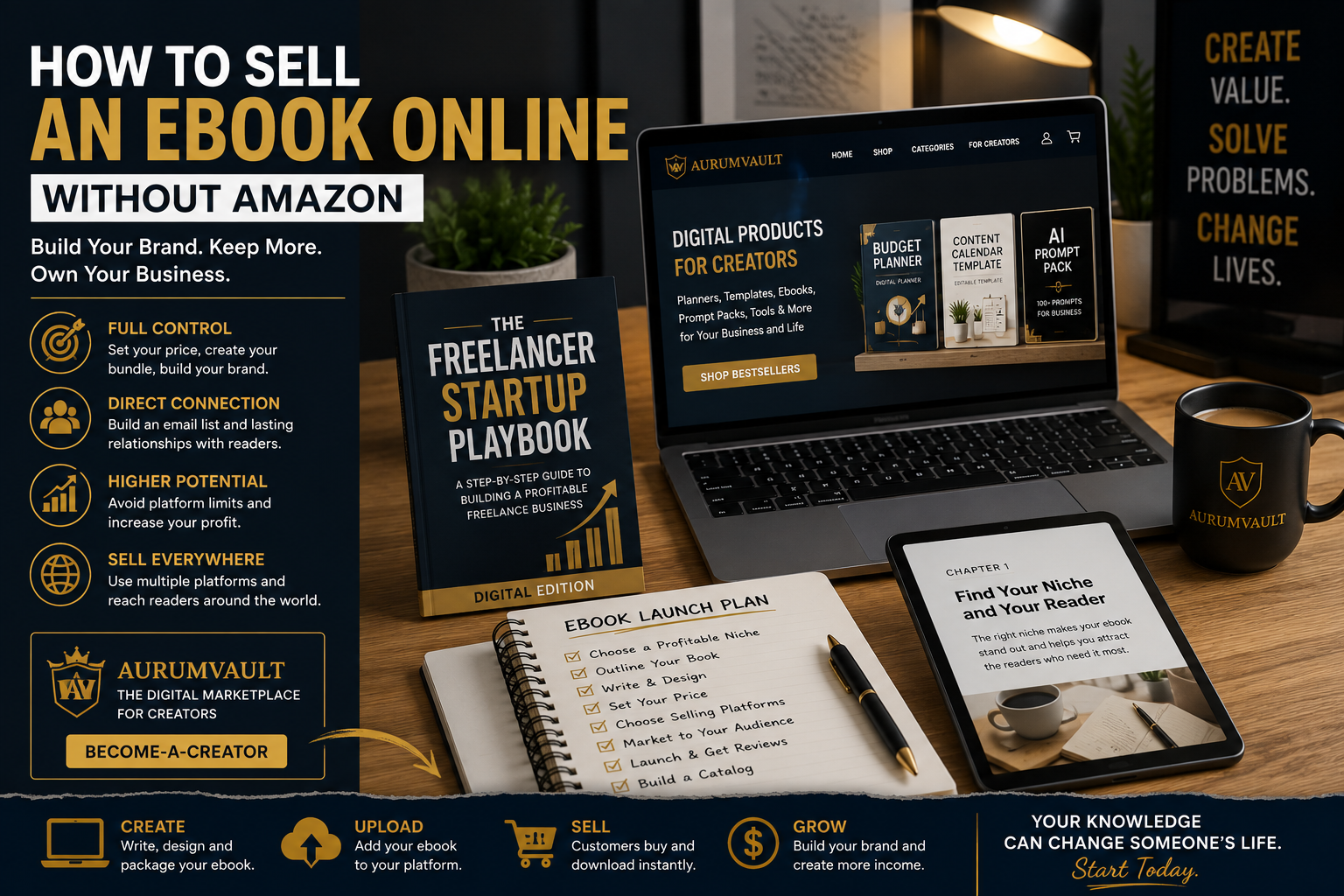
How to Sell an eBook Online Without Amazon
Amazon may be the first platform many people think of when they hear the word ebook.
But it is not the only way to sell digital books online.
In 2026, authors, experts, coaches, creators and entrepreneurs can sell ebooks through digital marketplaces, direct storefronts, personal websites, email lists and social media without depending entirely on one retailer.
That can give creators more flexibility over branding, pricing, product bundles, customer relationships and the rest of their digital-product catalog.
If you are wondering how to sell ebooks online without Amazon, the process is more straightforward than it may appear.
Why Sell an eBook Without Amazon?
Amazon can provide reach, but some creators want more control over how their ebook is presented and sold.
Selling through other channels may allow you to:
- Build your own creator brand
- Sell directly to customers
- Bundle ebooks with other products
- Create your own pricing strategy
- Build an email audience
- Sell alongside templates, planners or courses
- Use multiple marketplaces
- Create a broader digital-product catalog
The goal does not have to be avoiding Amazon forever.
The goal can simply be avoiding total dependence on one platform.
Step 1: Choose a Specific eBook Topic
The strongest ebooks usually solve a clear problem or serve a specific audience.
Instead of writing something extremely broad, consider narrowing the topic.
For example:
Instead of Business Guide, create A First-Time Freelancer's Guide to Pricing Services.
Instead of Social Media Tips, create 30 Days of Instagram Content for Realtors.
Instead of Money Guide, create A Beginner's Guide to Building an Emergency Fund.
Specific topics make it easier for customers to understand why they should buy the book.
Step 2: Identify the Reader
Before writing, answer:
Who is this ebook for?
Your reader could be:
- A first-time entrepreneur
- A parent
- A student
- A content creator
- A realtor
- A salon owner
- A church leader
- A job seeker
- A new investor
- A podcast creator
The clearer the audience, the easier it becomes to make decisions about tone, examples, cover design and marketing.
Step 3: Build the eBook Around an Outcome
A customer generally does not want pages simply for the sake of having pages.
They want help achieving something.
A strong ebook can guide the reader from:
Problem → Understanding → Action → Outcome
For example:
A creator ebook could move the reader from not knowing what to sell to creating and launching their first digital product.
A budgeting ebook could move the reader from scattered finances to a simple monthly money system.
The clearer the transformation, the stronger the product positioning.
Step 4: Create a Professional Structure
A professional ebook often includes:
- Cover
- Title page
- Copyright or use notice
- Table of contents
- Introduction
- Organized chapters
- Examples
- Action steps
- Conclusion
- Resources
- Author information
Longer is not always better.
A concise 40-page ebook that solves one problem clearly can be more valuable than a 200-page book filled with repetition.
Step 5: Design a Premium Cover
People do judge digital books by their covers.
Your ebook cover should communicate:
- Topic
- Audience
- Quality
- Tone
Use a clear hierarchy with a strong title and professional typography.
Avoid excessive graphics, difficult-to-read fonts and clutter.
Your cover should also remain readable when displayed as a small thumbnail on a marketplace or mobile screen.
Step 6: Choose Your eBook Format
Common ebook delivery formats can include:
- EPUB
PDF works especially well for ebooks containing visual layouts, worksheets, charts or interactive elements.
EPUB is useful for reflowable reading experiences on compatible ebook readers and applications.
Some creators offer both when appropriate.
Step 7: Make the Product Feel More Valuable
An ebook does not have to be only an ebook.
You can increase usefulness by adding complementary resources such as:
- Checklists
- Worksheets
- Templates
- Trackers
- Calculators
- Resource lists
- Bonus guides
- Prompt packs
For example, an ebook about starting a podcast might include an episode planner and guest-outreach template.
A business ebook could include a launch checklist.
Useful bonuses can differentiate your product from free articles on the same topic.
Step 8: Decide Where to Sell Your eBook
Several approaches are available.
Digital Marketplaces
A digital marketplace allows your ebook to appear alongside other downloadable products.
This can provide an additional discovery channel while reducing the need to build an entire ecommerce system from scratch.
Your Own Website
Selling through your own website gives you greater control over branding and customer experience.
However, you are generally responsible for bringing your own traffic.
Creator Storefront Platforms
Creator-focused storefront services can provide checkout, product delivery and basic selling tools.
These are especially useful for creators who already have an audience.
Multiple Platforms
Where platform terms permit it, creators can use more than one sales channel.
This reduces dependence on one marketplace and allows you to learn where your products perform best.
Step 9: Sell Your eBook on AurumVault
AurumVault is designed as a marketplace for digital creators selling products such as:
- Ebooks
- Digital planners
- Journals
- Prompt packs
- Templates
- Business resources
- Interactive digital products
For an ebook creator, this means the book can become part of a larger digital-product catalog instead of existing as a single isolated title.
An author could eventually offer:
- Ebook
- Workbook
- Planner
- Template bundle
- Course companion
- Prompt pack
That allows one area of expertise to support multiple products.
Step 10: Write a Strong Product Title
Your product title should make the topic obvious.
Weak title:
The Ultimate Guide
Stronger title:
How to Start a Podcast: A Beginner's 30-Day Launch Guide
A clear title improves both customer understanding and search visibility.
Step 11: Write a Product Description That Sells the Outcome
Do not simply describe the number of pages.
Explain:
- Who the ebook is for
- What problem it addresses
- What the reader will learn
- What is included
- What makes it useful
Instead of:
This ebook contains 75 pages.
Try:
This step-by-step guide helps first-time creators choose a digital-product idea, package it professionally and prepare it for sale online.
The customer is buying usefulness, not page count.
Step 12: Price Your eBook Intentionally
Pricing depends on factors such as:
- Topic
- Depth
- Audience
- Competition
- Expertise
- Bonuses
- Design quality
- Business value
A short consumer ebook may be priced differently from a specialized professional guide solving an expensive business problem.
Do not automatically price as low as possible.
Cheap pricing can sometimes reduce perceived value rather than increase sales.
Step 13: Create Professional Product Images
Your marketplace listing should show more than the front cover.
Consider displaying:
- Cover
- Interior pages
- Chapter overview
- Included tools
- Bonus resources
- Device mockups
Customers should be able to understand what they are buying before checkout.
Step 14: Build a Landing Page
A focused ebook landing page can include:
- Headline
- Problem
- Book promise
- What is included
- Reader benefits
- Preview images
- Frequently asked questions
- Purchase button
Avoid overwhelming visitors with unnecessary content.
The purpose is to help the right customer quickly determine whether the ebook fits their needs.
Step 15: Use SEO to Generate Long-Term Traffic
Search-engine content can help potential buyers discover your ebook through questions they are already asking.
For example, if your ebook teaches podcasting, you might publish articles around keywords such as:
- How to start a podcast
- Podcast equipment for beginners
- How to find podcast guests
- Podcast launch checklist
Each useful article can naturally introduce the relevant ebook.
This creates an evergreen discovery strategy instead of relying only on social-media posts.
Step 16: Use Social Media to Demonstrate Expertise
Do not promote the ebook in every post.
Teach around the topic.
If the ebook is about business credit, publish useful content answering business-credit questions.
If it is about content creation, share content tips.
If it is about budgeting, share practical budgeting ideas.
Then the ebook becomes the deeper resource for people who want more help.
Step 17: Create Short-Form Video Content
TikTok, Instagram Reels and YouTube Shorts can help creators explain the problem their ebook solves.
Potential video formats include:
- Three mistakes beginners make
- What I wish I knew before starting
- Quick checklist
- Before-and-after framework
- Myth versus fact
- Common question
The video provides immediate value and then points interested viewers toward the full resource.
Step 18: Build an Email List
One major advantage of direct digital-product selling is the ability to build a relationship with customers beyond a single purchase.
A creator can offer a useful free resource in exchange for an email signup.
Then future emails can provide:
- Educational content
- Product launches
- Updates
- Discounts
- Related products
An email audience can become a long-term business asset.
Step 19: Bundle the eBook With Other Products
Bundles can increase average order value.
For example:
Podcast Starter Bundle
- Podcast ebook
- Episode planner
- Guest tracker
- Launch checklist
- Social caption templates
The bundle solves more of the customer's problem than the ebook alone.
Step 20: Create an Upsell Path
An ebook can also become the first product in a broader customer journey.
Possible progression:
Free Article → Ebook → Workbook → Premium Toolkit → Full Operating System
This allows a customer to begin with a lower-cost resource and move toward more comprehensive solutions if they need them.
Step 21: Turn One eBook Into a Product Ecosystem
One well-developed topic can generate many products.
For example, a wedding-planning ebook could lead to:
- Wedding planner
- Budget spreadsheet
- Vendor tracker
- Guest-list template
- Timeline
- Checklist bundle
A creator does not necessarily need a new subject for every product.
You can solve different parts of the same customer's problem.
Step 22: Ask Customers What They Need Next
Customer questions can become your next product roadmap.
Pay attention to:
- Frequently asked questions
- Support messages
- Reviews
- Comments
- Requests
If several customers ask for the same additional resource, there may be an opportunity to create it.
Step 23: Keep Improving the eBook
Unlike a physical print run, digital products can often be updated.
Review your ebook periodically for:
- Broken links
- Outdated information
- Formatting issues
- Better examples
- Reader feedback
An improved edition can increase long-term product quality.
Step 24: Protect Your Work Professionally
Include appropriate copyright and licensing information.
Make it clear whether the purchase is for:
- Personal use
- Commercial use
- Client use
- Redistribution
Do not assume customers automatically understand what they may or may not do with the file.
Step 25: Build Your Creator Brand Beyond One Marketplace
One of the biggest benefits of selling ebooks independently is the opportunity to build something larger than one book listing.
Your long-term assets can include:
- Website
- Email list
- Social audience
- Marketplace profiles
- Product catalog
- Search-engine content
- Brand reputation
Those assets can continue serving your business even if one sales platform changes.
Amazon vs Direct eBook Selling
Amazon and direct digital selling solve different problems.
Amazon can provide access to a major book-shopping ecosystem.
Direct and marketplace selling outside Amazon can provide more flexibility for products that extend beyond a traditional book.
For example, a direct ebook offer can be bundled with planners, worksheets, templates or interactive tools.
The two strategies can also coexist when your publishing and platform agreements allow it.
The important thing is understanding the role each channel plays in your business.
Can You Make Money Selling eBooks Online?
Yes, but uploading an ebook does not guarantee sales.
Success depends on factors such as:
- Topic demand
- Product quality
- Positioning
- Pricing
- Traffic
- Marketing
- Audience trust
- Competition
A useful ebook aimed at a clear audience has a much stronger foundation than a generic book created only because digital products appear easy to sell.
Become an AurumVault Creator
If you create ebooks, guides, workbooks or other digital resources, AurumVault provides a marketplace where creators can build a broader downloadable-product catalog.
Potential products can include:
- Ebooks
- Planners
- Journals
- Prompt packs
- Templates
- Business tools
- Interactive resources
You do not need dozens of products to begin.
Start with one useful ebook.
Create a professional listing.
Learn what your customers need.
Then build the next resource around that need.
Final Takeaway
You do not need Amazon to begin selling ebooks online.
You need:
1. A useful topic.
2. A clearly defined reader.
3. A professional ebook.
4. A strong product page.
5. A selling platform.
6. A discovery strategy.
7. A plan for building beyond one product.
The smartest strategy in 2026 is not necessarily choosing one platform forever.
It is building a creator business with multiple ways for customers to discover your work.
Your ebook can be the beginning.
The larger opportunity is the catalog, audience and brand you build around it.
Enjoying the Academy?
Join AurumVault Insider for new practical guides, digital tools, and marketplace releases.
No spam. Unsubscribe anytime. Privacy
By subscribing, you agree to receive AurumVault Insider emails. You can unsubscribe at any time.