
Cyber Insurance Renewal Checklist: 90-Day Evidence Guide for 2026
Cyber insurance renewal should not begin with trying to make last year's answers fit today's environment. A stronger process starts by auditing prior representations, validating current controls, collecting evidence, documenting gaps and linking every material answer to what can actually be supported.
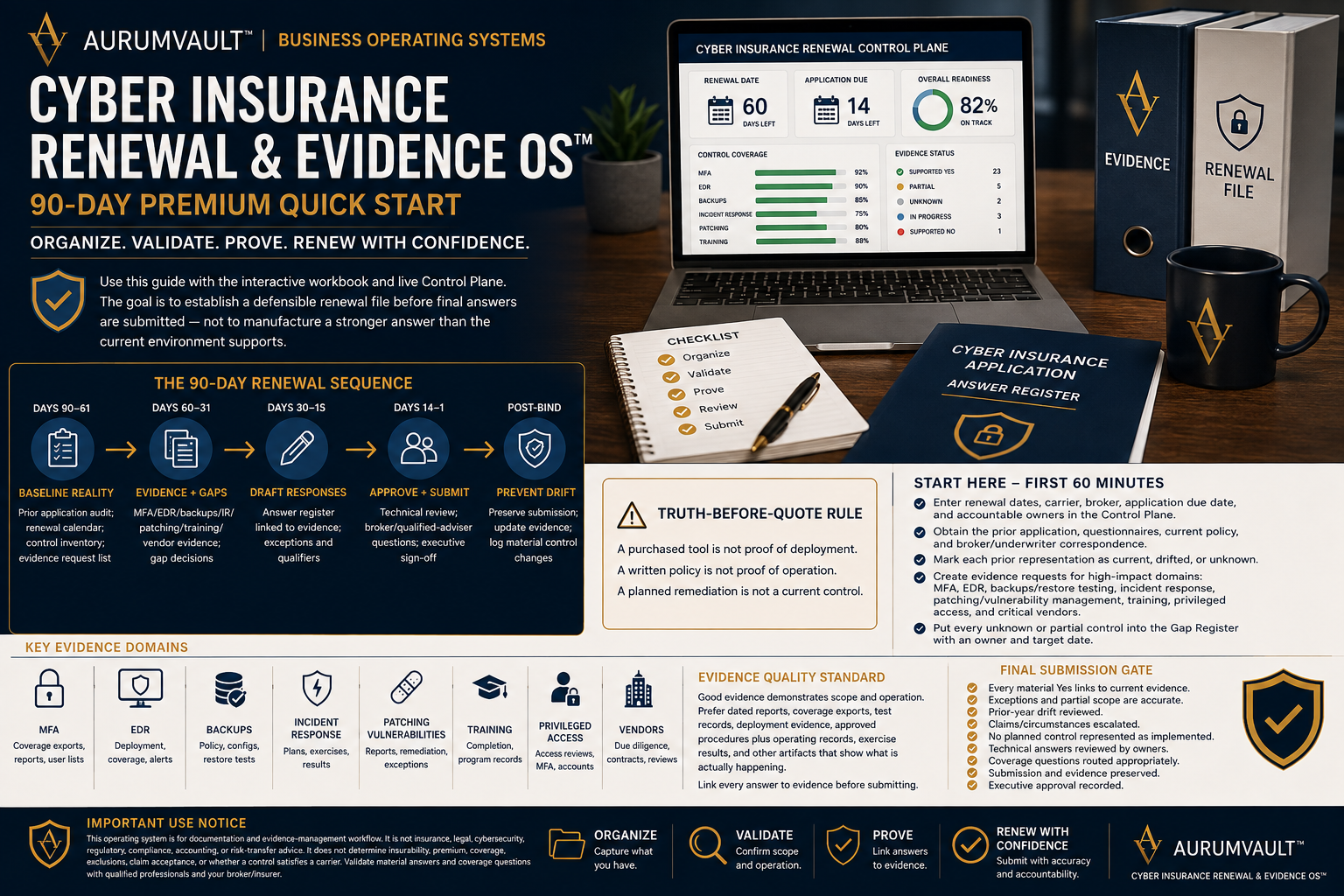
Cyber Insurance Renewal Checklist: A 90-Day Evidence Guide for 2026
Cyber insurance renewal is not just an insurance form exercise.
For many businesses, the renewal process requires accurate answers about cybersecurity controls, incident history, access management, backups, endpoint security, employee training, vendors and other operational safeguards.
That creates a critical challenge:
Can your business prove the answers it is preparing to submit?
A purchased cybersecurity product is not necessarily evidence that it has been fully deployed.
A written policy is not necessarily evidence that employees or systems are operating according to that policy.
A planned remediation project is not the same as a control that exists today.
That is why a strong cyber insurance renewal checklist should begin with evidence rather than assumptions.
What Is Cyber Insurance Renewal Readiness?
Cyber insurance renewal readiness is the process of organizing current cybersecurity information, validating important controls, identifying gaps, preserving supporting evidence and preparing accurate responses before submitting a renewal application.
The objective is not to make your cybersecurity environment appear stronger than it is.
The objective is to accurately represent the environment you actually have.
A useful principle is:
Organize. Validate. Prove. Renew with confidence.
The Truth-Before-Quote Rule
One of the most important principles in cyber insurance preparation is distinguishing between intention and evidence.
Examples include:
- Buying an endpoint-security platform is not proof that every required endpoint is protected.
- Writing an incident-response policy is not proof that the response process has been tested.
- Planning to enable multifactor authentication is not the same as having MFA operating today.
- Scheduling a backup-restoration test is not evidence that restoration has succeeded.
Your renewal file should reflect current reality.
Why Prior-Year Answers Need to Be Reviewed
A common mistake is treating the previous application as a template and copying last year's answers forward.
Cybersecurity environments change.
Since the previous renewal, your organization may have:
- Added employees
- Added remote workers
- Changed vendors
- Migrated systems
- Added cloud applications
- Changed MFA coverage
- Changed endpoint protection
- Added privileged accounts
- Changed backup processes
- Experienced incidents
- Modified patching practices
Every prior material representation should therefore be reviewed as:
- Current
- Drifted
- Unknown
Do not assume that an answer remains correct simply because it was accurate last year.
The 90-Day Cyber Insurance Renewal Timeline
A structured renewal process can begin approximately 90 days before submission.
The Cyber Insurance Renewal & Evidence OS™ organizes the process into five windows.
Days 90-61: Establish the Baseline
The first phase is about understanding reality.
Complete activities such as:
- Audit the prior application
- Establish the renewal calendar
- Identify the carrier and broker
- Confirm application deadlines
- Assign accountable owners
- Build a control inventory
- Create an initial evidence-request list
This is the point to determine what the organization actually said previously and whether those statements remain supportable.
Days 60-31: Collect Evidence and Identify Gaps
The second phase focuses on evidence.
Important control areas may include:
- Multifactor authentication
- Endpoint detection and response
- Backups
- Restore testing
- Incident response
- Patching
- Vulnerability management
- Security training
- Privileged access
- Critical vendors
For each control, determine what evidence exists and whether it demonstrates the actual scope and operation of the control.
Days 30-15: Draft Application Responses
Once evidence has been collected, begin drafting responses.
Each important answer should be connected to supporting evidence where appropriate.
Also document:
- Exceptions
- Limited scope
- Qualifiers
- Unknowns
- Remediation currently underway
Do not turn a partial control into an unqualified yes.
Days 14-1: Review, Approve and Submit
Before submission, perform final technical and business review.
This stage can include:
- Technical-owner review
- Broker questions
- Qualified-adviser questions
- Executive review
- Final application approval
- Preservation of the submitted application
- Preservation of supporting evidence
The exact application that was submitted should remain part of the organization's records.
After Binding: Prevent Control Drift
The process should not end when the policy is bound.
Maintain records of material changes throughout the policy period.
Examples can include:
- MFA coverage changes
- New critical vendors
- Security-tool changes
- New remote-access methods
- Major cloud migrations
- Incident-response changes
- Backup architecture changes
Keeping evidence current can make the next renewal easier and help prevent a large reconstruction exercise once renewal season begins again.
What Should You Do in the First 60 Minutes?
If your renewal is approaching and you have not started, begin with the basics.
1. Record the Critical Dates
Document:
- Renewal date
- Carrier
- Broker
- Application due date
- Accountable owners
2. Gather the Existing Insurance File
Collect:
- Prior application
- Supplemental questionnaires
- Current policy
- Material broker correspondence
- Material underwriter correspondence
3. Review Prior Representations
For each material prior answer, determine whether it is:
- Current
- Drifted
- Unknown
4. Create Evidence Requests
Begin with important cybersecurity domains such as:
- MFA
- EDR
- Backups
- Restore testing
- Incident response
- Patching
- Vulnerability management
- Training
- Privileged access
- Critical vendors
5. Create a Gap Register
Every unknown or partial control should have:
- Description
- Responsible owner
- Current status
- Target date
- Evidence needed
The goal is visibility rather than pretending the gap does not exist.
What Counts as Good Cyber Insurance Evidence?
Good evidence demonstrates both scope and operation.
Useful evidence may include:
- Dated reports
- Security coverage exports
- Deployment records
- Test results
- Exercise records
- Configuration reports
- Approved procedures accompanied by operating evidence
- Restore-test records
- Endpoint inventories
- Training records
- Vulnerability or patch reports
A screenshot showing that a security product exists may not prove that it protects the entire required environment.
The evidence should support the actual statement being made.
Build an Evidence Register
Instead of storing evidence across random email threads and folders, build an organized register.
For each artifact, record information such as:
- Evidence name
- Control supported
- Responsible owner
- Date
- Location
- Current status
- Notes
This makes application review faster and helps reviewers determine whether a material answer is actually supported.
Use Clear Evidence Statuses
A useful renewal process should distinguish between different levels of confidence.
Possible statuses include:
SUPPORTED YES
Evidence supports the affirmative answer.
SUPPORTED NO
Evidence supports the conclusion that the control or condition is not present.
PARTIAL
The control exists, but coverage or operation is incomplete.
UNKNOWN
The organization does not currently have enough information to make a supported determination.
IN PROGRESS
Remediation or implementation is underway but should not yet be treated as fully implemented.
These categories help prevent planned future improvements from being confused with present controls.
MFA Evidence for Cyber Insurance Renewal
Multifactor authentication is frequently an important security control.
When documenting MFA, do not stop at the question:
Do we use MFA?
Ask:
- Which users are covered?
- Are administrators covered?
- Is remote access covered?
- Are cloud applications covered?
- Are privileged systems covered?
- Are exceptions documented?
- What evidence proves deployment?
A partial MFA deployment should be represented according to its actual scope.
EDR Evidence
Endpoint detection and response evidence may need to demonstrate which systems are actually protected.
Useful questions include:
- Which endpoints are enrolled?
- Are servers included?
- Are laptops included?
- Are stale or inactive devices visible?
- How are alerts managed?
- Is coverage current?
Again, owning an EDR platform is different from demonstrating deployment coverage.
Backup and Restore Evidence
A backup is only part of the story.
Organizations should understand:
- What systems are backed up
- How frequently backups occur
- Where backups are stored
- Whether backups are protected from unauthorized alteration
- When restoration was last tested
- Whether the test succeeded
Evidence of a successful restoration can be more meaningful than simply showing that backup software is installed.
Incident Response Evidence
A written incident-response plan is useful.
Operational evidence may be stronger when it also shows that the organization has practiced or exercised the plan.
Possible evidence includes:
- Approved incident-response plan
- Tabletop exercise records
- Exercise results
- Corrective actions
- Updated contact information
- Escalation procedures
This helps distinguish policy existence from operational readiness.
Patching and Vulnerability Management
Cyber insurance applications may ask about vulnerability and patching practices.
Evidence might include:
- Vulnerability reports
- Patch-management reports
- Remediation records
- Exception records
- Aging reports
- Scanning schedules
Do not represent an aspirational patching timeline as consistently achieved unless operational evidence supports it.
Security Awareness Training
Training evidence can include:
- Training completion reports
- Participation records
- Program schedules
- Phishing exercise results where applicable
- Follow-up training records
Document both program existence and actual participation where relevant.
Privileged Access
Privileged accounts can create significant exposure.
Consider documenting:
- Administrative accounts
- Access owners
- MFA coverage
- Access reviews
- Dormant privileged accounts
- Shared accounts
- Service accounts
Evidence should reflect the current environment rather than the intended access model.
Critical Vendor Evidence
Third-party providers can become part of an organization's cyber risk.
Maintain information on critical vendors such as:
- Vendor name
- Service provided
- Data involved
- Criticality
- Security review status
- Contract status
- Available security evidence
Changes in key vendors should also be reviewed during renewal preparation.
Create a Gap Register
Every incomplete or uncertain control should have a place to live.
A Gap Register might include:
- Control area
- Current condition
- Evidence missing
- Responsible owner
- Remediation decision
- Target date
- Renewal impact
This prevents gaps from disappearing into email conversations.
Do Not Turn Remediation Into Current Evidence
This distinction is critical.
Suppose MFA is being rolled out to administrator accounts next week.
The accurate current statement is not necessarily that administrator MFA is already fully deployed.
The current condition and remediation plan should remain separate.
Future work should not be represented as completed work.
Link Answers to Evidence
The application-answer register should connect important responses to the evidence supporting them.
This creates a chain such as:
QUESTION → ANSWER → EVIDENCE → OWNER → REVIEW
That structure can make technical review significantly easier.
Review Qualifiers and Exceptions Carefully
Security controls are rarely identical across every system.
A business may have MFA across most applications but not one legacy system.
It may have EDR across workstations but not a particular device category.
It may have a formal patch standard with documented exceptions.
Where required, describe partial scope and exceptions accurately rather than hiding them inside an unconditional yes.
Escalate Claims and Circumstances Questions
Questions involving known claims, incidents, circumstances, potential claims, or coverage interpretation can carry significant consequences.
These issues should be routed to the appropriate broker, insurer, legal counsel, or other qualified professional rather than guessed at internally.
The Final Cyber Insurance Submission Gate
Before submitting a renewal application, verify that:
- Every material yes is linked to current supporting evidence where appropriate
- Partial scope is accurately described
- Material exceptions are documented
- Prior-year drift has been reviewed
- Claims or circumstances questions have been appropriately escalated
- Planned controls are not represented as implemented
- Technical answers have accountable-owner review
- Policy and coverage questions are routed appropriately
- The exact submitted application is preserved
- Supporting evidence is preserved
- Executive approval is recorded
This final gate helps prevent rushed, unsupported submissions.
Why Preserve the Exact Submitted Application?
After submission, keep a copy of the exact version sent to the carrier or broker.
Do not rely solely on an editable working document.
Preserve:
- Submitted application
- Supplemental questionnaires
- Evidence package
- Material correspondence
- Final approvals
This creates a reliable historical record for future renewal and internal review.
A Better Cyber Insurance Renewal Workflow
A practical operating sequence is:
BASELINE → COLLECT → VALIDATE → GAP → ANSWER → REVIEW → APPROVE → SUBMIT → PRESERVE → MAINTAIN
The process starts with reality and ends with a maintained evidence record.
Build a Defensible Cyber Insurance Renewal File
The Cyber Insurance Renewal & Evidence OS™ is designed to help organizations structure this process rather than manage renewal through scattered email, spreadsheets and memory.
Its 90-Day Premium Quick Start emphasizes:
- Prior-application auditing
- Renewal calendars
- Control inventories
- Evidence requests
- MFA evidence
- EDR evidence
- Backup and restore evidence
- Incident-response evidence
- Patching and vulnerability management
- Training evidence
- Privileged-access review
- Critical-vendor review
- Gap tracking
- Evidence-linked answer preparation
- Technical review
- Executive approval
- Post-bind evidence maintenance
The central principle is simple:
Do not manufacture a stronger answer than the current environment supports.
Final Takeaway
A strong cyber insurance renewal process does not begin by asking:
What answer will make this application look best?
It begins by asking:
What is true today, and what evidence proves it?
Audit the prior application.
Validate current controls.
Document gaps.
Link answers to evidence.
Escalate questions that require professional judgment.
Preserve exactly what was submitted.
Then maintain the evidence throughout the policy period so next year's renewal does not require rebuilding the entire record from scratch.
Important notice: This article and the Cyber Insurance Renewal & Evidence OS™ provide documentation and evidence-management guidance only. They are not insurance, legal, cybersecurity, regulatory, compliance, accounting, or risk-transfer advice and do not determine insurability, premium, coverage, exclusions, claim acceptance, or whether a specific control satisfies a carrier.
Enjoying the Academy?
Join AurumVault Insider for new practical guides, digital tools, and marketplace releases.
No spam. Unsubscribe anytime. Privacy
By subscribing, you agree to receive AurumVault Insider emails. You can unsubscribe at any time.
Continue your journey
Keep reading
Where to Sell Digital Products in 2026: AurumVault vs Etsy vs Gumroad vs Payhip
Choosing where to sell digital products can affect your brand, customer experience, discovery and growth. This guide compares AurumVault, Etsy, Gumroad and Payhip and explains what creators should consider when choosing a platform.
How to Plan a Wedding Without Losing Your Mind (or Your Budget)
Engaged couples don't burn out because there's too much to plan — they burn out because they tackle it in the wrong order. Here's the sequence that actually keeps a wedding on budget and on schedule.
The Complete Guide to Selling Digital Products Online
Selling digital products successfully comes down to a handful of decisions made in the right order: a specific offer, intentional pricing, the right platform, and a system that turns one-time buyers into repeat customers.