
AI Content Disclosure & Provenance: A Practical Guide
AI-assisted publishing creates a new responsibility: being able to explain what AI contributed, what a human reviewed, what disclosure decision was made and what evidence supports the content's history.
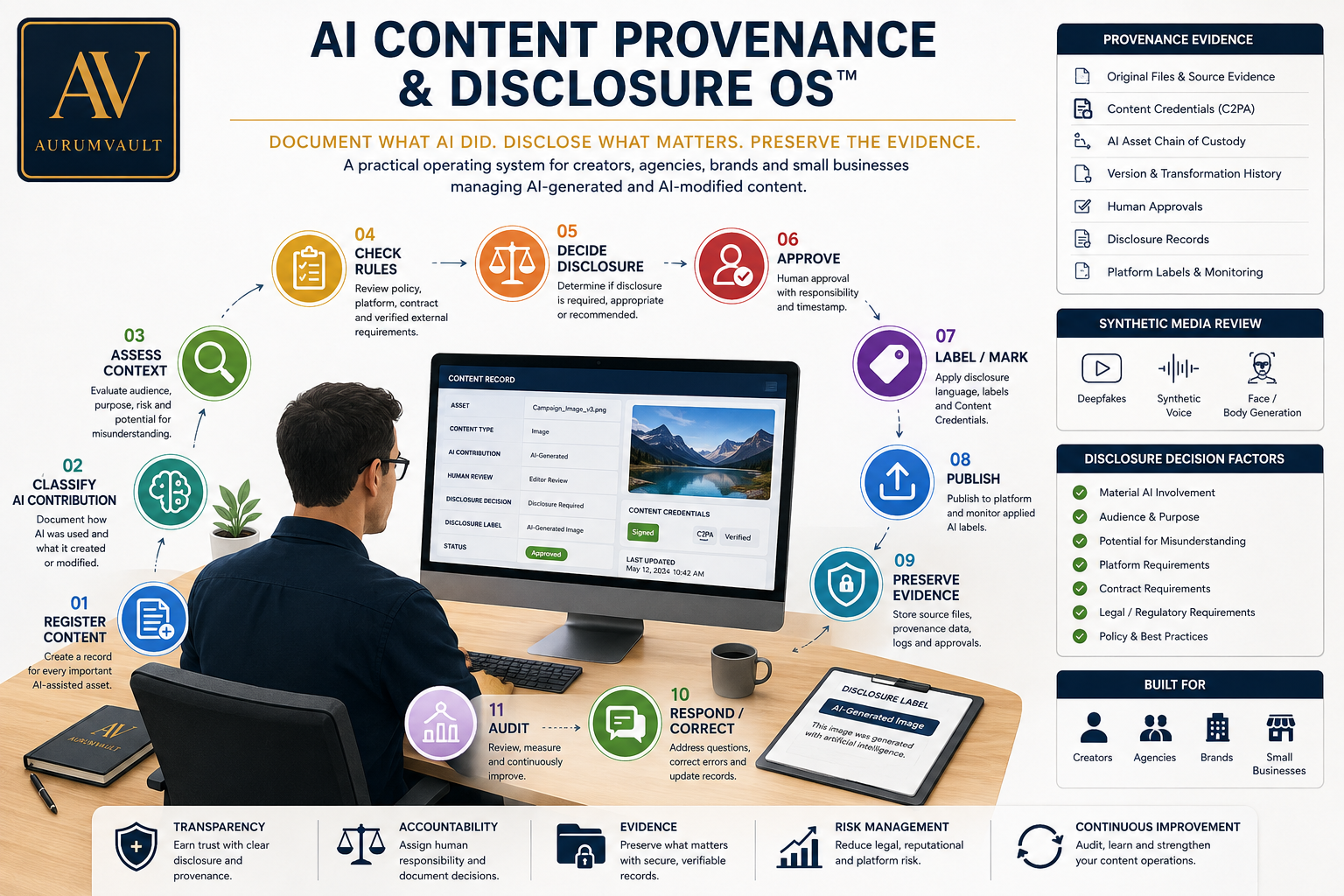
AI Content Disclosure & Provenance: How to Document, Label and Prove AI-Assisted Content
Artificial intelligence can now help create articles, advertisements, images, videos, voiceovers, translations, social posts and entire marketing campaigns.
That creates an increasingly important question for creators, agencies, brands and small businesses:
Can you explain how the content was actually made?
AI transparency is becoming more complicated than simply labeling something as AI or not AI.
A stronger approach documents what AI contributed, what a human reviewed, whether disclosure is appropriate, what evidence exists and what happened after publication.
That is the purpose of AI content disclosure and provenance.
What Is AI Content Disclosure?
AI content disclosure is the practice of informing an audience when artificial intelligence materially contributed to content when disclosure is appropriate or required.
AI may contribute to:
- Articles and written content
- Images and illustrations
- Advertising creative
- Audio
- Synthetic or cloned voices
- Video
- Translation
- Personalization
- Chatbots
- Publishing automation
But not every use of AI is identical.
Using AI to correct grammar is different from generating a realistic video of a person saying something they never said.
That is why responsible AI disclosure begins with classification.
AI-Generated, AI-Modified and AI-Assisted Content
A useful content-governance process distinguishes between different levels of AI involvement.
AI can contribute to:
- Ideation
- Research
- Outlining
- Drafting
- Rewriting
- Grammar cleanup
- Fact extraction
- Translation
- Image generation
- Image editing
- Audio generation
- Voice generation or cloning
- Video generation
- Video editing
- Personalization
- Publishing automation
The AI Content Provenance & Disclosure OS™ specifically provides an AI Contribution Classification Matrix™ for documenting these different forms of involvement. 0
The Core AI Provenance Question
A strong content operation should be able to explain:
What was created, how AI contributed, what a human reviewed, which disclosure rule or policy applied, what label was used, what provenance evidence exists and what happened after publication?
That is the central operating question of the AI Content Provenance & Disclosure OS™. 1
The 11-Step Provenance and Disclosure Lifecycle
A practical AI content workflow can follow eleven stages:
1. Register Content
2. Classify AI Contribution
3. Assess Context
4. Check Rules
5. Decide Disclosure
6. Approve
7. Label or Mark
8. Publish
9. Preserve Evidence
10. Respond or Correct
11. Audit
This creates a repeatable process instead of making disclosure decisions at the last moment before publication. 2
Step 1: Register Important AI-Assisted Content
Maintain a record of materially AI-assisted public content.
Useful information includes:
- Content or asset
- Owner or client
- Content type
- AI contribution
- Publication platform
- Current status
A content registry becomes especially valuable when an agency or business produces a large volume of assets.
Step 2: Document What AI Actually Did
Instead of simply checking an AI-used box, document the contribution.
Ask:
- What did AI materially contribute?
- Could the audience misunderstand how the content was created?
- Which element would matter most to audience trust?
- What did the human creator contribute?
The goal is a documented classification decision rather than an assumption.
Step 3: Keep a Human Responsible
AI assistance should not eliminate human accountability.
For important content, record:
- Responsible editor or creator
- Human-created portions
- AI-assisted portions
- Human verification performed
- Editorial changes after AI output
- Final approval
- Approval date and version
The OS specifically records human editorial and creative responsibility behind AI-assisted content. 3
Step 4: Decide Whether Disclosure Matters
A disclosure decision should consider context.
Questions may include:
- Was AI materially involved?
- Is the content customer or public facing?
- Is realistic image, audio or video generated or manipulated?
- Could the audience misunderstand the origin?
- Is an AI system directly interacting with someone?
- Is the content sponsored or advertising?
- Does a client contract require disclosure?
- Does company policy require disclosure?
- Does a current platform rule require disclosure?
- Does a verified external requirement appear applicable?
The OS's Disclosure Decision Engine™ is designed around these questions. 4
Step 5: Give Synthetic Media Extra Review
Synthetic media can create greater audience-confusion risk.
Review whether:
- A real person appears to say or do something they did not
- A real event or location has been materially altered
- A realistic scene was generated
- A voice was cloned
- A face or body was generated or replaced
- An audience could reasonably believe it is authentic
- A high-trust person is depicted
- Financial, political, health or emergency information is involved
- The content appears in advertising
- Consent is documented
- Disclosure is visible
The OS includes a dedicated Synthetic Media & Deepfake Assessment for this purpose. 5
Step 6: Maintain a Current Rules Library
Platform requirements, contracts and external rules can change.
Maintain records for:
- Rule or source
- Type
- Status
- Jurisdiction
- Applicability
- Effective date
- Version
- Interpretation
- Exceptions
- Reviewer
- Next review
When applicability is uncertain, avoid guessing.
The system specifically instructs users to use states such as ESCALATE or NOT VERIFIED rather than converting uncertainty into unsupported conclusions. 6
Step 7: Maintain Approved Disclosure Language
Organizations can maintain standard disclosure wording for recurring situations such as:
- AI-assisted articles
- AI-generated images
- AI-modified images
- Synthetic voices
- AI-generated videos
- Altered realistic videos
- AI chatbots
- Public-interest text
- Sponsored AI content
- Client campaigns
- Translated or dubbed voices
- Mixed-media campaigns
The OS includes a Disclosure Template Vault for maintaining this language and its version history. 7
Step 8: Understand Content Credentials and C2PA
Content Credentials and C2PA-related provenance technologies can help document digital-content origin and editing history.
A provenance record may track:
- Asset and version
- Whether a credential exists
- Signing authority
- Capture or origin information
- AI-generated assertions
- AI-modified assertions
- Editing actions
- Verification date
- Whether credentials survive export
- Whether credentials survive platform upload
- Original credentialed file location
The OS includes a dedicated Content Credentials & C2PA Center™ for maintaining these records. 8
However, a credential does not answer every trust question.
It does not replace content review, consent, rights assessment, factual verification or contextual disclosure.
Likewise, missing provenance metadata does not automatically prove that content is fake or deceptive. It means provenance evidence may be missing. 9
Step 9: Preserve Original Source Evidence
Keep important creation evidence such as:
- RAW files
- Original media
- Drafts
- Project files
- Timestamps
- Capture information
- Working assets
- Storage locations
The OS includes an Original Source & Creation Evidence section specifically for indexing these materials. 10
Step 10: Maintain a Chain of Custody
An asset may move through several people, AI systems, vendors and editing applications before publication.
Document:
- Timestamp
- Version
- Person, tool or vendor
- Action
- Input and output
- Storage
- Supporting evidence
The AI Asset Chain-of-Custody Log™ is designed to document that movement. 11
Step 11: Track Versions and Transformations
AI-assisted content often changes several times before publication.
Document:
- Version
- Date
- Transformation
- Who or what performed it
- What changed
- Why
- Evidence
This helps distinguish human transformations from automated or AI-assisted transformations. 12
Verify Claims Before Publishing
AI disclosure does not replace factual verification.
Important claims, quotations and statistics should have evidence attached to them.
The OS uses a Claim Verification Register that records the claim, source, evidence status, reviewer, date and notes. 13
If a claim cannot be verified, mark it accordingly instead of allowing AI-generated confidence to substitute for evidence.
Do Not Rely Only on AI Detectors
AI detectors should not be the sole foundation of provenance decisions.
A stronger evidence system preserves actual creation records such as:
- Original files
- Drafts
- Project history
- Content Credentials
- Transformation logs
- Human approvals
- Publication evidence
The objective is not simply to predict whether something looks AI-generated.
The objective is to document what actually happened.
Why AI Content Provenance Matters
For creators, provenance can help preserve evidence of creative work and AI involvement.
For agencies, it helps manage different client contracts, platforms and disclosure expectations.
For brands, it creates a record of how advertising and public-facing content were created.
As AI becomes more common, the ability to answer how was this made? may become increasingly important to audience and client trust.
A Practical AI Content Disclosure Checklist
Before publishing important AI-assisted content, confirm:
- The content is registered
- AI involvement is classified
- A responsible human is identified
- Publication context has been assessed
- Applicable rules have been checked
- A disclosure decision is documented
- Synthetic media has received appropriate review
- Consent is documented where relevant
- Approved disclosure wording has been selected
- Original source evidence is preserved
- Content Credentials are recorded when available
- Material claims have been verified
- The publication version is preserved
- The asset history can be reconstructed
If several answers remain unknown, additional review may be appropriate before publication.
Build an AI Content Provenance System
AI content transparency is becoming too complex to manage with memory, scattered notes and inconsistent labels.
A repeatable system should answer four questions:
What did AI do?
What did a human do?
What should the audience know?
What evidence proves the record?
The AI Content Provenance & Disclosure OS™ — Premium Interactive Edition is designed for creators, agencies, brands and small businesses managing AI-generated and AI-modified content across text, image, audio, video, synthetic media, platform disclosure and content provenance. 14
Its operating principle is straightforward:
DOCUMENT WHAT AI DID. DISCLOSE WHAT MATTERS. PRESERVE THE EVIDENCE.
The goal is not to label everything indiscriminately.
It is to build a reliable record of AI contribution, human responsibility, disclosure decisions and evidence.
Important use notice: AI Content Provenance & Disclosure OS™ provides educational and operational guidance. It is not legal advice, compliance certification or a guarantee that any disclosure or provenance record satisfies every jurisdiction, contract, platform, advertising, intellectual-property or industry requirement. External requirements change and should be independently verified. 15
Enjoying the Academy?
Join AurumVault Insider for new practical guides, digital tools, and marketplace releases.
No spam. Unsubscribe anytime. Privacy
By subscribing, you agree to receive AurumVault Insider emails. You can unsubscribe at any time.
Continue your journey
Keep reading
EU Packaging Compliance 2026: PPWR Checklist for Small Brands and Ecommerce
EU packaging compliance can involve far more than choosing recyclable packaging. Small brands selling into European markets may need to understand their economic role, map packaging components, collect supplier evidence, document material data, review recyclability and labeling, track country-level EPR actions and maintain technical records. This guide provides an evidence-first framework for organizing that work.
AI Governance for Small Business: The Complete 2026 Checklist
Small businesses are adopting AI faster than many are creating rules for it. This practical 2026 checklist shows business owners how to inventory AI tools, protect sensitive information, define employee and AI-agent authority, require human approval for consequential actions, evaluate vendors, document incidents and create a manageable AI governance system.
AI Governance in Banking: A Practical Operations Framework
Banking AI governance should go beyond documenting models. This practical framework shows how financial institutions can inventory AI use, classify customer and financial impact, establish authority limits, validate material systems, preserve transaction-level evidence and review complaints, incidents and controls.