
AI Governance in Banking: A Practical Operations Framework
Banking AI governance should go beyond documenting models. This practical framework shows how financial institutions can inventory AI use, classify customer and financial impact, establish authority limits, validate material systems, preserve transaction-level evidence and review complaints, incidents and controls.
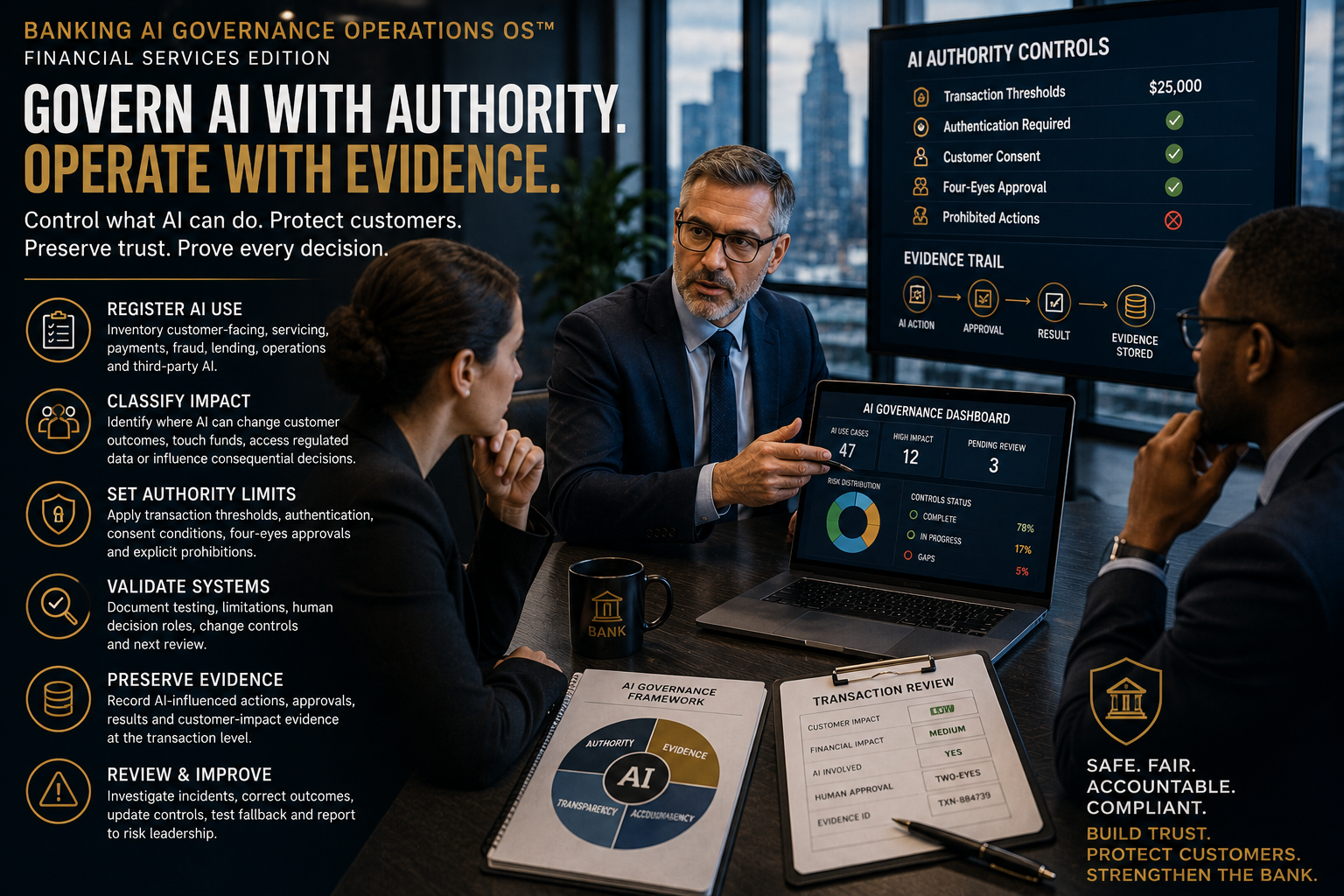
AI Governance in Banking: A Practical Operations Framework
Artificial intelligence is becoming part of more financial-services workflows.
Banks may encounter AI across customer-facing systems, servicing, payments, fraud-related operations, lending workflows, internal operations and third-party tools.
That creates an important governance question.
It is not simply:
Which AI models are we using?
A stronger operational question is:
What is AI actually allowed to do to customers, accounts, transactions and regulated workflows?
That distinction matters.
A bank can possess extensive model documentation while still lacking clear operational boundaries around authority, approvals, transaction limits, customer impact and evidence.
That is why a practical banking AI governance program should begin with the control problem, not the technology.
Why Banking AI Governance Must Go Beyond Model Documentation
AI governance is sometimes treated primarily as a documentation exercise.
Teams may focus on model descriptions, technical characteristics or inventories while overlooking a more immediate operational issue:
What actions can the system take?
For banking operations, that question can involve whether AI may:
- Influence a customer outcome
- Access regulated information
- Affect an account
- Touch funds
- Influence a consequential decision
- Trigger an operational action
- Participate in a regulated workflow
The greater the potential impact, the stronger the governance controls should become.
The Authority-and-Evidence Approach
A useful way to structure banking AI governance is around two ideas:
Authority
What may the AI system actually do?
Authority should be bounded by explicit controls rather than assumed from technical capability.
Evidence
What records exist showing what the AI influenced, who approved it, what happened and how the customer or financial outcome was affected?
Together, authority and evidence turn abstract AI governance into an operating discipline.
Step 1: Register Banking AI Use
The first governance step is knowing where AI is actually being used.
Create an inventory covering areas such as:
- Customer-facing AI
- Customer servicing
- Payments
- Fraud-related workflows
- Lending
- Internal operations
- Third-party AI
For every use case, identify enough information to understand its operational role.
Useful questions include:
- What business process uses the AI?
- Who owns the use case?
- Does it interact directly with customers?
- Does it access financial or regulated information?
- Can it influence an account or transaction?
- Does a third party operate any part of the system?
- What human role remains in the workflow?
An incomplete inventory creates a basic governance problem: the institution cannot control what it cannot see.
Do Not Limit the Inventory to Customer-Facing Chatbots
AI use may be less visible than a public chatbot.
A system working behind the scenes may still influence consequential outcomes.
For example, AI might support:
- Servicing decisions
- Fraud investigation
- Operational prioritization
- Lending workflows
- Transaction review
- Internal analysis
The governance inventory should therefore focus on function and impact, not only whether the customer sees the AI.
Step 2: Classify Customer and Financial Impact
After inventorying AI use, classify the potential impact.
The key question is:
Can this AI change something meaningful for the customer or the institution?
Look for situations where AI may:
- Change a customer outcome
- Touch funds
- Access regulated data
- Influence a consequential decision
These characteristics should drive the level of governance attention.
A low-impact internal productivity tool should not necessarily be governed identically to an AI-enabled workflow capable of affecting money or customer outcomes.
Build Impact Classification Into the Workflow
Impact classification should not exist only as a label in a spreadsheet.
It should help determine the controls that follow.
For example, higher-impact use may justify stronger requirements around:
- Human approval
- Authentication
- Consent
- Transaction limits
- Validation
- Evidence retention
- Incident review
The purpose is not merely to assign a risk category.
The purpose is to connect the classification to operational behavior.
Step 3: Set Financial Authority Limits
One of the most important questions in banking AI governance is:
How much authority does the system actually have?
Technical capability should not automatically equal operational permission.
Financial authority can be controlled through mechanisms such as:
- Transaction thresholds
- Authentication requirements
- Consent conditions
- Four-eyes approvals
- Explicit prohibitions
These controls define the boundary between what AI may recommend, what it may prepare and what it may actually execute.
Use Transaction Thresholds
A system should not necessarily have unlimited authority simply because it can technically perform an action.
Transaction thresholds can define when additional review is required.
The operating question becomes:
At what point must a human or additional control enter the workflow?
This allows institutions to establish clear boundaries rather than relying on vague instructions to use AI carefully.
Require Authentication Where Appropriate
AI-enabled workflows involving accounts, transactions or sensitive information may require clear authentication conditions.
Governance should document when identity or authorization needs to be established before an action proceeds.
The important principle is that automation should not bypass controls that exist to protect customers and financial operations.
Define Consent Conditions
Where a workflow requires customer consent or another authorization condition, that requirement should be part of the AI control design.
Do not allow the AI system to infer that permission exists simply because completing the action would be convenient.
The authorization state should be explicit and supportable by evidence.
Use Four-Eyes Approval for Appropriate Actions
A four-eyes control requires another authorized person to review or approve an action before it proceeds.
This can be especially useful when the potential consequences justify an additional layer of human accountability.
The purpose is not to place a human checkbox after every AI action.
It is to identify the actions important enough that independent approval should be required.
Define Explicit Prohibitions
Authority limits should include what AI cannot do.
This is often more useful than a general statement saying that systems should operate responsibly.
Examples of operational prohibitions should be determined by the institution based on its workflows, policies and professional judgment.
The important point is that prohibited actions should be visible and enforceable rather than implied.
Step 4: Validate Material AI Systems
AI systems with meaningful customer or financial impact should be validated before being treated as operationally ready.
A validation record should document areas such as:
- Testing
- Known limitations
- Human decision roles
- Change controls
- Next review
Validation should help answer:
What evidence supports allowing this system to participate in this workflow?
Document Testing
Do not rely solely on the fact that a system works in a demonstration.
Record what was tested and what the testing supports.
The objective is not to claim certainty.
It is to preserve evidence about what the institution actually evaluated.
Record Known Limitations
Every material AI system should have visible limitations.
If a limitation is unknown, it should remain unresolved until evidence supports a conclusion.
This is stronger governance than quietly turning uncertainty into an assumption.
Define the Human Decision Role
Human oversight should be specific.
Avoid statements such as:
'Human review is involved.'
Instead clarify:
- Who reviews?
- What do they review?
- At which point in the workflow?
- What authority do they have?
- What causes escalation?
- Can they override or stop the AI-influenced action?
Human involvement should be operationally meaningful.
Establish Change Controls
A previously reviewed system can change.
Its configuration, workflow, data dependencies or operational role may evolve.
A governance program should therefore document how material changes trigger additional review.
The question is:
Has anything changed that affects the basis on which this system was originally approved?
Set the Next Review Date
Validation should not be treated as permanent.
Every material system should have a next-review expectation appropriate to the institution's governance process.
This creates a recurring control rather than a one-time approval event.
Step 5: Preserve Transaction-Level Evidence
This is one of the most important differences between high-level AI policy and operational AI governance.
When AI influences a meaningful banking action, preserve evidence of what happened.
That can include records of:
- AI-influenced action
- Approval
- Result
- Customer impact
Transaction-level evidence makes later review possible.
Without it, organizations may know that an AI system was generally involved but be unable to reconstruct a specific event.
Why Transaction-Level Evidence Matters
Imagine a customer questions an outcome months later.
Leadership may need to understand:
- What happened?
- Was AI involved?
- What did it influence?
- Who approved the action?
- What controls were applied?
- What was the final result?
- What customer impact occurred?
If those facts were not preserved, the organization may be forced to reconstruct the event from incomplete records.
Evidence should therefore be designed into the workflow from the beginning.
Evidence Should Follow the Action
A strong operating principle is:
The more consequential the AI-influenced action, the stronger the evidence trail should be.
Governance should not depend entirely on summary reports generated later.
Important records should be persisted close to the action they support.
Step 6: Review Complaints, Incidents and Controls
Governance does not end when an AI-enabled workflow goes live.
Banks should review what happens afterward.
This includes:
- Complaints
- Incidents
- Harm
- Incorrect outcomes
- Control failures
- Fallback behavior
The purpose is not merely to create an incident log.
It is to use real operational evidence to improve the system and its controls.
Investigate Harm
When a problem appears, investigate what actually happened.
Review persisted records rather than relying only on memory or assumptions.
Ask:
- What action occurred?
- Was AI involved?
- What authority did the AI have?
- Were required approvals present?
- What evidence exists?
- What outcome followed?
- Was a customer affected?
This helps convert incidents into operational learning.
Correct Outcomes Where Appropriate
A governance process should include a mechanism for correcting outcomes when the institution determines that corrective action is necessary.
AI governance is incomplete if the organization can identify a problem but has no operational path to respond.
Update Controls After Incidents
An incident can reveal that an existing control is insufficient.
Possible questions include:
- Was an authority limit too broad?
- Was a threshold missing?
- Did approval fail?
- Was authentication inadequate?
- Was the system used outside its validated scope?
- Did evidence capture fail?
The answer should inform the next version of the control environment.
Test Fallback
Organizations should know what happens when AI cannot safely or reliably continue.
A fallback mechanism may involve routing the workflow to an appropriate human or established non-AI process.
The important point is that fallback should be tested rather than assumed.
Report From Persisted Records
Risk leadership should receive reporting based on evidence that has actually been recorded.
This is stronger than creating retrospective narratives unsupported by operational data.
Useful reporting can focus on:
- Material use cases
- High-impact AI activity
- Authority exceptions
- Approval failures
- Complaints
- Incidents
- Unresolved limitations
- Control changes
- Upcoming reviews
A Six-Step Banking AI Governance Operating Model
A practical implementation sequence is:
1. REGISTER BANKING AI USE
Inventory customer-facing, servicing, payments, fraud, lending, operational and third-party AI.
2. CLASSIFY CUSTOMER AND FINANCIAL IMPACT
Identify where AI can change customer outcomes, touch funds, access regulated data or influence consequential decisions.
3. SET FINANCIAL AUTHORITY LIMITS
Apply thresholds, authentication, consent conditions, four-eyes approvals and explicit prohibitions.
4. VALIDATE MATERIAL AI SYSTEMS
Document testing, limitations, human decision roles, change controls and the next review.
5. PRESERVE TRANSACTION-LEVEL EVIDENCE
Record AI-influenced actions, approvals, results and customer-impact evidence.
6. REVIEW COMPLAINTS, INCIDENTS AND CONTROLS
Investigate harm, correct outcomes, update controls, test fallback and report to risk leadership using persisted records.
This six-step sequence is the core Quick Start architecture of Banking AI Governance Operations OS™. 1
The Key Question: What Is AI Authorized to Do?
Many AI governance conversations begin with technology.
What model is being used?
How advanced is it?
How accurate is it?
Those questions can matter.
But banking operations require another layer of discipline.
Leadership should also be able to answer:
- What is this AI authorized to do?
- What is it prohibited from doing?
- What financial threshold applies?
- What authentication is required?
- What consent is required?
- When is a second approval required?
- What human remains responsible?
- What evidence is created?
- What happens when the system fails?
These questions turn governance from documentation into operating control.
Do Not Turn Unknowns Into Green Checkmarks
One of the strongest governance habits is preserving uncertainty when evidence is missing.
If you do not know whether a system satisfies a requirement, do not automatically mark it complete.
If testing evidence does not exist, record that gap.
If a limitation has not been investigated, leave it unresolved.
If human responsibility is unclear, assign an owner before increasing AI authority.
The operating standard should be:
Unknown information remains unresolved until evidence supports a conclusion.
Build Governance Around Customer and Financial Consequences
Banking AI governance becomes more practical when every control traces back to potential consequences.
Ask:
- Could this affect a customer?
- Could this affect money?
- Could this affect an account?
- Could this influence a consequential decision?
- Could this expose regulated information?
If the answer is yes, governance should become more explicit.
The goal is not simply to control technology.
It is to control authority, consequences and accountability.
From Policy to Operational Evidence
A written AI policy is useful.
But policy alone cannot prove what happened during a particular AI-influenced transaction or workflow.
Operational governance closes that gap by connecting:
USE CASE → IMPACT → AUTHORITY → VALIDATION → ACTION → EVIDENCE → REVIEW
That creates a chain from the initial AI use case to the evidence leadership can inspect later.
Build a Banking AI Governance Operating System
Banking AI Governance Operations OS™ — Financial Services Edition applies an authority-and-evidence architecture to banking operations.
Its focus extends beyond model documentation to what AI may actually do to:
- Customers
- Accounts
- Transactions
- Regulated workflows
The Quick Start implementation sequence helps financial-services teams organize six core operating disciplines:
- Banking AI inventory
- Customer and financial impact classification
- Financial authority limits
- Material-system validation
- Transaction-level evidence
- Complaint, incident and control review
The central principle is simple:
Start with the control problem, not the technology.
Because responsible banking AI is not only about understanding the model.
It is about knowing what the system may do, what requires human authority, what evidence exists and how the institution responds when something goes wrong.
Important use notice: Banking AI Governance Operations OS™ provides strategic and operational guidance. It is not legal advice, regulatory certification or a substitute for enterprise risk, compliance, security, audit or domain-specific professional judgment. Unknown information should remain unresolved until evidence supports a conclusion. 2
Enjoying the Academy?
Join AurumVault Insider for new practical guides, digital tools, and marketplace releases.
No spam. Unsubscribe anytime. Privacy
By subscribing, you agree to receive AurumVault Insider emails. You can unsubscribe at any time.
Continue your journey
Keep reading
EU Packaging Compliance 2026: PPWR Checklist for Small Brands and Ecommerce
EU packaging compliance can involve far more than choosing recyclable packaging. Small brands selling into European markets may need to understand their economic role, map packaging components, collect supplier evidence, document material data, review recyclability and labeling, track country-level EPR actions and maintain technical records. This guide provides an evidence-first framework for organizing that work.
AI Governance for Small Business: The Complete 2026 Checklist
Small businesses are adopting AI faster than many are creating rules for it. This practical 2026 checklist shows business owners how to inventory AI tools, protect sensitive information, define employee and AI-agent authority, require human approval for consequential actions, evaluate vendors, document incidents and create a manageable AI governance system.
Home Insurance Claim Checklist After a Disaster
After a fire, storm, water loss, theft or other property disaster, the amount of paperwork can become overwhelming. This guide explains how to document damage, preserve evidence, organize your home insurance claim, track temporary living expenses, manage contractors and reconcile payments from the first hours through final recovery.