
AI Governance for Small Business: The Complete 2026 Checklist
Small businesses are adopting AI faster than many are creating rules for it. This practical 2026 checklist shows business owners how to inventory AI tools, protect sensitive information, define employee and AI-agent authority, require human approval for consequential actions, evaluate vendors, document incidents and create a manageable AI governance system.
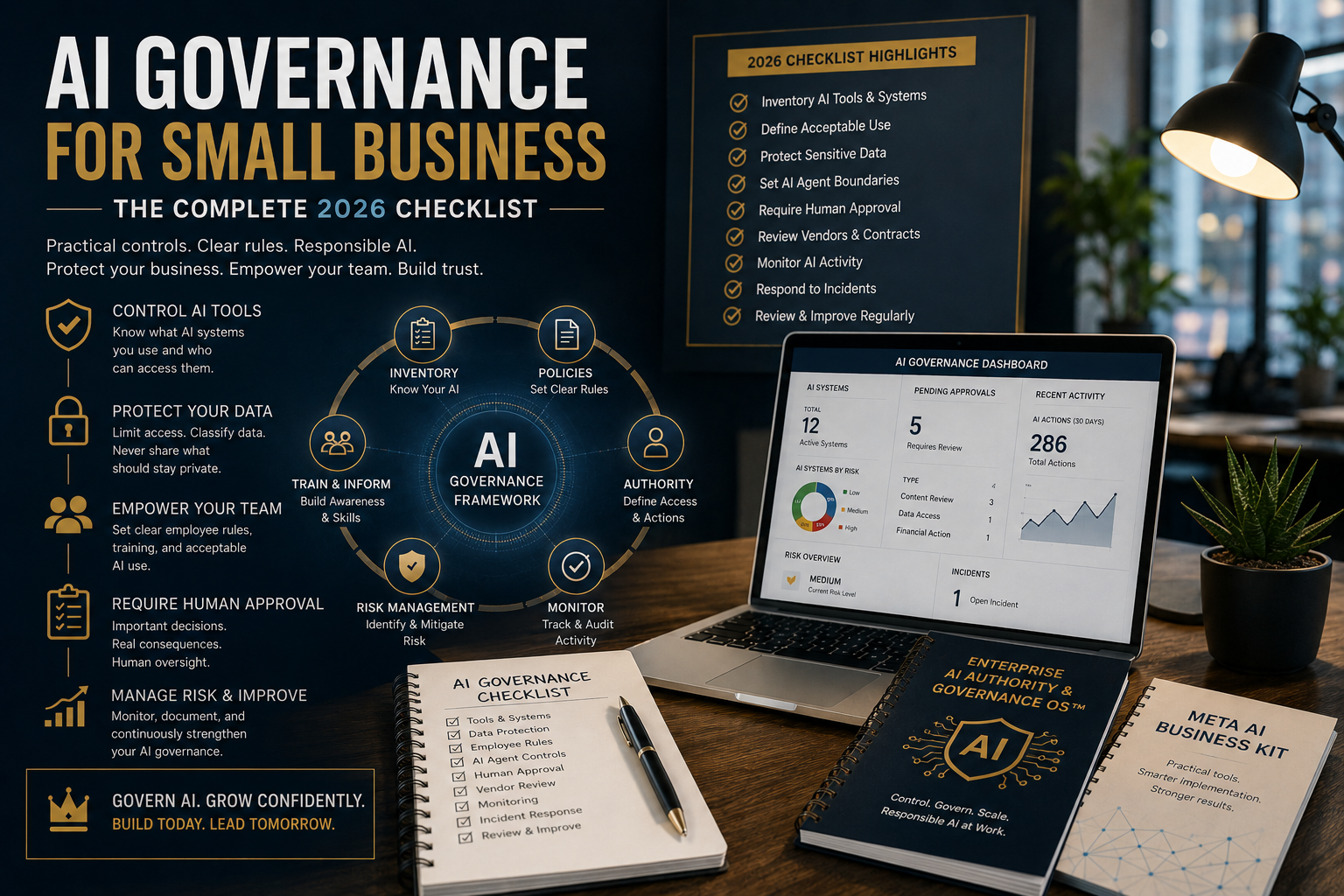
AI Governance for Small Business: The Complete 2026 Checklist
Artificial intelligence is no longer something only large corporations need to manage.
Small businesses are using AI to write emails, create advertisements, answer customer questions, generate images, summarize documents, analyze data, automate workflows and increasingly perform tasks through AI agents.
That creates enormous opportunity.
It also creates a new management responsibility.
If your business uses AI, you should be able to answer questions such as:
- Which AI tools are we using?
- Who is allowed to use them?
- What business or customer information can employees enter into them?
- Which AI-generated work requires human review?
- Can an AI system communicate directly with customers?
- Can an AI agent take actions inside business systems?
- Who approves consequential actions?
- What happens when AI makes a mistake?
- What evidence do we keep?
You do not need to operate a Fortune 500 company to need answers.
You need an AI governance system appropriate to the size and risk of your business.
What Is AI Governance for Small Business?
AI governance is the set of rules, responsibilities, permissions and controls a business uses to determine how artificial intelligence may be used.
For a small business, AI governance does not need to mean creating hundreds of pages of corporate policy.
It means establishing enough structure to answer four practical questions:
What AI are we using?
What is it allowed to access?
What is it allowed to do?
Who remains responsible?
That distinction becomes increasingly important as AI moves from simply generating content to taking actions.
Why Small Businesses Need AI Governance in 2026
The risk profile of business AI has changed.
An employee using AI to brainstorm social-media captions creates one level of risk.
An AI agent capable of accessing customer records, sending emails, issuing refunds, changing appointments or interacting with financial systems creates another.
The more access and authority AI receives, the more important governance becomes.
Small businesses therefore need to think beyond which AI application they purchased.
They need to think about authority.
The Complete 2026 Small Business AI Governance Checklist
Use the following checklist as a practical starting point.
1. Create an Inventory of Every AI Tool Your Business Uses
Start with visibility.
List every AI-enabled tool being used across the business.
This may include:
- Generative AI assistants
- AI writing tools
- Image generators
- Video generators
- AI meeting assistants
- Customer-service chatbots
- CRM AI features
- Accounting AI features
- Marketing automation
- AI scheduling tools
- AI coding assistants
- AI agents
- AI features embedded inside existing software
For each system, record:
- Tool name
- Business purpose
- Owner
- Users
- Data accessed
- External actions available
- Vendor
- Current status
Do not forget AI functionality embedded inside software you already use.
2. Assign a Human Owner to Every Important AI System
Technology should not become ownerless simply because it is automated.
For every material AI tool or agent, identify the person responsible for its use.
That owner should understand:
- Why the system is being used
- What information it accesses
- What it may do
- What restrictions apply
- What happens when something goes wrong
For a very small company, the owner may simply be the founder.
The important part is that responsibility remains identifiable.
3. Classify AI Uses by Risk
Not every AI use deserves the same level of control.
Consider separating uses into categories such as:
Low Risk
Examples might include brainstorming, internal formatting or drafting non-sensitive material.
Moderate Risk
Examples might include customer communications, marketing claims, business analysis or processing internal information.
High Risk
Examples might include sensitive customer data, financial actions, consequential decisions, legal matters, employment decisions or autonomous external actions.
The objective is not to create a perfect mathematical risk score.
It is to recognize that greater consequences require stronger controls.
4. Decide What Information Employees May Put Into AI
One of the most important small-business AI rules concerns data.
Employees should know whether they may enter information such as:
- Customer names
- Customer contact information
- Financial information
- Employee information
- Passwords
- API keys
- Confidential contracts
- Proprietary business information
- Health information
- Legal documents
- Source code
- Trade secrets
Do not rely on employees individually deciding whether something feels sensitive.
Create a clear policy.
5. Protect Passwords, Credentials and Secrets
Passwords, private keys, API credentials and authentication information should receive especially strong protection.
Employees should not casually paste credentials into AI systems.
Your AI governance checklist should identify:
- Which credentials AI systems may access
- Where secrets are stored
- Who can authorize access
- How access can be revoked
An AI system should receive only the access necessary for its approved purpose.
6. Establish Approved and Prohibited AI Uses
Create two simple lists.
Approved Uses
Document the activities employees may perform with approved AI tools.
Prohibited Uses
Document activities AI should not perform without additional review or authorization.
Examples of higher-risk activities could include:
- Sending sensitive customer communications without review
- Making unauthorized financial commitments
- Entering confidential information into unapproved tools
- Making unsupported legal or financial claims
- Publishing fabricated testimonials
- Impersonating real people
- Creating deceptive synthetic media
- Sharing passwords or credentials
Clear boundaries are easier to follow than a vague instruction to 'use AI responsibly.'
7. Create Human Approval Rules
AI can help prepare work without necessarily having authority to finalize it.
Define which actions require human approval.
Possible examples include:
- Sending certain external communications
- Publishing advertisements
- Issuing refunds
- Changing prices
- Making purchases
- Signing or accepting agreements
- Deleting important records
- Changing customer information
- Publishing sensitive content
- Deploying software
The question is:
Where must a human decision occur before the action becomes real?
8. Define AI Agent Authority
AI agents make governance especially important because they may do more than generate recommendations.
An AI agent may potentially:
- Read email
- Send email
- Access calendars
- Update CRM records
- Create documents
- Use business software
- Publish content
- Contact customers
- Trigger workflows
- Access databases
Do not give an agent unrestricted authority simply because the technology supports it.
Define whether the agent may:
- Observe
- Suggest
- Draft
- Execute with approval
- Execute within clearly defined limits
This creates bounded autonomy instead of unlimited autonomy.
9. Set Financial Authority Limits
If AI can participate in financial activity, establish thresholds.
For example, an AI system might be allowed to prepare a refund recommendation but require human approval before money moves.
Your policy should address relevant activities such as:
- Refunds
- Discounts
- Purchases
- Vendor payments
- Credits
- Pricing changes
- Subscription changes
Technical capability should never automatically equal financial authority.
10. Review Customer-Facing AI
If customers interact directly with AI, review the experience carefully.
Ask:
- Can customers tell when they are interacting with AI when appropriate?
- What information can the AI access?
- Can it make commitments?
- Can it change customer records?
- Can customers reach a human?
- What happens when the AI is uncertain?
- Are conversations retained?
Customer-facing automation should have a clear escalation path.
11. Require Human Review of Important AI-Generated Content
AI-generated content can contain errors, invented information or inappropriate claims.
Before publishing important content, review:
- Facts
- Statistics
- Quotes
- Product claims
- Pricing
- Legal statements
- Financial statements
- Customer promises
- Brand representation
AI-generated confidence is not evidence.
12. Establish AI Content Disclosure Rules
Determine when your business should disclose material AI involvement.
This can be particularly important for realistic synthetic:
- Images
- Video
- Voice
- Testimonials
- Spokespeople
- Representations of real people
Your policy should distinguish ordinary AI assistance from uses that could materially affect audience understanding or trust.
13. Review AI Vendors Before Adoption
Before introducing an AI vendor into important workflows, investigate what is relevant to your business.
Questions may include:
- What data does the vendor receive?
- How is information retained?
- Can business data be used for training?
- What security controls exist?
- Can data be deleted?
- What happens when the service ends?
- Does the vendor use subprocessors?
- What contractual terms apply?
If something has not been verified, mark it NOT VERIFIED rather than assuming the answer.
14. Limit AI Access to What It Actually Needs
Apply the principle of least privilege.
An AI marketing assistant probably does not need access to payroll.
A scheduling assistant probably does not need access to financial accounts.
A content generator probably does not need administrator privileges.
For every AI system, ask:
What is the minimum access necessary for this tool to perform its approved job?
15. Keep Records of Important AI Decisions and Actions
For higher-impact AI activity, preserve enough information to understand what happened later.
Useful records may include:
- AI system or agent
- Action attempted
- Business object affected
- Tool used
- Human approval
- Result
- Date
- Relevant evidence
You do not need to preserve private chain-of-thought.
You need operational evidence.
16. Create an AI Incident Response Plan
Eventually, an AI system may produce an incorrect output or behave unexpectedly.
Decide what happens before the incident occurs.
Your process can include:
1. Stop or contain the activity.
2. Preserve evidence.
3. Identify affected customers, systems or records.
4. Determine what happened.
5. Correct the outcome where appropriate.
6. Update the control that failed.
7. Document the incident.
Small businesses need incident discipline too.
17. Know How to Disable AI Systems Quickly
For AI systems with meaningful access or authority, know how to turn them off.
Document:
- Who can disable the system
- How access is revoked
- Which integrations must be disconnected
- What business process replaces it temporarily
An emergency shutdown procedure should exist before you need it.
18. Train Employees on AI Rules
An AI policy nobody understands will not provide much protection.
Employee training should cover:
- Approved tools
- Prohibited tools
- Sensitive data
- Customer information
- Human review
- AI-generated content
- Synthetic media
- Security
- Incident reporting
Keep the rules understandable enough that employees can actually use them.
19. Control Shadow AI
Shadow AI occurs when employees use unapproved AI applications without the business fully understanding the data or risks involved.
Instead of assuming employees are not doing this, create a process for requesting new AI tools.
Ask employees to identify:
- Tool
- Purpose
- Information involved
- Business benefit
- Required integrations
Then approve, restrict or reject the use.
20. Review Your AI Governance Regularly
AI systems, vendors and business processes change quickly.
Review your AI inventory and rules periodically.
Check whether:
- New tools have appeared
- Vendors changed their terms
- Employees changed workflows
- AI agents gained new capabilities
- New integrations were connected
- Permissions expanded
- Incidents revealed weaknesses
- Customer-facing uses changed
Governance should evolve with actual business use.
21. Keep Evidence Instead of Assuming Compliance
One of the strongest AI governance principles is simple:
Evidence before certainty.
If you have not confirmed something, do not automatically mark it safe, compliant or complete.
Use statuses such as:
- Verified
- Not verified
- Pending
- Needs review
- Approved
- Restricted
- Prohibited
This creates a more trustworthy governance record.
22. Create a Written Small Business AI Policy
Your AI policy does not have to be 100 pages long.
At minimum, it should address:
- Approved AI systems
- Responsible owners
- Acceptable use
- Prohibited use
- Sensitive data
- Customer data
- Human review
- AI-agent authority
- Financial authority
- External communications
- AI-generated content
- Vendor review
- Incident response
- Employee responsibilities
The objective is operational clarity.
23. Review AI Before Giving It More Authority
Businesses often begin with AI as an assistant and gradually connect it to more systems.
That can create silent authority expansion.
Before giving an AI system additional permissions, ask:
- What new action can it perform?
- What new data can it access?
- What could go wrong?
- Is the action reversible?
- Does human approval remain necessary?
- What evidence will be recorded?
- How can the permission be removed?
Every significant increase in authority deserves review.
24. Use a Simple AI Governance Operating Model
A small business can organize its AI governance around this lifecycle:
INVENTORY → CLASSIFY → BOUND → APPROVE → USE → MONITOR → DOCUMENT → IMPROVE
INVENTORY
Know which AI systems exist.
CLASSIFY
Understand their potential impact.
BOUND
Define data, tool and authority limits.
APPROVE
Require human decisions where necessary.
USE
Allow AI to operate within approved boundaries.
MONITOR
Watch for exceptions, errors and unexpected behavior.
DOCUMENT
Preserve important operational evidence.
IMPROVE
Change controls when evidence reveals weaknesses.
The 2026 Small Business AI Governance Quick Checklist
Before considering your basic AI governance program operational, confirm:
- Every important AI tool is inventoried
- Every material AI system has a human owner
- AI uses are classified by risk
- Employees know which AI tools are approved
- Sensitive-data rules exist
- Credentials and secrets are protected
- Prohibited AI uses are documented
- Human approval boundaries are defined
- AI-agent authority is limited
- Financial authority limits exist where relevant
- Customer-facing AI has escalation procedures
- Important AI-generated content receives human review
- AI disclosure rules exist
- AI vendors are reviewed
- AI systems follow least-privilege access
- Important actions create evidence
- An AI incident process exists
- High-impact AI can be disabled
- Employees receive AI training
- Shadow AI has an approval process
- Governance is reviewed regularly
If several of these answers are unknown, that is where your governance work should begin.
Small Business AI Governance Does Not Need Enterprise Complexity
Small businesses should not copy enterprise bureaucracy simply because large organizations have larger governance departments.
The objective is proportional control.
A five-person company may need a one-page approved-tool list, a straightforward data policy, clear human-approval boundaries and a basic incident record.
A growing company using multiple AI agents across sales, customer service, operations and finance may need substantially more structure.
Governance should grow with the authority and consequences of the AI systems being deployed.
From AI Tools to AI Workers
The next phase of small-business AI will make governance even more important.
Traditional AI tools wait for a prompt.
AI agents can increasingly interact with business systems and complete multi-step workflows.
That changes the management question from:
Can AI generate this?
To:
Should AI be authorized to do this?
That is why authority, approval and evidence are becoming central to responsible business AI.
Build Your Small Business AI Governance System
AurumVault provides two complementary resources for businesses building this capability.
Enterprise AI Authority & Governance OS™
For organizations that need deeper operational governance, the Enterprise AI Authority & Governance OS™ provides a structured framework for managing AI systems, agents, authority, tool access, data access, human approvals, runtime actions, evidence, incidents, vendor dependencies and executive oversight.
It is especially relevant as businesses move from simple AI assistance toward AI agents capable of taking real actions.
Meta AI Business Kit
For business owners looking to organize practical AI adoption and implementation, the Meta AI Business Kit can complement the governance framework by helping businesses approach AI use as an intentional operating capability rather than a collection of disconnected tools.
Together, these resources support two sides of the same business challenge:
Use AI effectively. Govern it responsibly.
The Most Important AI Governance Question for 2026
You do not need to know everything about artificial intelligence to govern its use responsibly.
But you should be able to answer:
What AI is operating in my business, what information can it access, what is it allowed to do, what requires my approval and what happens when something goes wrong?
If you can answer those questions clearly, you are already moving beyond casual AI adoption toward responsible AI operations.
If you cannot, start with the checklist above.
Because in 2026, the competitive advantage is not simply using more AI.
It is building a business that can use AI without losing control of the business itself.
Important notice: This article provides educational and operational information and is not legal, regulatory, cybersecurity, privacy, employment, financial or compliance advice. AI requirements vary by jurisdiction, industry, data type, technology and use case. Businesses should verify requirements applicable to their specific operations and obtain qualified professional guidance where appropriate.
Enjoying the Academy?
Join AurumVault Insider for new practical guides, digital tools, and marketplace releases.
No spam. Unsubscribe anytime. Privacy
By subscribing, you agree to receive AurumVault Insider emails. You can unsubscribe at any time.
Continue your journey
Keep reading
EU Packaging Compliance 2026: PPWR Checklist for Small Brands and Ecommerce
EU packaging compliance can involve far more than choosing recyclable packaging. Small brands selling into European markets may need to understand their economic role, map packaging components, collect supplier evidence, document material data, review recyclability and labeling, track country-level EPR actions and maintain technical records. This guide provides an evidence-first framework for organizing that work.
AI Governance in Banking: A Practical Operations Framework
Banking AI governance should go beyond documenting models. This practical framework shows how financial institutions can inventory AI use, classify customer and financial impact, establish authority limits, validate material systems, preserve transaction-level evidence and review complaints, incidents and controls.
Home Insurance Claim Checklist After a Disaster
After a fire, storm, water loss, theft or other property disaster, the amount of paperwork can become overwhelming. This guide explains how to document damage, preserve evidence, organize your home insurance claim, track temporary living expenses, manage contractors and reconcile payments from the first hours through final recovery.