
AI Likeness Rights for Creators: Protect Face & Voice
AI can now reproduce a creator's face, voice, mannerisms and digital presence at unprecedented scale. This guide explains how creators can organize permissions, assess risks, separate campaign use from AI training, negotiate licensing terms, require approvals, monitor authorized uses and document suspected unauthorized replicas.
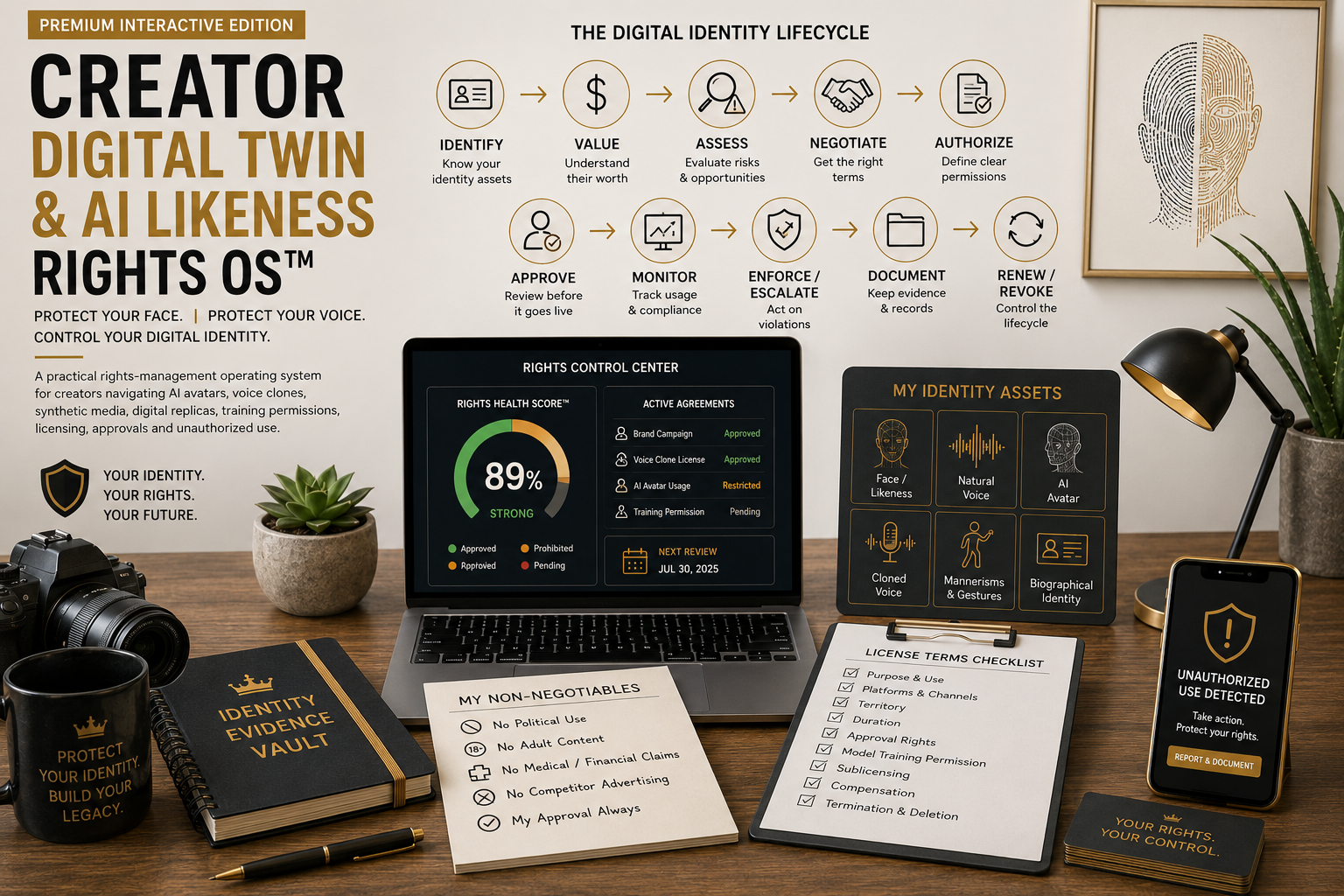
AI Likeness Rights for Creators: How to Protect Your Face, Voice and Digital Identity
For creators, your identity may be one of your most valuable business assets.
Your face.
Your voice.
Your appearance.
Your mannerisms.
Your personality.
Your reputation.
Your audience's recognition of you.
Artificial intelligence adds a new dimension to that value because technology can increasingly generate content that looks, sounds or behaves like a real person.
A creator may now encounter opportunities involving:
- AI avatars
- Digital humans
- Voice clones
- Synthetic advertisements
- AI-generated spokesperson content
- Digital replicas
- Automated customer-facing avatars
- Model training
- Fine-tuned models
- Derivative characters
- International synthetic campaigns
These opportunities can create new revenue possibilities.
They can also introduce questions traditional sponsorship agreements were never designed to answer.
The most useful question is not simply:
Can someone make an AI version of me?
A stronger operating question is:
Who may use which parts of my identity, for what purpose, on which platforms, in which territories, for how long, under what approval conditions, for what compensation—and what happens when permission ends?
That question turns AI likeness management from a vague concern into an organized creator-business process.
1. Understand What Your Digital Identity Includes
Your digital identity may extend well beyond your profile photo.
Start by inventorying identity elements such as:
- Legal or professional name
- Creator or stage name
- Face and photographic likeness
- Natural voice
- Synthetic or cloned voice
- AI avatar
- Digital human
- Signature phrases
- Catchphrases
- Mannerisms
- Gestures
- Biographical identity
- Existing characters or avatars
You may have different levels of control over different assets.
For example, you may control your natural voice but not automatically control every recording containing that voice.
A photographer may hold rights involving certain photographs.
A production company may have contractual rights in footage.
A previous brand agreement may contain continuing usage rights.
That is why the first step is inventory before authorization.
2. Inventory the Source Materials That Could Build a Digital Replica
An AI replica is created from source material.
That material might include:
- Headshots
- Photographs
- Video libraries
- Podcast episodes
- Voice recordings
- Livestream archives
- Social videos
- Training recordings
- Motion-capture files
- 3D scans
- Brand assets
- Previous campaign materials
- Public interviews
Document what exists and where it came from.
Then ask:
- Who created it?
- Who possesses it?
- Which agreements apply?
- What restrictions already exist?
- Can it legally or contractually be used for the proposed purpose?
Do not assume that appearing in a recording automatically means you control every possible use of that recording.
3. Decide Whether You Are Actually Ready to License an AI Clone
A brand opportunity can create urgency.
That is usually the worst time to begin deciding your fundamental boundaries.
Before receiving an offer, ask whether you can answer questions such as:
- Which identity elements do I control?
- Which uses will I prohibit?
- Who approves synthetic outputs?
- Can I track where licensed outputs appear?
- What happens when the license expires?
- Is model training permitted?
- Do existing exclusivity agreements create conflicts?
- Who reviews high-risk contracts?
- What would I do if an unauthorized clone appeared?
A creator who has already answered these questions can negotiate from a much stronger position.
4. Separate Campaign Permission From Model-Training Permission
This distinction is critical.
A brand may request permission to create an AI-assisted advertisement using your likeness.
That does not necessarily mean you intend to authorize your photographs, videos or voice recordings for model training.
Treat separately:
Campaign Use
Permission to generate or use specific content for a defined campaign.
Model Training
Permission to use source material to train or fine-tune an AI system.
Model Improvement
Permission to use generated outputs or interactions to improve a model.
Future Derivatives
Permission to generate new content later.
Model Retention
Permission to retain a custom model after the original campaign ends.
These are different business questions and should not automatically be bundled together.
5. Ask What Happens to the Model After the Campaign
Suppose a company builds a custom voice or avatar model based on you.
The campaign ends six months later.
What happens next?
Ask:
- Can the model remain stored?
- Can it be used again?
- Can the model be transferred?
- Can it be sublicensed?
- Can new derivatives be created?
- Must training data be deleted?
- Must model weights or embeddings be deleted where feasible?
- Is new authorization required for a new purpose?
A license expiration date is much less meaningful when nobody has defined what happens to the technology created under the license.
6. Define Your Default Rights Boundaries
Creators should consider defining default positions before negotiations begin.
Potential use categories can include:
- Model training
- Paid advertising
- Political use
- Adult or sexual content
- Gambling
- Health or medical claims
- Financial claims
- Competitor advertising
- International use
- Derivative characters
- Sublicensing
- Continued use after license expiration
Some categories may be acceptable.
Some may require special approval.
Others may be completely prohibited.
The goal is not to use identical boundaries for every creator.
The goal is to decide your boundaries intentionally.
7. Create a Non-Negotiables List
Before a deal arrives, document:
- Uses you will not authorize
- Industries you will not work with
- Brands you exclude
- Minimum approval rights you require
- Maximum default license duration
- What must happen when permission ends
This can prevent a large payment from causing you to agree impulsively to rights you would normally reject.
Your identity can have value long after one campaign ends.
8. Distinguish Approved, Restricted and Prohibited Uses
Avoid relying on broad wording such as commercial purposes whenever the business relationship requires greater precision.
Instead, evaluate use cases individually.
Examples include:
- Organic social content
- Paid social advertising
- Television or streaming advertisements
- Websites and ecommerce
- Email marketing
- Customer-service avatars
- Education or training
- Entertainment
- Political advocacy
- Adult content
- Gambling
- Health or medical use
- Financial services
- Dating
- Religious advocacy
- News or documentary use
- Competitor campaigns
- Merchandise
- AI model training
For each category, decide whether it is:
APPROVED
RESTRICTED
or
PROHIBITED
This produces clearer boundaries than one broad permission sentence.
9. Assess the Risk of Each Proposed AI-Likeness Deal
Not every synthetic-media deal creates the same level of risk.
Evaluate factors such as:
- Reputation impact
- Audience confusion
- Sensitive industry
- Advertising scale
- Duration
- Territory breadth
- Platform breadth
- Sublicensing
- Derivative works
- Model training
- Exclusivity
- Approval rights
- Termination rights
- Data or security uncertainty
A small one-week campaign may deserve different controls than a worldwide multi-year license allowing derivative synthetic content.
The point of risk assessment is not merely to produce a score.
It is to identify which safeguards the deal requires.
10. Determine Who Actually Controls the Rights
Creators should distinguish between what they appear to control and what evidence shows they control.
Potential parties may include:
- Creator
- Photographer
- Videographer
- Production company
- Agency
- Record label
- Employer
- Client
- Brand
- Platform
- Other contractual rights holder
For every important identity asset, document:
Asset → Possible Rights Holder → Current Status → Evidence → Professional Review Needed
Do not manufacture certainty where the ownership position has not been verified.
11. Define Face and Image Authorization Precisely
If a company wants to generate synthetic visual content using your likeness, record the authorization carefully.
Document:
- Identity element being authorized
- Licensee
- Brand
- Campaign
- Permitted purpose
- Platforms
- Channels
- Territory
- Start date
- End date
- Prohibited uses
- Human approval requirements
- Termination requirements
- Deletion requirements
The word likeness can cover many different practical uses.
A precise authorization provides much greater operational clarity.
12. Treat Voice Cloning as Its Own Permission
Your natural voice and a synthetic voice model are related but not identical assets.
If voice cloning is involved, define:
- Which recordings may be used
- What model may be created
- Who may access it
- What the voice may say
- Where it may appear
- Which subjects are prohibited
- Whether you approve each output
- Whether the model may remain after the license
- What deletion obligations apply
One important question is:
Can the synthetic voice be used to make statements you never personally said?
If so, approval rights become especially important.
13. Define Avatar and Digital-Human Rights Separately
An AI avatar may reproduce more than facial appearance.
It can incorporate:
- Face
- Body
- Voice
- Movement
- Mannerisms
- Expressions
- Personality cues
- Clothing or visual identity
Document the same core parameters used in other licenses:
Purpose → Platform → Territory → Duration → Prohibited Uses → Approval → Termination
Do not assume an avatar automatically receives the same rights as the original campaign footage used to create it.
14. Protect Human Approval Rights
One of the most valuable controls a creator can retain is the right to approve synthetic outputs before publication.
Approval can cover:
- Script
- Spoken statements
- Visual appearance
- Context
- Brand association
- Product claims
- Editing
- Final generated output
The more realistic the synthetic replica becomes, the more easily an audience may believe you personally participated in the communication.
That makes human approval a practical reputation safeguard.
15. Consider Audience Confusion
Ask whether a reasonable viewer could believe:
- You personally recorded the content
- You personally made the statement
- You personally endorsed the product
- You personally participated in the interaction
If the answer may be yes, disclosure and approval deserve careful consideration.
Synthetic media can create commercial value precisely because it resembles authentic participation.
That same realism can also create reputational risk.
16. Build Your Compensation Position Around the Rights Granted
AI-likeness compensation should not necessarily be treated like one ordinary sponsored post.
Possible compensation components may include:
- Base campaign fee
- Synthetic-use premium
- Paid-media usage
- Duration premium
- Territory premium
- Exclusivity premium
- Training-rights premium
- Derivative-rights premium
- Revenue share or royalty
- Renewal fee
These categories are not universal market-rate formulas.
They provide a way to think about what commercial value is actually being requested.
A company asking for six months of campaign usage is requesting something different from a company seeking perpetual model-training and derivative rights.
17. Examine the Value Drivers of Your Digital Identity
The commercial context of a creator's likeness can depend on factors such as:
- Audience reach
- Audience trust
- Niche expertise
- Scarcity
- Exclusivity
- Existing brand relationships
- Paid-media potential
- Geographic reach
- Voice recognizability
- Visual recognizability
- Reputation sensitivity
- Longevity of use
- Training or derivative value
No workbook or simple formula can establish a universal value for someone's identity.
But documenting these factors can improve negotiation discipline.
18. Review AI-Likeness Deals as Rights Transactions
When an agreement arrives, do not review only the headline payment.
Examine:
- Identity elements covered
- Campaign purpose
- Platforms
- Territory
- Duration
- Paid advertising
- Model training
- Future derivatives
- Sublicensing
- Exclusivity
- Approval
- Termination
- Deletion
- Compensation
- Renewal
The larger the rights package, the more important professional review may become.
A high fee does not automatically make broad or unclear rights favorable.
19. Plan for Revocation and the End of Permission
Every authorization should answer:
What happens when permission ends?
Your process may need to address:
- New generation stopping
- Existing campaigns ending
- Content removal where required
- Model access being disabled
- Source-data deletion
- Model deletion where applicable and feasible
- Sublicensee notification
- Archive retention
- Evidence of compliance
The end of authorization should be an operational event—not merely a date buried inside a contract.
20. Monitor Authorized Uses
Licensing your likeness does not mean you should stop paying attention to how it is used.
Track:
- Licensee
- Campaign
- Approved platforms
- Actual platforms used
- Territory
- Start and end dates
- Outputs generated
- Approvals
- Deviations
- Renewal status
Monitoring allows creators to compare what was authorized with what actually happened.
21. Prepare for Unauthorized Clones
A creator may eventually encounter suspected synthetic content they did not authorize.
Instead of immediately assuming the exact legal remedy, begin by preserving evidence.
Document:
- URL
- Platform
- Screenshot
- Date discovered
- Account involved
- Content description
- Whether the content appears commercial
- Whether your face or voice was reproduced
- Known source material
- Audience confusion
- Communications sent
- Platform reports
- Professional review
The objective is to build a reliable incident record before important evidence disappears.
22. Keep a Digital Identity Evidence Vault
Important rights-management records should remain organized.
Maintain copies or references for:
- Agreements
- Licenses
- Approvals
- Screenshots
- Source files
- Training permissions
- Notices
- Revocations
- Campaign records
- Evidence of deletion
- Incident records
- Professional reviews
A contract is much more useful when you can locate it quickly several years later.
23. Audit Your Digital Identity Regularly
AI-likeness management should not be a one-time exercise.
Run periodic reviews of:
- Active licenses
- Expiring licenses
- Training permissions
- Exclusivity conflicts
- Output approvals
- Unauthorized-use incidents
- Evidence records
- Exclusion lists
- Revocation processes
- Professional-review items
Your business changes.
Technology changes.
Your audience changes.
Your negotiating leverage may change.
Your boundaries may change too.
24. Use a Complete Digital Identity Lifecycle
A structured digital-identity process can follow ten stages:
IDENTIFY → VALUE → ASSESS → NEGOTIATE → AUTHORIZE → APPROVE → MONITOR → ENFORCE / ESCALATE → DOCUMENT → RENEW / REVOKE
Each stage solves a different problem.
Identify what makes up your digital identity.
Value the commercial context.
Assess the proposed use and its risks.
Negotiate the rights and compensation.
Authorize only the defined use.
Approve synthetic outputs where required.
Monitor what happens after authorization.
Enforce or escalate when serious issues appear.
Document decisions and evidence.
Renew or revoke when the term changes or ends.
Your Face and Voice Are Not Just Content Inputs
As generative AI becomes more capable, a creator's identity may be reusable in ways that were previously impossible.
A photograph can help generate new images.
A voice sample can contribute to synthetic speech.
Video can provide expressions, gestures and appearance data.
An avatar can continue appearing after the original shoot has ended.
That makes one principle increasingly important:
Permission should be specific enough that everyone understands what was actually authorized.
Build a Digital Identity Rights System Before the Deal Arrives
Creator Digital Twin & AI Likeness Rights OS™ — Premium Interactive Edition is designed as a practical rights-management operating system for creators navigating AI avatars, voice clones, synthetic media, digital replicas, training permissions, licensing, approvals and unauthorized use.
It helps creators organize areas including:
- Digital Identity Passport™
- Identity asset inventory
- AI clone readiness
- Digital identity value mapping
- AI clone risk assessment
- Rights ownership and control
- Training-data permissions
- Face and image authorization
- Voice clone authorization
- Avatar and digital-human authorization
- Approved, restricted and prohibited uses
- Brand and industry exclusions
- AI likeness deal analysis
- Human approvals
- Monitoring
- Revocation planning
- Unauthorized-clone incidents
- Digital identity evidence
- Quarterly and annual reviews
The operating principle is straightforward:
Protect your face. Protect your voice. Control your digital identity.
Because the opportunity to license a digital version of yourself can create value.
But control depends on knowing exactly what you authorized, what you prohibited, what evidence exists and what happens when permission ends.
Educational notice: This article is an educational and operational resource, not legal advice or a determination of ownership, enforceability or market value. Rights involving name, image, likeness, voice, privacy, publicity, copyright, contracts, labor, advertising and AI can vary by jurisdiction and circumstance. Obtain qualified professional advice for material or high-risk transactions.
Enjoying the Academy?
Join AurumVault Insider for new practical guides, digital tools, and marketplace releases.
No spam. Unsubscribe anytime. Privacy
By subscribing, you agree to receive AurumVault Insider emails. You can unsubscribe at any time.
Continue your journey
Keep reading
EU Packaging Compliance 2026: PPWR Checklist for Small Brands and Ecommerce
EU packaging compliance can involve far more than choosing recyclable packaging. Small brands selling into European markets may need to understand their economic role, map packaging components, collect supplier evidence, document material data, review recyclability and labeling, track country-level EPR actions and maintain technical records. This guide provides an evidence-first framework for organizing that work.
AI Governance for Small Business: The Complete 2026 Checklist
Small businesses are adopting AI faster than many are creating rules for it. This practical 2026 checklist shows business owners how to inventory AI tools, protect sensitive information, define employee and AI-agent authority, require human approval for consequential actions, evaluate vendors, document incidents and create a manageable AI governance system.
AI Governance in Banking: A Practical Operations Framework
Banking AI governance should go beyond documenting models. This practical framework shows how financial institutions can inventory AI use, classify customer and financial impact, establish authority limits, validate material systems, preserve transaction-level evidence and review complaints, incidents and controls.