
Athlete Endorsement Deals: Protect Your Rights & Brand
A professional athlete's commercial value extends far beyond a playing contract. Learn how to organize name, likeness, voice, content, endorsements, licensing, paid media, group rights, AI permissions, exclusivity and post-career assets before granting another company access to your identity.
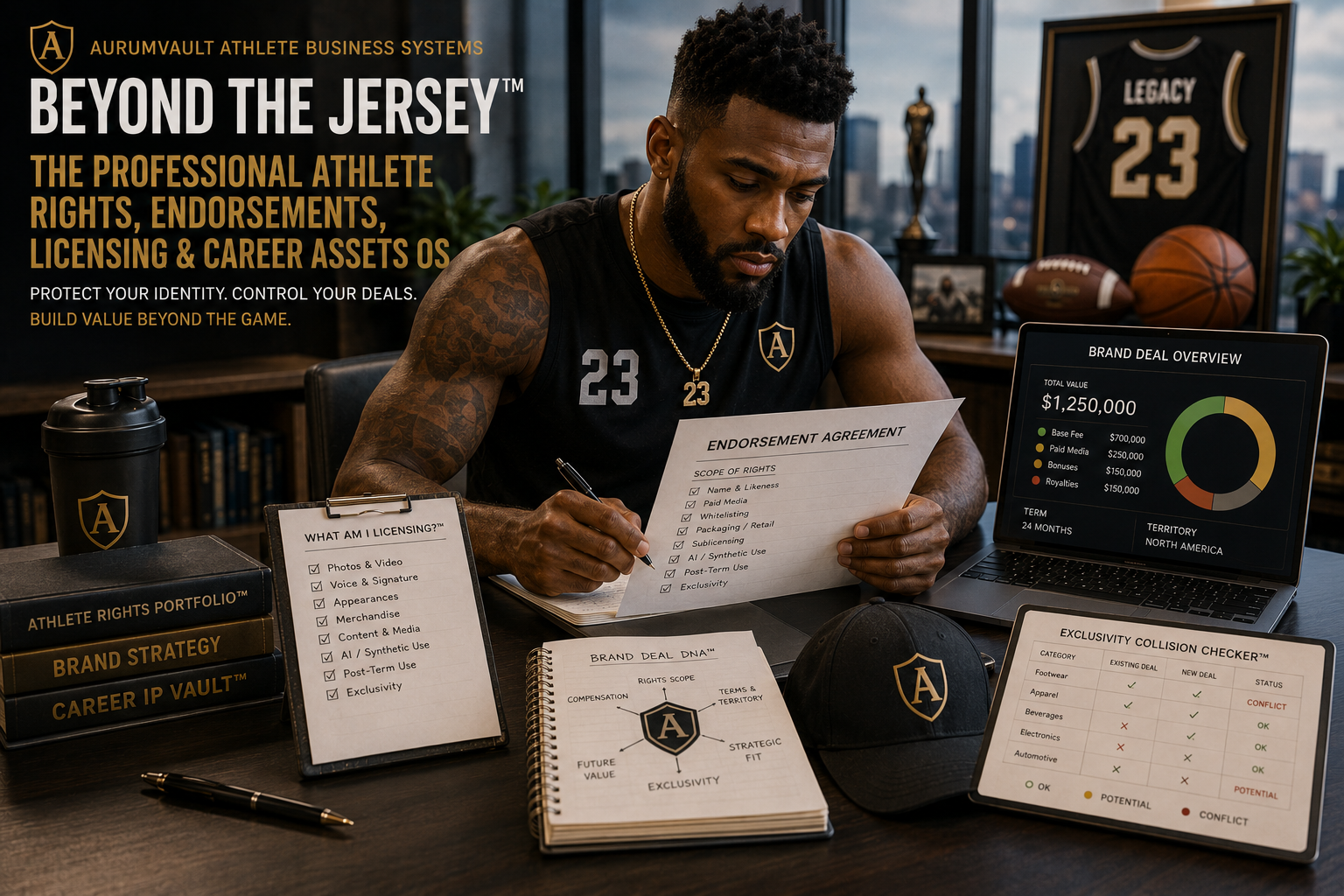
Athlete Endorsement Deals: How to Protect Your Rights, Brand and Long-Term Value
A professional athlete may be paid to compete.
But the playing contract is only one part of the athlete's commercial life.
An athlete may also have value connected to:
- Name
- Image
- Likeness
- Voice
- Signature
- Nickname
- Biography
- Social presence
- Personal brand
- Merchandise
- Content
- Appearances
- Camps
- Books
- Documentaries
- Training businesses
- Collectibles
- Future media opportunities
That means the athlete is not only a player under contract.
The athlete can also be the owner or controller of a valuable commercial identity.
The challenge is that these rights can overlap with player-association licensing, team marks, league intellectual property, federation rules, existing sponsors, category exclusivity, media rights and increasingly AI-generated uses.
So before accepting an endorsement or licensing opportunity, the most useful question is not simply:
How much are they paying me?
A stronger question is:
What exactly are they paying for, what rights am I granting, who else may need to approve the use, what restrictions am I accepting and what remains mine after the deal ends?
1. Treat the Athlete as a Business
A professional athlete should think about the playing contract and commercial identity as related but distinct business assets.
The playing agreement may govern compensation for athletic performance.
Commercial agreements can involve a very different set of assets.
A disciplined athlete-business review should identify:
- The asset involved
- Who controls it
- What the commercial partner wants
- Third-party dependencies
- Term
- Territory
- Compensation
- Conflicts
- Professional review needs
A useful operating framework is:
ASSET → CONTROL → SCOPE → CONFLICT → TERM → VALUE
Asset
What identity, content or business asset is involved?
Control
Who can authorize the use?
Scope
What exactly may the partner do?
Conflict
Could an existing sponsor, team rule, league rule or third-party right interfere?
Term
When does the permission end?
Value
What compensation or future leverage is being affected?
2. Build an Athlete Rights Portfolio Before the Next Deal Arrives
Do not wait until a major brand offer arrives to figure out what you control.
Create an inventory of your commercial assets.
Possible entries include:
- Legal name
- Nickname
- Catchphrase
- Face and likeness
- Natural voice
- Synthetic voice
- Signature
- Jersey number
- Biography
- Life story
- Social handles
- Distinctive celebrations
- Personal logos
- Trademarks
- Foundations
- Camps
- Training programs
- Media businesses
- Merchandise
- Content libraries
For each asset, document:
- Control status
- Owner or controller
- Group-rights dependencies
- Team or league dependencies
- Registration or trademark status
- Current licensee
- Exclusivity
- Evidence location
- Potential post-career value
The objective is simple:
Know what is in the vault before someone asks you to license it.
3. Break NIL Into Specific Rights
The phrase name, image and likeness can be useful shorthand.
But a commercial agreement should be more precise.
Different assets can have different uses and restrictions.
For example:
Name
Your name may appear in advertising, packaging, retail products, press releases and search marketing.
Likeness
Photographs and video can be licensed differently depending on platform, territory, duration and context.
Voice
A recorded voiceover is different from a synthetic voice clone.
Signature
An autograph or facsimile signature can become part of collectibles, licensed products and promotions.
Jersey Number
A number may carry personal commercial value while also intersecting with team or league presentation.
Biography or Life Story
Books, documentaries, branded storytelling and adaptations can create separate commercial opportunities.
Social Handles
Brands may request tags, usernames, handles or account access.
Celebration or Mannerism
A recognizable gesture may become part of merchandising or brand identity.
The point is to stop treating every identity right as one generic bundle.
4. Know the Difference Between Individual and Group Licensing
An athlete may control certain individual endorsement opportunities while other uses involve collective rights.
Professional sports commercialization can involve:
- Athlete rights
- Player-association rights
- Team rights
- League rights
- Tour or federation rights
- Third-party intellectual property
A one-athlete commercial is not necessarily governed the same way as a licensed product featuring multiple athletes.
Before granting a right, ask:
- Can the athlete authorize this alone?
- Does a player association have a role?
- Are team marks involved?
- Is league or federation IP involved?
- Is broadcast footage being used?
- Are photographer rights involved?
- Are sponsor marks involved?
An athlete agreement does not automatically grant someone else team, league, union or third-party intellectual property.
5. Expect Some Campaigns to Require Multiple Approvals
Certain opportunities may require more than one permission.
A campaign could involve:
Athlete + player association + team or league + content owner
For example, the athlete may approve personal likeness use while another party controls the game footage being incorporated into the advertisement.
This is why rights mapping should happen before production begins.
6. Treat an Endorsement as a Bundle of Services and Rights
An endorsement agreement should not be evaluated by the headline payment alone.
The overall deal may include:
- Base fee
- Bonuses
- Royalties
- Appearances
- Social posts
- Photo shoots
- Video production
- Interviews
- Events
- Content creation
- Name use
- Likeness use
- Paid advertising
- Whitelisting
- Packaging
- Retail
- Sublicensing
- Exclusivity
- Post-term use
- AI or synthetic use
A $500,000 deal granting narrow campaign rights can be commercially different from a $500,000 deal granting broad worldwide usage, paid media, AI rights and long-term exclusivity.
The number matters.
The scope matters too.
7. Separate the Base Fee From Rights Add-Ons
The athlete may be compensated for services such as:
- Appearance
- Production day
- Social post
- Interview
- Event participation
But the brand may also receive valuable licensing rights.
Consider separating compensation associated with:
- Paid media
- Extended usage
- International territory
- Packaging
- Retail
- Whitelisting
- Exclusivity
- Sublicensing
- AI rights
- Renewal
This makes it easier to understand what the athlete is actually being paid for.
8. Make Deliverables Specific
Avoid vague requirements when possible.
Instead of:
'Participate in social promotion.'
clarify:
- Number of posts
- Platform
- Format
- Length
- Production responsibility
- Posting window
- Required tags
- Required talking points
- Revision process
- Approval process
- Appearance requirements
Specific deliverables reduce confusion later.
9. Use an Endorsement Rights Scope Checker
A broad NIL grant should be broken into specific commercial uses.
Review whether the deal includes:
- Name use
- Photo and likeness use
- Video use
- Voice use
- Signature use
- Social-content reuse
- Paid media
- Whitelisting
- Packaging and retail
- Sublicensing
- AI or synthetic use
- Archival or post-term use
- Approval requirements
The more precisely these rights are documented, the easier it is to understand the real commercial package.
10. Understand Paid Media
A brand posting your sponsored content organically is different from paying to amplify that content as an advertisement.
Paid media can increase the scale and commercial value of athlete content.
Document:
- Paid-media duration
- Territory
- Platform
- Spend context where relevant
- Allowed edits
- Approval process
- End or takedown rules
A sponsored post that receives 100,000 organic impressions and an advertisement shown millions of times are different commercial uses.
11. Understand Whitelisting
Whitelisting may allow a brand to run advertising through or in connection with an athlete's social account or identity.
Clarify:
- Which account
- Which platform
- Duration
- Who has access
- What content may be promoted
- Whether dark ads are permitted
- What edits are allowed
- Approval rights
- Takedown procedure
Do not treat account-based advertising as automatically included in ordinary social posting.
12. Watch for Exclusivity Collisions
Professional athletes may already have multiple commercial relationships.
A new deal can collide with an existing sponsor.
Before signing, compare:
- Existing sponsor
- Existing category
- Existing exclusivity
- Existing end date
- Proposed sponsor
- Proposed category
- Proposed exclusivity
- Proposed term
Then identify:
- Category overlap
- Term overlap
- Potential conflict
- Agent or attorney review need
Exclusivity should not be analyzed in isolation.
Its value depends partly on what future opportunities the athlete is agreeing not to pursue.
13. Define the Category Carefully
A broad exclusivity category can create unintended restrictions.
For example, there may be a meaningful difference between:
- Athletic footwear
- All footwear
- Athletic apparel
- All apparel
- Sports drinks
- All beverages
- Financial services
- Banking
- Credit cards
- Insurance
The broader the definition, the more future opportunity may be affected.
14. Examine What Survives After the Deal Ends
An endorsement may technically end while certain commercial rights continue.
Ask:
- Can old advertisements stay live?
- Can retail packaging continue circulating?
- Is there a sell-off period?
- Can archived social content remain online?
- Can the brand retain campaign assets?
- Can sublicenses continue?
- Can AI models or synthetic assets survive?
A contract end date does not always mean every use stops on that date.
15. Distinguish Licensing From Ownership
A commercial partner may need permission to use an asset without needing to own the asset.
For every agreement, identify:
You Keep
Rights remaining with the athlete.
You License
Specific identity, media or product rights granted for the deal.
You Restrict
Activities or categories the athlete agrees not to pursue during a defined period.
Review Required
Uses involving team marks, league footage, group rights, AI or third-party intellectual property that require additional analysis or approval.
This before-and-after picture can make a complicated agreement easier to understand.
16. Attach Dates to Every Meaningful Commercial Permission
Every important right should have a start and end point whenever appropriate.
Track:
- Campaign start
- Campaign end
- Content usage term
- Paid-media term
- Exclusivity term
- Whitelisting term
- Retail sell-off period
- Renewal period
- Post-term archival use
A permission without a clearly understood endpoint deserves careful review.
17. Treat Merchandise and Collectibles as Their Own Business
Athlete merchandise can extend beyond a single endorsement campaign.
Licensing opportunities may involve:
- Apparel
- Trading cards
- Collectibles
- Autographed products
- Memorabilia
- Digital collectibles
- Personal-brand products
Track:
- Product category
- Licensee
- Athlete IP used
- Territory
- Sales channels
- Term
- Minimum guarantee
- Royalty rate
- Approval rights
- Sell-off period
- Sublicensing
- Group-rights dependency
Merchandise can become a recurring royalty asset rather than simply a one-time promotion.
18. Protect Athlete-Created Content and Media Rights
Athletes increasingly create their own:
- Podcasts
- Video channels
- Documentaries
- Social series
- Production companies
- Newsletters
- Training content
- Behind-the-scenes footage
For each project, identify:
- Who created it
- Who owns it
- Whether team or league footage appears
- Whether music or archive rights are involved
- Sponsor integrations
- Distribution rights
- Promotional clip rights
- Archival use
- Post-term use
- Long-term career value
Content created during an athletic career can continue creating value after competition ends.
19. Treat AI Permissions Separately
Artificial intelligence introduces rights that should not automatically disappear inside broad NIL language.
Possible AI and synthetic-media uses include:
- AI training
- Voice cloning
- Synthetic voice
- Digital replica
- Synthetic video
- Face replacement
- Motion or performance simulation
- Avatar or game character
- Generated advertising
- Personalized fan content
For every use, document:
- Permission
- Output approval rights
- Compensation
- Duration
- Territory
- Revocation
- End-of-use requirements
A normal recorded voice and a synthetic voice capable of generating new speech are different commercial uses.
20. Treat Voice Cloning as a Separate Consent Decision
A brand may already have permission to use a recording of the athlete's voice.
That does not necessarily answer whether the company may create a synthetic model that can produce new statements.
Ask:
- May the voice be cloned?
- Which recordings may train the model?
- What may the synthetic voice say?
- Can the athlete approve outputs?
- Can the brand create new advertising later?
- Is separate compensation required?
- What happens when permission ends?
The same logic applies to digital replicas and synthetic video.
21. Think Carefully About Athlete Data and Wearables
Modern athletes may also generate valuable performance data.
Questions can arise around:
- Wearable data
- Training data
- Performance metrics
- Health-related information
- Analytics
- Commercial reuse
- AI training
- Machine-learning models
For every proposed use, ask who controls the information, what the partner wants to do with it, how long the permission lasts and whether compensation or additional review is required.
22. Score the Entire Brand Deal, Not Just the Headline Fee
The biggest number in the agreement is not necessarily the best measure of the deal.
A useful brand-deal analysis should consider areas such as:
- Compensation
- Rights scope
- Term
- Territory
- Exclusivity
- Approval rights
- Post-term use
- Strategic fit
- Long-term opportunity cost
The point is not to reduce every partnership to one perfect score.
It is to force the athlete and business team to evaluate the entire commercial package.
23. Evaluate Renewal Based on Performance
Do not automatically renew an endorsement simply because the first agreement existed.
Before renewal, review:
- Campaign performance
- Athlete visibility growth
- Audience growth
- Brand value growth
- Expanded usage requested
- New markets
- New platforms
- Longer term
- Increased exclusivity
- Stronger negotiating leverage
The first deal can create evidence that improves the economics of the next deal.
24. Build an Athlete Career IP Vault
Some of the most valuable athlete assets may outlive the playing career.
Preserve and organize assets such as:
- Signature and autograph brand
- Career archive
- Personal photos
- Interviews
- Behind-the-scenes content
- Life-story rights
- Training methods
- Camps
- Academies
- Coaching systems
- Digital courses
- Media brands
- Podcasts
- Production companies
- Newsletters
- Foundation or community brands
- Personal trademarks
- Digital identity policies
An organized career IP portfolio creates more options after retirement.
25. Treat the Career Archive as an Asset
Photos, interviews, personal footage and behind-the-scenes material can support future:
- Books
- Documentaries
- Media specials
- Licensing
- Brand campaigns
- Speaking
- Educational content
Do not wait until retirement to discover that important footage, rights records and media assets were never organized.
26. Preserve Life-Story Rights
The athlete's story may become part of:
- Memoirs
- Documentaries
- Scripted adaptations
- Speaking
- Educational products
- Branded storytelling
Career storytelling can create long-term commercial value.
Document what you control and what prior media agreements may affect.
27. Turn Training Knowledge Into Intellectual Property
Athletes accumulate knowledge about:
- Performance
- Preparation
- Conditioning
- Leadership
- Recovery
- Discipline
- Position-specific technique
- Competition
That knowledge can become:
- Camps
- Clinics
- Academies
- Coaching systems
- Certifications
- Digital courses
- Training programs
The objective is to turn expertise into an owned system rather than leaving all value attached only to game participation.
28. Develop Media Capabilities While Still Active
A professional athlete can begin building future media opportunities before retirement.
Possible paths include:
- Broadcasting
- Commentary
- Podcasting
- Production
- On-camera hosting
- Documentary development
- Newsletter publishing
Building these capabilities while the athlete remains active can make the transition beyond competition more deliberate.
29. Build Owned Experiences
Camps and clinics can become more than paid appearances.
They can become owned businesses and branded experiences.
Think about:
- Curriculum
- Name and marks
- Sponsors
- Pricing
- Media
- Merchandise
- Coaches
- Licensing
- Expansion
The goal is to create assets the athlete controls rather than relying exclusively on someone else to hire the athlete for an appearance.
30. Consider Post-Career Merchandise
An athlete may continue licensing or selling products after retirement.
That can include:
- Apparel
- Memorabilia
- Collectibles
- Autographs
- Training products
- Legacy merchandise
The athlete's identity does not automatically stop having value when active competition ends.
31. Think About Digital Identity Beyond Retirement
AI avatars, digital replicas and synthetic media may create post-career issues that traditional endorsement planning did not anticipate.
Athletes may eventually need policies addressing:
- Who can authorize a digital replica
- Whether voice cloning is allowed
- What happens after death or incapacity
- Who controls digital identity later
- Whether old commercial partners retain AI assets
- Whether successors may license those rights
Long-term identity management can therefore become part of estate and successor planning.
32. Build Revenue Engines Before the Game Ends
One of the most important long-term lessons is to avoid waiting until retirement to begin thinking about the next business chapter.
Potential post-career revenue engines include:
- Speaking
- Broadcasting
- Media
- Coaching
- Training
- Camps
- Clinics
- Merchandise
- Books
- Documentaries
- Licensing
- Education
- Production
- Personal brands
The playing career can create attention.
The business objective is to convert some of that attention into assets capable of lasting beyond the competitive window.
33. Run a Before-You-Sign Quality Gate
Before finalizing a major endorsement or licensing agreement, confirm that you understand:
- What asset is being licensed
- Who currently controls it
- Which third parties may need approval
- Exact commercial scope
- Deliverables
- Paid-media rights
- Whitelisting
- Packaging and retail
- Sublicensing
- Exclusivity
- Term
- Territory
- Post-term use
- Compensation
- Renewal
- AI and synthetic rights
- Approval rights
- Existing sponsor conflicts
- Group-rights dependencies
- Team or league restrictions
- Long-term career impact
- What requires agent, union or legal review
If those answers are unclear, the athlete-business analysis is not finished.
Your Contract Pays You to Play. Your Identity Can Create Value for Decades.
Professional athletes spend years developing performance at an elite level.
During that process, something else can grow alongside the career:
commercial identity.
The athlete's name, likeness, voice, reputation, audience, story, knowledge, archive, content and personal brands may continue creating opportunities long after the final game.
The objective is not simply to collect as many endorsement checks as possible.
It is to understand what you control, license intentionally, prevent avoidable conflicts and preserve assets with long-term potential.
Build the Full Athlete Rights Operating System
Beyond the Jersey™ — The Professional Athlete Rights, Endorsements, Licensing & Career Assets OS by AurumVault Athlete Business Systems is designed to turn athlete-commercial-rights complexity into an organized operating system.
The system covers:
- Athlete as a Business
- Name, Image, Likeness & Identity Rights
- Individual vs Group Licensing
- Endorsement Deals
- Sponsorship Rights Scope
- Exclusivity & Category Conflicts
- Social Media, Paid Media & Whitelisting
- Merchandise, Collectibles & Licensing
- Appearances, Camps & Clinics
- Content & Media Rights
- AI, Voice, Digital Replicas & Synthetic Athletes
- Athlete Data & Wearables
- Agents, Managers & Business Teams
- Brand Deal Economics & Payment Terms
- Brand Deal DNA™
- What Am I Licensing?™
- Group Rights & League / Team Restrictions
- Athlete Career IP Vault™
- Career After the Game™
- Before You Sign Quality Gate
The system also includes practical tools such as the Athlete Rights Portfolio™, Endorsement Rights Scope Checker™, Brand Deal DNA™, Exclusivity Collision Checker™, Group vs Individual Rights Map™, Athlete AI Consent Matrix™, Athlete Career IP Vault™ and Career After the Game™ framework.
The core principle is straightforward:
Protect your identity. Control your deals. Build value beyond the game.
Because your playing contract may pay you to compete.
Your commercial identity may create value for decades.
Educational notice: This article and Beyond the Jersey™ are educational and organizational resources. They are not legal, tax, collective-bargaining, league-compliance, agent, investment or financial advice. Athlete rights vary by jurisdiction, sport, player association, team, league, federation, contract and commercial context. Qualified professionals should be used when interpretation or transaction-specific advice is required.
Enjoying the Academy?
Join AurumVault Insider for new practical guides, digital tools, and marketplace releases.
No spam. Unsubscribe anytime. Privacy
By subscribing, you agree to receive AurumVault Insider emails. You can unsubscribe at any time.
Continue your journey
Keep reading
How to Use Meta AI for Business Without Losing Control
Meta AI can help creators and small businesses analyze content, plan campaigns, organize customer questions and streamline routine work. The bigger challenge is using it with clear data boundaries, verified inputs, human review and defined authority.
How to Turn Content Creation Into a Real Business: A Digital Creator Operating System
Successful creators do more than publish content. They build systems around their audience, offers, products, partnerships, revenue, and operations. This guide explains how to start turning your creative work into a more organized and sustainable business.
How to Create a Reality Show: From Idea to Pitch
A reality show needs more than interesting people and cameras. Learn how to develop the premise, format, cast, story engine, episodes, production plan, sizzle reel, pitch package and commercial strategy behind a professional unscripted property.