
How to Create a Reality Show: From Idea to Pitch
A reality show needs more than interesting people and cameras. Learn how to develop the premise, format, cast, story engine, episodes, production plan, sizzle reel, pitch package and commercial strategy behind a professional unscripted property.
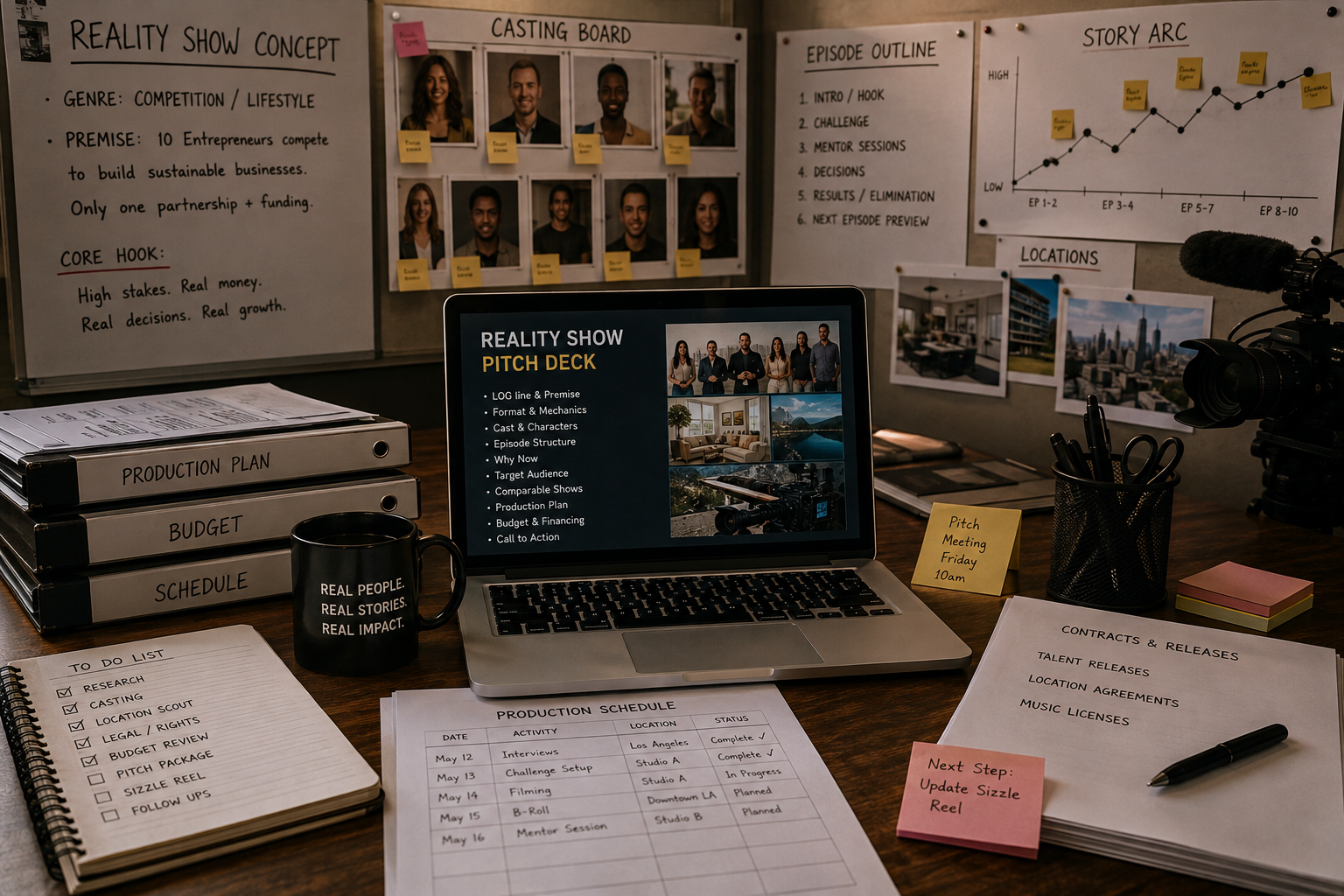
How to Create a Reality Show: From Idea to Pitch
Reality television can look spontaneous on screen.
The people may be real.
The emotions may be real.
The outcomes may not be scripted in advance.
But successful unscripted television is rarely unstructured.
Behind a strong reality property are decisions about format, casting, relationships, story engines, production, consent, editorial integrity, budgets, pitching, rights and commercial positioning.
That means creating a reality show requires much more than finding interesting people and turning on a camera.
A useful way to think about the process is:
DEVELOP → CAST → PRODUCE → PITCH → PACKAGE → GROW
Here is how to begin building the property professionally.
1. Decide What Kind of Reality Show You Are Building
Start by defining the unscripted format.
Possible categories include:
- Docu-reality
- Lifestyle
- Competition
- Dating
- Transformation
- Business
- Family or relationship
- Social experiment
- Talent or performance
- Travel or adventure
- Creator-led formats
The format affects nearly everything that follows.
A competition series requires rules, progression and elimination mechanics.
A docu-reality series may depend more heavily on relationships, access and naturally developing events.
A transformation show needs a clear before-and-after engine.
Do not simply say, 'I want to make a reality show.'
Define what type of unscripted property it actually is.
2. Write the One-Sentence Show Premise
If you cannot explain the show simply, development becomes much harder.
Your premise should communicate:
- Who the show follows
- What they are doing
- What makes the situation interesting
- What creates pressure, change or conflict
For example:
'Five first-time restaurant owners compete to revive struggling neighborhood businesses while risking their own money, reputations and relationships.'
That tells us much more than:
'A reality show about restaurant owners.'
Keep refining the premise until someone unfamiliar with the project can quickly understand what they would be watching.
3. Find the Core Hook
The premise tells us what the show is.
The hook tells us why someone should care.
Ask:
- What is immediately intriguing?
- What makes this different from similar programs?
- What creates curiosity?
- What would make someone watch the next scene?
- Why does this property deserve to exist now?
A useful hook can come from access, personality, stakes, competition, unusual relationships, transformation, setting or a distinctive world.
The stronger the hook, the easier it becomes to build the rest of the format around it.
4. Define the Audience Promise
What does the viewer expect to experience every episode?
Maybe the show promises:
- Transformation
- Competition
- Humor
- Romance
- Conflict
- Insider access
- Business tension
- Family dynamics
- Wish fulfillment
- Surprise
- Emotional payoff
The audience promise becomes a creative standard.
If viewers arrive expecting transformation but receive mostly casual conversation, the show may feel unfocused.
You do not need every episode to look identical.
But the emotional and entertainment promise should remain recognizable.
5. Build the Format Engine
A reality show needs a reason to keep producing episodes.
That repeatable mechanism is the format engine.
Ask:
- What happens repeatedly?
- What changes each episode?
- What stays consistent?
- What creates decisions?
- What generates story naturally?
- What moves participants from one state to another?
In a competition format, the engine might include a challenge, evaluation and elimination.
In docu-reality, the engine may be ongoing relationships, business pressure, family events and changing alliances.
A strong format creates structure without making every episode feel mechanically identical.
6. Test Whether the Story Can Sustain a Season
One interesting event does not automatically create a series.
Ask whether the concept can realistically support:
- Multiple episodes
- Developing relationships
- Escalating stakes
- New situations
- Reversals
- Payoffs
- A meaningful season arc
Imagine Episodes 1, 3, 6 and the finale.
What changes?
What keeps viewers watching?
What prevents the series from repeating the same conflict indefinitely?
If you cannot identify enough story potential, the idea may work better as a special, short-form property or limited project rather than a full season.
7. Build a Strong Cast Engine
Unscripted television depends heavily on people.
But casting should go beyond asking whether someone is entertaining.
Evaluate:
- Current situation
- Goals
- Relationships
- Personality
- Story value
- Communication ability
- Stakes
- Access
- Reliability
- Potential risks
The Reality Show Creator OS specifically treats casting as an observed story-development process, tracking the person's relationship, current situation, story value, risks and next casting action. 1
The goal is not simply finding loud personalities.
The goal is finding people whose real lives, goals and relationships can create compelling unscripted story.
8. Test Cast Chemistry
A cast may contain several interesting individuals who become boring together.
Chemistry matters.
Consider testing participants through conversations, group activities, interviews or controlled casting environments.
Observe:
- Who connects naturally?
- Who challenges whom?
- Who dominates conversation?
- Who becomes more interesting around another participant?
- Where does tension emerge naturally?
- Which relationships feel forced?
The best ensemble often contains different personalities who create movement when placed together.
9. Map the Relationships
Reality television frequently runs on relationships.
Create a relationship map.
Track connections such as:
- Family
- Romantic
- Friendship
- Rivalry
- Business
- Mentor and student
- Competitor
- Former relationship
- Authority relationship
Then ask what each person wants from the other.
A relationship becomes especially useful for story when the participants' wants do not perfectly align.
10. Identify Natural Sources of Conflict
Conflict does not mean manufacturing fights.
It means identifying competing goals, priorities and pressures already present in the format or participants' lives.
Possible sources include:
- Money
- Status
- Competition
- Family expectations
- Business decisions
- Romantic relationships
- Limited resources
- Time pressure
- Different values
- Leadership
- Reputation
Good unscripted development looks for genuine pressure points rather than inventing false ones.
11. Define the Stakes
Ask what participants can actually gain or lose.
Stakes can include:
- Money
- Career opportunity
- Relationships
- Reputation
- Business success
- Personal goals
- Competition placement
- Lifestyle change
- Family consequences
If nothing meaningful changes whether participants succeed or fail, the audience may have little reason to stay emotionally invested.
12. Build a Transformation Engine When Appropriate
Transformation formats need measurable movement.
Clarify:
Before → Process → Obstacles → Turning Points → After
The transformation could involve:
- Business
- Lifestyle
- Fitness
- Home
- Career
- Talent
- Relationships
- Personal development
The transformation should be observable rather than simply claimed.
What can viewers see changing?
What evidence demonstrates progress?
What happens when progress stalls?
13. Understand Your Access Advantage
Access can make an unscripted property uniquely valuable.
Ask:
- What world can you enter that viewers normally cannot?
- Which people will allow cameras into their lives?
- Are you connected to an unusual community or profession?
- Can you follow events competitors could not easily reproduce?
Access is especially important in docu-reality.
A familiar idea with extraordinary access can sometimes be more valuable than an unusual concept with weak access.
14. Build the Episode Format
Define the rhythm of a typical episode.
An episode might include:
1. Opening hook
2. Current participant goal
3. Story setup
4. Emerging complication
5. Relationship or format pressure
6. Turning point
7. Consequence
8. Next-story setup
The structure will vary by format.
But every episode should create movement.
The OS itself evaluates episodes through participant/current state, development or turn, stakes, integrity or continuity questions and the next story action. 2
15. Build the Season Model
Zoom out from individual episodes.
Ask:
- Where does the season begin?
- What major stories develop?
- Which relationships change?
- What escalates?
- What pays off near the end?
- What creates a finale?
- What could continue into another season?
Your season should feel like more than several unrelated episodes placed beside one another.
16. Run a Story Sustainability Test
Before investing heavily in production, stress-test the idea.
Ask whether there are enough:
- Participants
- Relationships
- Goals
- Conflicts
- Events
- Locations
- Stakes
- Transformations
- Format mechanics
The Reality Show Creator OS includes a dedicated Story Sustainability Test because a property must be able to continue generating meaningful story rather than depending on one early hook. 3
17. Protect Story Integrity
Unscripted does not mean ethically unrestricted.
Story-producing decisions can affect real people.
Review:
- Whether events are accurately represented
- Whether editing creates a misleading impression
- Whether participant continuity makes sense
- Whether context is being removed unfairly
- Whether important claims require verification
- Whether the project is respecting its stated boundaries
The OS includes a dedicated Story Ethics & Integrity Check, treating integrity and continuity as part of story production rather than an afterthought. 4
18. Organize Consent and Rights Early
Unscripted production can involve participants, locations, music, businesses, artwork, photographs and other materials requiring appropriate permission or rights review.
Keep organized records of:
- Participant releases
- Location permissions
- Appearance releases
- Music
- Artwork
- Photos
- Third-party footage
- Business permissions where applicable
- Other rights-sensitive material
Use qualified professional review where necessary.
Do not wait until a serious pitch or distribution opportunity appears to discover that key rights questions remain unresolved.
19. Build a Production Reality Check
A great idea still has to be producible.
Evaluate:
- Locations
- Crew
- Equipment
- Participants
- Travel
- Schedule
- Availability
- Coverage
- Cost
- Permissions
- Safety
The Reality Show Creator OS includes a Production Reality Check that tracks each shoot, asset or location alongside requirements, current coverage, missing items, risk and next production action. 5
This is where creative ambition meets operational reality.
20. Create a Production Budget
Track what the production is expected to cost and what is actually being committed.
Possible budget areas include:
- Development
- Casting
- Crew
- Cameras
- Audio
- Locations
- Travel
- Insurance
- Postproduction
- Music
- Graphics
- Legal or professional review
- Deliverables
- Pitch materials
Do not only record a budget ceiling.
Track:
Approved → Actual → Committed → Variance → Cost Pressure → Next Action
That structure is built directly into the OS production budget workflow. 6
21. Capture Enough Coverage to Build Story
Reality editing depends on coverage.
Production teams may need:
- Wide shots
- Medium shots
- Close reactions
- Establishing footage
- Participant interactions
- Confessionals
- Transitional footage
- Detail shots
- Environmental sound
The exact approach depends on the format.
But missing reactions or transitions can make an otherwise strong story difficult to construct in postproduction.
22. Treat Editing as Story Production
Reality television is often heavily shaped in the edit.
Editors and producers organize real events into understandable narrative progression.
Track:
- Timeline
- Participant goals
- Important turns
- Conflicts
- Reveals
- Reactions
- Continuity
- Open story threads
- Payoffs
The objective is narrative clarity without falsely manufacturing facts.
23. Build a Sizzle Reel With a Clear Purpose
A sizzle reel is not simply a montage of attractive footage.
It should quickly communicate:
- Concept
- Cast
- Tone
- World
- Conflict
- Stakes
- Format
- Entertainment value
Someone watching it should understand why the show could sustain attention.
Lead with the strongest material.
Do not make the viewer wait several minutes to understand what is interesting.
24. Create a Professional Pitch Package
Depending on the opportunity and recipient requirements, a reality-show pitch package might contain:
- Title
- Logline
- Premise
- Format
- Audience
- Cast
- World
- Episode structure
- Season model
- Comparable properties
- Creator or production team
- Sizzle reel
- Visual materials
- Production status
- Contact information
Your pitch materials should all describe the same version of the property.
Version control matters.
A pitch deck describing an older format than the sizzle reel creates confusion.
25. Know Exactly What You Are Asking For
Before contacting a production company, buyer, distributor or potential partner, define the ask.
Are you looking for:
- Development partnership?
- Production partner?
- Financing?
- Distribution?
- Acquisition?
- Representation?
- Format partnership?
Do not make the recipient determine what you want.
State the opportunity clearly.
26. Research the Right Pitch Targets
Not every company is right for every unscripted property.
Research:
- Genre fit
- Format fit
- Audience fit
- Company credits
- Submission requirements
- Representation expectations
- Current priorities where publicly available
Submission policies change.
Always verify current requirements before sending creative materials.
Do not assume a company accepts unsolicited pitches merely because it produces reality television.
27. Track the Pitch Pipeline
Do not manage outreach through memory and scattered email threads.
Track:
- Company
- Contact
- Date contacted
- Material sent
- Current status
- Follow-up date
- Response
- Notes
- Next action
Possible stages could include:
Research → Ready → Contacted → Materials Sent → Follow-Up → Conversation → Opportunity / Pass
A professional pipeline prevents good opportunities from disappearing simply because nobody remembered to follow up.
28. Keep Commercial Decisions Separate From Creative Excitement
A promising opportunity can create momentum quickly.
But commercial decisions may involve:
- Rights
- Ownership
- Options
- Exclusivity
- Fees
- Credit
- Revenue participation
- Territory
- Term
- Format rights
- Derivative rights
- Renewal
Evaluate the actual terms rather than assuming that any deal is automatically a good deal.
Use qualified legal and business professionals for consequential contract decisions.
29. Think Beyond Season One
A reality show can become more than one set of episodes.
A strong unscripted property may potentially expand through:
- Additional seasons
- Spin-offs
- New cast groups
- New territories
- Format licensing
- Adaptations
- Digital extensions
- Brand partnerships
- Live experiences
The goal is not to force expansion prematurely.
It is to recognize that you may be developing an intellectual property asset rather than just making a few videos.
30. Build the Property, Not Just the Pilot
The biggest shift for a reality-show creator is moving from:
I have an interesting idea.
To:
I have a structured unscripted property.
A structured property has:
- Premise
- Hook
- Audience promise
- Format engine
- Cast
- Relationships
- Conflict sources
- Stakes
- Episode design
- Season model
- Story sustainability
- Production plan
- Budget
- Rights organization
- Sizzle reel
- Pitch package
- Commercial strategy
That is what makes the concept easier to develop, explain, produce and evaluate.
Reality Is Not the Absence of Structure
One of the most important principles of unscripted production is simple:
Real people do not eliminate the need for structure.
The people may be real.
The emotions may be real.
The outcomes may be unscripted.
But professional unscripted production still needs format, cast, story engines, production planning, consent organization, editorial control and commercial positioning.
That is the difference between recording interesting moments and developing a reality property.
Build the Complete Property With Reality Show Creator OS™
Reality Show Creator OS™ — Master Edition by AurumVault Professional Creator Systems is designed as a complete digital interactive operating system for unscripted creators.
The 190-page system helps organize development, casting, production, editing, packaging and pitching while keeping story, production, rights questions, versions and commercial decisions connected.
It is designed for docu-reality, lifestyle, competition, dating, transformation, business, family and relationship, social experiment, talent and performance, travel and adventure, creator-led and other unscripted formats.
The system follows a simple property-development path:
DEVELOP. CAST. PRODUCE. PITCH. PACKAGE. GROW.
Because reality television may be unscripted.
But building a professional reality property should not be unmanaged.
Enjoying the Academy?
Join AurumVault Insider for new practical guides, digital tools, and marketplace releases.
No spam. Unsubscribe anytime. Privacy
By subscribing, you agree to receive AurumVault Insider emails. You can unsubscribe at any time.
Continue your journey
Keep reading
Athlete Endorsement Deals: Protect Your Rights & Brand
A professional athlete's commercial value extends far beyond a playing contract. Learn how to organize name, likeness, voice, content, endorsements, licensing, paid media, group rights, AI permissions, exclusivity and post-career assets before granting another company access to your identity.
How to Use Meta AI for Business Without Losing Control
Meta AI can help creators and small businesses analyze content, plan campaigns, organize customer questions and streamline routine work. The bigger challenge is using it with clear data boundaries, verified inputs, human review and defined authority.
How to Turn Content Creation Into a Real Business: A Digital Creator Operating System
Successful creators do more than publish content. They build systems around their audience, offers, products, partnerships, revenue, and operations. This guide explains how to start turning your creative work into a more organized and sustainable business.