
How to Use Meta AI for Business Without Losing Control
Meta AI can help creators and small businesses analyze content, plan campaigns, organize customer questions and streamline routine work. The bigger challenge is using it with clear data boundaries, verified inputs, human review and defined authority.
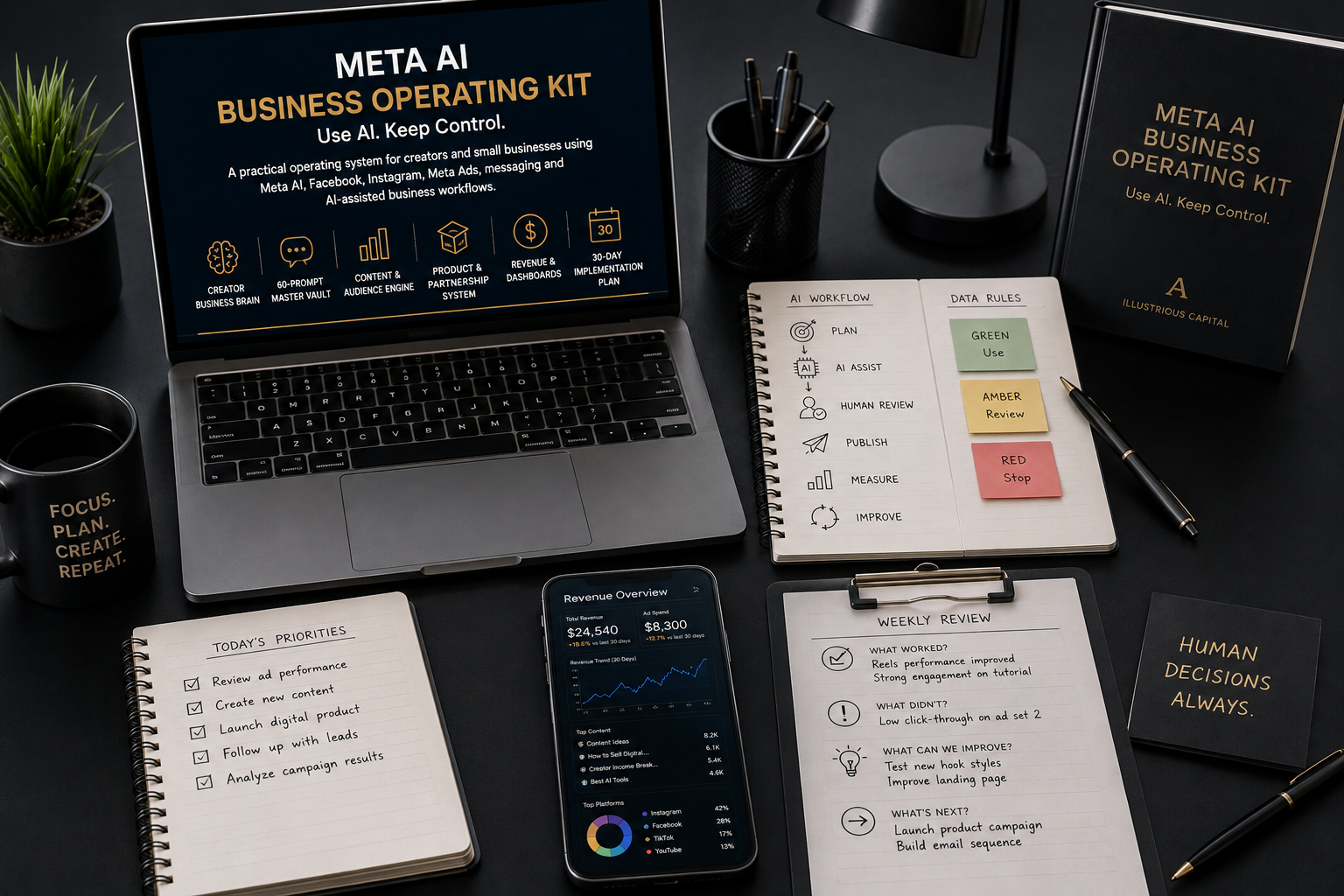
How to Use Meta AI for Business Without Losing Control
AI can make everyday business work faster.
It can help analyze content performance, organize campaign data, generate creative ideas, summarize customer questions, plan social calendars, prepare reports and support decision-making.
For businesses already using Facebook, Instagram, Meta Ads, Messenger or WhatsApp, Meta AI may become part of that workflow.
But there is an important difference between using AI and operating with AI responsibly.
The question is not simply:
What can AI do for my business?
A better question is:
What should AI be allowed to do, what information should it receive, what must be verified, and which decisions must remain human?
That is where an AI operating system becomes valuable.
What Is Meta AI for Business?
For practical business use, Meta AI can be thought of as part of a broader collection of AI-assisted workflows involving Meta-related tools and channels.
These may include:
- Facebook professional accounts
- Instagram professional accounts
- Meta Ads
- Messenger
- WhatsApp Business
- Meta Business Suite
- Meta AI
- Other approved business tools
The exact features available can change over time, so businesses should verify current platform capabilities before relying on them.
The bigger opportunity is not one individual feature.
It is using AI systematically across real business processes.
Step 1: Map Your Meta Business Environment
Before automating anything, document what is already connected.
Ask:
- Which Facebook and Instagram accounts are used for business?
- Who manages them?
- Is Meta Ads data used in AI-assisted analysis?
- Are customer messages handled with AI assistance?
- Which team members use AI?
- Which other tools connect to these workflows?
This gives you a clearer picture of where AI already touches the business.
Without that map, automation can expand faster than accountability.
Step 2: Identify the Human Owner
Every AI-assisted business workflow should have a human owner.
For each workflow, document:
- Person or role responsible
- How AI is used
- Whether AI can publish or act
- Who reviews the output
If nobody can clearly identify the human responsible for a workflow, that workflow is not ready for greater autonomy.
AI may assist the work.
A person should still own the outcome.
Step 3: Create Data Boundaries
One of the most important questions in business AI is:
What information are we comfortable giving the system?
A practical way to organize data is through three categories.
GREEN — Routine Approved Inputs
Examples may include:
- Public product information
- Published content
- Approved brand guidance
- Public business facts
These are lower-risk inputs your business has specifically approved for use.
AMBER — Review Before Use
Examples may include:
- Unpublished campaigns
- Internal strategy
- Customer communications
- Client materials
- Contracts
- Employee information
- Detailed performance data
These may be appropriate in some situations, but should receive review first.
RED — Stop Without Explicit Authorization
Examples may include:
- Passwords
- API keys
- Authentication codes
- Payment credentials
- Highly sensitive customer information
- Confidential third-party information you are not authorized to disclose
The point is not that every organization must classify every data type identically.
The point is to make the decision intentionally instead of guessing each time.
Step 4: Run a Pre-Share Data Check
Before sending information into an AI workflow, ask:
- Do I know exactly what I am providing?
- Am I authorized to use it for this purpose?
- Did I check for passwords, keys or credentials?
- Did I check for customer or client confidentiality?
- Does a contract restrict disclosure?
- Do I know which AI service will receive the information?
- Does this require human approval?
- Can unnecessary sensitive information be removed?
If the information falls into your RED category—or you are unsure whether you are authorized to share it—the workflow should stop until the responsible person reviews it.
Step 5: Build Repeatable Workflows Instead of Random Prompts
Random prompting can be useful for brainstorming.
But business operations work better when the process is repeatable.
A structured AI workflow should define:
- Workflow name
- Business objective
- Approved inputs
- What AI should do
- What AI must not assume or do
- Human verification required
- Final human decision or owner
This is much stronger than simply asking AI to 'help with marketing.'
The workflow itself becomes understandable, reviewable and improvable.
Step 6: Use AI for Weekly Marketing Reviews
One useful workflow is a weekly marketing review.
Provide approved engagement and campaign data.
Ask AI to:
- Identify observable patterns
- Separate facts from hypotheses
- Highlight unusual movement
- Recommend a small number of tests
Then verify:
- Reporting period
- Metrics
- Attribution
- Any causal claims
AI can suggest that one type of post appears to outperform another.
It should not confidently claim why people behaved that way unless the evidence actually supports the conclusion.
Step 7: Diagnose Content Performance
AI can also help compare posts or campaigns.
Provide:
- Performance metrics
- Creative format
- Topic
- Hook
- CTA
- Publishing context
Then ask it to identify differences.
Useful questions include:
- Which formats performed differently?
- Which hooks may deserve another test?
- Which posts produced more saves or shares?
- Which posts produced clicks?
- Are there obvious differences in timing or topic?
Avoid allowing AI to invent audience motives.
A post receiving more engagement does not prove exactly why people engaged.
Step 8: Turn Audience Data Into Better Questions
AI can help organize approved audience analytics and identify observable patterns.
That can generate better business questions such as:
- Which topics consistently receive more attention?
- Which formats generate conversation?
- What frequently appears in comments?
- What information is missing?
- Which assumptions should be tested?
Avoid unsupported inference about sensitive personal traits.
The goal is better analysis, not false certainty.
Step 9: Use AI for Competitive Content Scans
Businesses can use public competitor content as an input for structured analysis.
AI can help summarize:
- Repeated themes
- Content formats
- Messaging patterns
- Positioning differences
- Visible gaps
Then humans should verify:
- Which competitors were included
- Whether the comparison is current
- Whether important context is missing
The objective should not be copying competitors.
It should be understanding the public market more clearly.
Step 10: Audit Meta Ad Campaigns
AI can assist with campaign reviews when the inputs are verified.
Provide:
- Campaign objective
- Spend
- Creative
- Audience configuration
- Conversion definition
- Performance metrics
AI can help identify:
- Strengths
- Weaknesses
- Possible next tests
- Questions requiring investigation
Human reviewers should still verify spend, attribution and conversion definitions before conclusions are used to make business decisions.
Step 11: Review Advertising Claims
AI-generated advertising copy should not automatically become publishable advertising.
Review claims involving:
- Results
- Savings
- Performance
- Testimonials
- Comparisons
- Guarantees
- Product benefits
AI can flag unsupported or ambiguous claims.
Humans should approve material public claims before publication.
This matters because confident writing is not the same thing as verified writing.
Step 12: Use AI for Creative Brainstorming
Creative brainstorming is a relatively natural AI use case.
Provide:
- Brand guidance
- Audience brief
- Offer information
- Campaign goal
Then request several different concepts.
Treat those concepts as creative options—not as verified final advertising statements.
Humans should still review:
- Brand fit
- Rights
- Feasibility
- Claims
- Audience appropriateness
Step 13: Build Product Launch Plans
AI can help organize a launch across:
- Organic content
- Paid advertising
- Email or messaging
- Follow-up
- Owners
- Dependencies
- Dates
Before execution, verify:
- Pricing
- Dates
- Product availability
- Offer details
- Promises
A beautiful AI-generated launch plan built on the wrong price or date is still a bad launch plan.
Step 14: Create a Weekly CEO Brief
AI can help turn approved business performance data into a concise executive review.
The most useful structure separates:
- Facts
- Estimates
- Recommendations
For example:
Fact: Instagram reach increased 18% this week.
Estimate: The increase may be related to a higher publishing frequency.
Recommendation: Test the same frequency for two more weeks before changing the strategy permanently.
Those are three different statements.
Keeping them separate helps reduce false certainty.
Step 15: Analyze Customer Questions Carefully
Approved customer-message data can help identify recurring themes.
AI may help:
- Cluster repeated questions
- Find FAQ gaps
- Identify confusing policies
- Suggest content topics
Before using customer communications as input, remove unnecessary personal information.
The objective is understanding recurring business questions—not unnecessarily exposing customer data.
Step 16: Build Customer FAQs From Verified Facts
AI can draft customer FAQs using approved product and policy information.
That can include:
- Product questions
- Shipping or delivery
- Refund policy
- Account questions
- Service terms
- Escalation triggers
Humans should verify:
- Promises
- Refund terms
- Exceptions
- Edge cases
AI should never quietly expand the business's actual policy.
Step 17: Create Social Media Calendars
AI can help turn approved themes and business goals into a balanced publishing calendar.
For each post, define:
- Purpose
- Platform
- Topic
- Format
- CTA
- Date
Then confirm that the schedule fits the team's actual capacity.
There is little value in generating 90 pieces of content that nobody has time to produce.
Step 18: Use AI for Brand Consistency
Provide approved brand guidelines and draft content.
Ask AI to identify possible inconsistencies involving:
- Tone
- Vocabulary
- Positioning
- Message
- Audience fit
The AI can flag differences.
A human decides whether the difference is actually a problem or an intentional exception.
Step 19: Analyze Comments Without Overgeneralizing
Comment analysis can help reveal recurring questions, sentiment and themes.
Use an approved or minimized comment set.
AI can summarize patterns cautiously.
But do not assume a few loud commenters represent the entire audience.
Qualitative feedback is useful when treated as evidence with limits.
Step 20: Use AI for Research Synthesis
AI can help organize multiple verified sources.
A strong research workflow should distinguish:
- What the sources actually say
- What remains uncertain
- What the AI is inferring
Important sources should still be opened and verified by a human before high-impact decisions or public claims rely on them.
Step 21: Build Measurable Marketing Experiments
Instead of asking AI to 'improve our marketing,' use it to design controlled experiments.
Define:
- Goal
- Baseline
- Constraint
- Hypothesis
- Variable
- Success metric
For example:
Hypothesis: Shorter opening hooks will improve Reel completion rate.
Variable: First three seconds.
Success metric: Completion rate after a defined sample period.
Small, measurable tests produce more useful learning than vague optimization.
Step 22: Plan Influencer Campaigns
AI can also help organize creator partnerships.
Using approved briefs and contract constraints, it can help structure:
- Deliverables
- Timeline
- Review points
- Content requirements
Humans should verify:
- Disclosure requirements
- Usage rights
- Contract terms
- Public claims
That is especially important when creator content will be used beyond the creator's own channel.
Step 23: Repurpose Approved Content
AI can help adapt one approved source asset into:
- Reels
- Captions
- Stories
- Carousels
- FAQs
- Short summaries
The goal should be preserving meaning while adapting format.
Claims should be checked again after editing because shortening or rewriting can accidentally change what the original statement actually meant.
Step 24: Build Human-Approved Lead Follow-Up
AI can draft follow-up sequences from approved lead information and offer facts.
It can help determine:
- Sequence
- Timing suggestions
- Draft messages
- Escalation logic
But external communication should follow the authority assigned by the business.
If human approval is required, the system should not bypass it simply because automation is technically possible.
Step 25: Prepare Customer Support Responses
AI can help draft standard response patterns and escalation rules using approved FAQ and policy information.
It should flag exceptions instead of inventing a solution.
One important principle is:
No autonomous promises beyond approved authority.
If a refund, credit, exception or contractual promise requires authorization, AI should not create that authorization for itself.
Step 26: Conduct Weekly and Monthly Business Reviews
AI can help summarize verified metrics consistently.
A weekly review might examine:
- Marketing
- Sales
- Customer activity
- Campaigns
- Content
- Open issues
A monthly management review may examine:
- Results
- Risks
- Decisions
- Opportunities
- Priorities
The AI can organize the information.
Humans still own the final decisions.
Step 27: Use AI to Generate Growth Hypotheses
AI can help rank potential growth opportunities using approved performance and market inputs.
For example:
- New content formats
- New offers
- Different audience segments
- New partnerships
- Better follow-up
- Campaign experiments
Ask AI to rank ideas by evidence and effort.
Do not present forecasts as guarantees.
A growth hypothesis is something to test—not a promise about the future.
Step 28: Build a Controlled 90-Day Marketing Plan
AI can help translate goals into a phased 90-day marketing plan.
Provide:
- Business goals
- Budget boundaries
- Approved offers
- Team capacity
- Existing channels
Ask for:
- Phases
- Owners
- Metrics
- Review gates
- Dependencies
Human approval should remain required for spending and material public claims.
Step 29: Verify Before Publishing
One of the most important operating rules is simple:
AI output is draft material until the business verifies what matters.
Before publication, review:
- Facts
- Statistics
- Claims
- Prices
- Dates
- Links
- Rights
- Privacy
- Brand fit
- Required disclosures
The faster AI can generate material, the more important a reliable review process becomes.
Step 30: Separate AI Assistance From Business Authority
AI can help:
- Analyze
- Draft
- Compare
- Summarize
- Organize
- Recommend
Those capabilities do not automatically mean AI should:
- Publish
- Spend money
- Make contractual commitments
- Approve refunds
- Send sensitive communications
- Change policy
- Make high-impact business decisions
Authority should be explicitly assigned.
A Better Operating Model: MAP, BOUND, WORK, VERIFY, AUTHORIZE, IMPROVE
A useful way to organize business AI is through six stages:
MAP
Identify accounts, tools, connections and people.
BOUND
Decide which information and actions are acceptable.
WORK
Create repeatable workflows instead of improvising.
VERIFY
Check claims, facts, privacy, rights and brand fit.
AUTHORIZE
Define what AI may do and what humans must approve.
IMPROVE
Record mistakes, lessons and policy changes.
This creates an operating loop instead of a collection of random AI experiments.
Use AI. Keep Control.
The most valuable AI system is not necessarily the one that automates the most work.
It is the one that helps a business move faster without losing ownership, judgment, verification or accountability.
That means understanding what is connected.
Knowing what information is safe to use.
Building repeatable workflows.
Checking important output.
Defining human authority.
And improving the system when something goes wrong.
Build Your Meta AI Business Operating System
The Meta AI Business Operating Kit is designed as a practical interactive operating system for creators and small businesses using Meta AI, Facebook, Instagram, Meta Ads, messaging and AI-assisted business workflows.
It helps businesses organize areas such as:
- Business readiness
- Account and tool mapping
- People and responsibility
- GREEN / AMBER / RED data rules
- Pre-share data checks
- Repeatable AI workflows
- Marketing reviews
- Campaign audits
- Ad creative review
- Product launch planning
- Customer question analysis
- Social calendar planning
- Brand consistency
- Research synthesis
- Influencer campaigns
- Lead follow-up
- Customer support preparation
- Weekly and monthly management reviews
- Growth opportunity analysis
- Human review and claim control
The philosophy is simple:
Use AI. Keep Control.
Because the goal is not to remove humans from the business.
It is to help humans operate the business more effectively with AI.
Enjoying the Academy?
Join AurumVault Insider for new practical guides, digital tools, and marketplace releases.
No spam. Unsubscribe anytime. Privacy
By subscribing, you agree to receive AurumVault Insider emails. You can unsubscribe at any time.
Continue your journey
Keep reading
Athlete Endorsement Deals: Protect Your Rights & Brand
A professional athlete's commercial value extends far beyond a playing contract. Learn how to organize name, likeness, voice, content, endorsements, licensing, paid media, group rights, AI permissions, exclusivity and post-career assets before granting another company access to your identity.
How to Turn Content Creation Into a Real Business: A Digital Creator Operating System
Successful creators do more than publish content. They build systems around their audience, offers, products, partnerships, revenue, and operations. This guide explains how to start turning your creative work into a more organized and sustainable business.
How to Create a Reality Show: From Idea to Pitch
A reality show needs more than interesting people and cameras. Learn how to develop the premise, format, cast, story engine, episodes, production plan, sizzle reel, pitch package and commercial strategy behind a professional unscripted property.