
50 Business Words for Kids: A Simple First Business Dictionary
Children hear words like profit, budget, marketing, investment and negotiation all the time, but those ideas can feel complicated. This guide explains 50 important business concepts in simple language and shows how learning them can help kids understand money, entrepreneurship, customers, leadership and problem-solving.
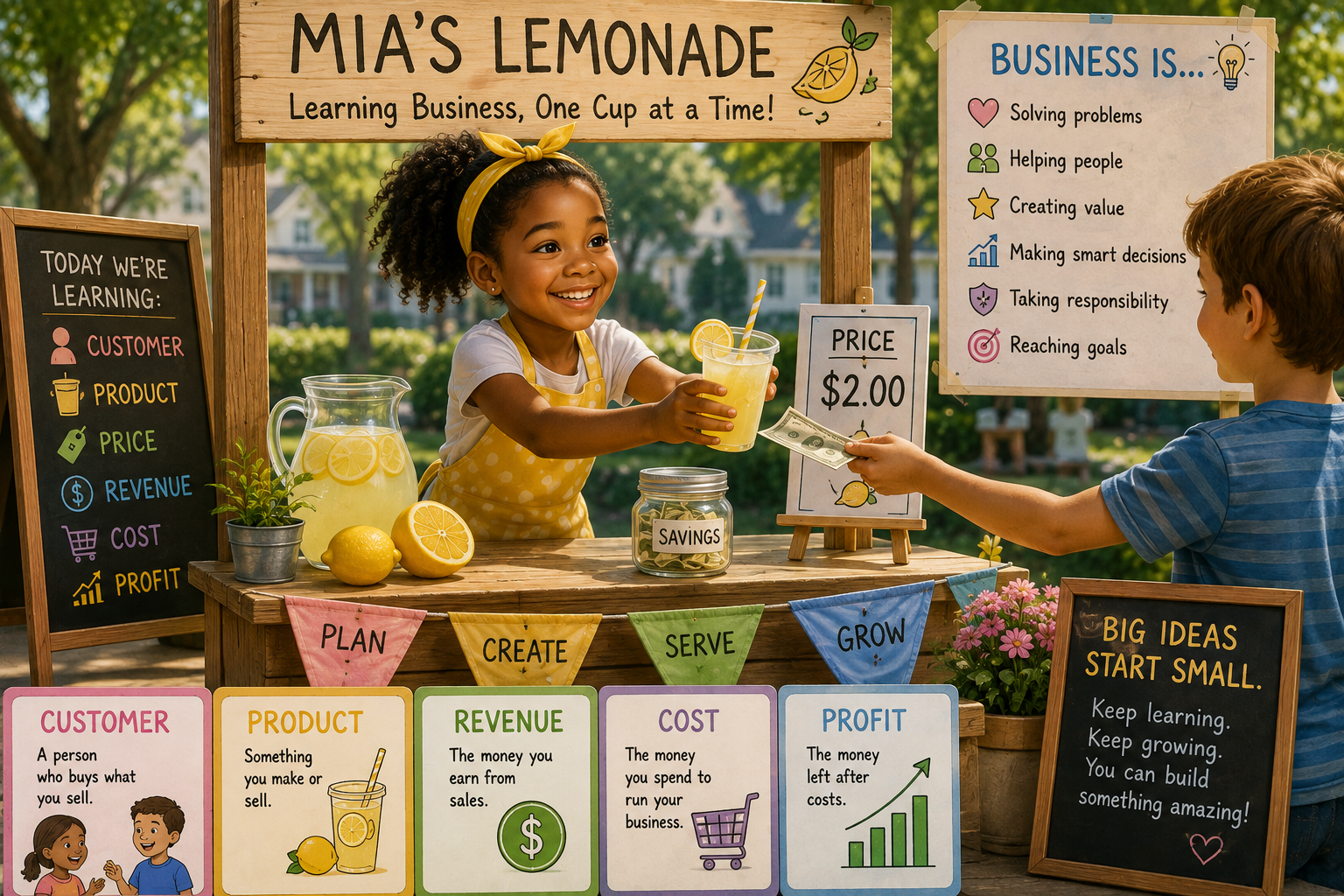
50 Business Words for Kids: A Simple First Business Dictionary
Children are surrounded by business every day.
They see stores.
They see advertisements.
They watch people buy products online.
They hear adults talk about prices, jobs, money, companies and customers.
Yet many children reach their teenage years without understanding the basic language behind how businesses actually work.
Words such as revenue, profit, marketing, budget, investment, negotiation and cash flow may sound advanced, but the ideas behind them can be taught in simple, practical ways.
That matters because business vocabulary is not only for future CEOs.
It helps children understand:
- How money moves
- Why businesses charge prices
- Why customers matter
- How products and services are created
- Why planning is important
- How teamwork works
- How risk and opportunity are different
- How online stores operate
- Why good leadership matters
The earlier children understand these ideas, the easier it becomes for them to think critically about money, work, problem-solving and entrepreneurship.
Why Teach Business Vocabulary to Kids?
Business education can help children connect everyday experiences with larger ideas.
A lemonade stand can teach:
- Product
- Price
- Customer
- Revenue
- Cost
- Profit
- Value
A school fundraiser can teach:
- Goal
- Budget
- Teamwork
- Marketing
- Responsibility
An online shop can teach:
- Website
- Online store
- Delivery
- Quality
- Customer service
The goal is not to turn childhood into a business seminar.
It is to give children useful language for concepts they already encounter.
1. Business
A business is work that provides products or services to people in exchange for money.
A lemonade stand is a simple example.
The seller provides something useful or enjoyable, and customers choose whether to buy it.
A helpful question for children is:
What useful problem could this business solve?
That question introduces one of the most important ideas in entrepreneurship: businesses create value by helping people in some way.
2. Entrepreneur
An entrepreneur is a person who starts and runs a business and takes responsibility for its ideas, decisions, risks and rewards.
Kids can think of an entrepreneur as a builder.
The entrepreneur takes an idea and turns it into something real.
That might be a lemonade stand, lawn-care service, handmade bracelet shop or digital project.
3. Customer
A customer is a person who buys a product or service from a business.
Customers are important because businesses exist to serve people.
Children can learn that listening to customers helps a business improve.
Questions, complaints, reviews and feedback can all teach the business what people need.
4. Product
A product is something a business makes or sells for people to buy or use.
Examples include:
- Books
- Toys
- Clothing
- Food
- Digital downloads
- School supplies
A good product should be useful, dependable and worth its price.
5. Service
A service is work performed to help someone or complete a task for them.
Examples can include:
- Tutoring
- Cleaning
- Designing
- Repairing
- Pet sitting
- Lawn care
Teaching this difference helps children understand that businesses do not always sell physical things.
Sometimes they sell skills and time.
6. Revenue
Revenue is all the money a business receives from sales before costs are subtracted.
If a child sells ten cups of lemonade for $2 each, the business receives $20 in revenue.
But that does not mean the business earned $20 in profit.
That distinction is important.
7. Cost
A cost is money spent to make, buy or provide a product or service.
For a lemonade stand, costs might include:
- Lemons
- Sugar
- Cups
- Ice
- Signs
Teaching children to track costs helps them understand why a selling price must be high enough to cover what the business spends.
8. Profit
Profit is the money left after costs are subtracted from revenue.
A simple formula is:
Revenue - Costs = Profit
If revenue is $20 and costs are $8, the profit is $12.
This helps children see why strong sales do not automatically mean strong profit.
9. Price
Price is the amount of money a customer pays for a product or service.
A price should make sense for both the customer and the business.
It needs to be high enough to cover costs while still offering fair value.
10. Value
Value describes how useful, enjoyable, helpful or important something feels to a customer.
Children can think of value by asking:
Is this worth what I am paying for it?
Businesses grow by creating real value, not simply by charging higher prices.
11. Advertising
Advertising means telling people about a business, product or service to get attention and encourage interest.
A sign outside a lemonade stand is advertising.
So is an online video showing a product.
Good advertising should be truthful and easy to understand.
12. Marketing
Marketing is broader than advertising.
It includes understanding customers and helping the right people discover and choose what a business offers.
Marketing asks:
- Who is the customer?
- What do they need?
- What message will make sense to them?
- Where should the business reach them?
13. Inventory
Inventory is the products and supplies a business has ready to sell or use.
For a lemonade stand, inventory might include lemons, cups, sugar and napkins.
If inventory runs out, the business may not be able to serve customers.
14. Expense
An expense is money a business spends to operate.
Businesses have to keep track of expenses so they understand where their money is going.
This can introduce children to basic recordkeeping.
15. Budget
A budget is a plan for how money will be spent, saved and used toward goals.
A budget works like a road map for money.
It helps decide what needs to be paid first and what can wait.
16. Supplier
A supplier is a person or business that provides materials or products another business needs.
A lemonade business might buy lemons and cups from a supplier.
Reliable suppliers help businesses maintain quality and avoid running out of important materials.
17. Sale
A sale happens when a customer buys a product or service.
It represents the moment someone decides the offer is worth paying for.
18. Cash Flow
Cash flow is the movement of money coming into and going out of a business.
Children can picture it like water moving through pipes.
A business needs enough money coming in to handle what is going out.
19. Break-Even
Break-even is the point where total revenue equals total costs.
At break-even, the business has covered its costs but has not yet made extra profit.
This is a powerful early business concept because it helps children understand how much must be sold before a business truly starts earning.
20. Innovation
Innovation means creating or trying a new idea that improves a product, service or way of working.
A lemonade stand might test a new flavor or a better ordering system.
Innovation begins with asking:
How could this be better, easier or more useful?
21. Brand
A brand is the name, look, feeling and reputation people remember about a business.
It is like a business personality.
Children can learn that brand is much more than a logo.
It also includes how customers feel about the business.
22. Logo
A logo is a symbol or design used to represent a business or brand.
A strong logo should be recognizable and clear, even when it is small.
23. Target Customer
A target customer is the kind of person a business most wants to serve.
Businesses do not have to sell to everyone.
Knowing the target customer helps determine what to make and how to explain it.
24. Order
An order is a request from a customer to buy a specific product or service.
Clear orders help businesses give customers exactly what they asked for.
25. Delivery
Delivery means getting a purchased product or completed order to the customer.
Good delivery means providing the right item, at the right time and in good condition.
26. Quality
Quality describes how well a product or service is made and how reliably it does what it should.
Consistent quality helps build customer trust.
27. Review
A review is an opinion a customer shares about their experience with a product or business.
Reviews can show both what a business does well and what it needs to improve.
28. Feedback
Feedback is advice, comments or information people provide to help something improve.
Kids can learn that helpful feedback is information—not an insult.
29. Loyalty
Customer loyalty means people continue choosing a business because they trust and value it.
Good service and consistent quality can encourage customers to return.
30. Refund
A refund is money returned to a customer after a purchase is canceled or a problem needs to be corrected.
A fair refund policy can help protect customer trust.
31. Savings
Savings is money set aside now so it can be used later.
Saving part of what is earned teaches planning and patience.
32. Goal
A goal is something specific a person plans to achieve.
Children can learn to break large goals into smaller measurable steps.
33. Loan
A loan is money borrowed with a promise to pay it back under agreed terms.
The important lesson is responsibility.
Borrowed money must be repaid.
34. Interest
Interest is extra money paid for borrowing money, or money earned on certain savings and investments.
This concept helps children understand that borrowing often costs more than the original amount received.
35. Investment
An investment is money or resources put into something with the hope that it will create more value in the future.
Investments can support growth, but outcomes are never guaranteed.
36. Risk
Risk is the chance that something may not go as planned and could cause a loss.
Children can learn to ask:
- What could go wrong?
- How likely is it?
- What could I do about it?
37. Opportunity
An opportunity is a useful chance to do something that may help someone grow or solve a problem.
Many business opportunities begin by noticing what people need.
38. Competition
Competition means other businesses are trying to serve some of the same customers or sell similar products.
Competition does not have to be feared.
Businesses can learn from competitors without copying them.
39. Strategy
A strategy is a plan for how to reach a goal.
A strategy connects everyday actions with a larger destination.
40. Expansion
Expansion means making a business larger by serving more customers, offering more products or operating in more places.
A useful lesson for kids is that growth should happen only as fast as quality and systems can support it.
41. Teamwork
Teamwork means people combining their skills and effort to reach a shared goal.
Strong teams communicate, help one another and keep their promises.
42. Responsibility
Responsibility means doing what you are supposed to do and being dependable.
In business, people need to be able to count on one another.
43. Problem-Solving
Problem-solving means finding useful ways to understand and fix a challenge.
Problems can reveal exactly where a business has an opportunity to improve.
44. Time Management
Time management means planning how to use time so important work gets done.
Kids can practice this by deciding which task needs to happen first.
45. Leadership
Leadership means guiding and encouraging people toward a shared goal.
Strong leaders listen, communicate clearly and set a good example.
46. Negotiation
Negotiation is a discussion in which people try to reach an agreement that works for everyone involved.
Children can learn three valuable negotiation habits:
- Know what matters most
- Ask questions
- Listen before agreeing
47. Partnership
A partnership is an arrangement where two or more people work together and share business responsibilities or ownership.
Good partnerships require trust, clear roles and honest communication.
48. Website
A website is a group of internet pages where people can learn about a person, organization or business.
Children can think of it as a business's online home.
A useful website should be clear, trustworthy and easy to navigate.
49. Online Store
An online store is a digital shop where customers can buy products or services over the internet.
Even digital shops still need:
- Clear prices
- Good customer service
- Secure payments
- Accurate product information
50. Success
Success means reaching meaningful goals through learning, effort, good decisions and persistence.
It is important for children to understand that success is not one perfect moment.
It is progress built one good step at a time.
The Bigger Lesson: Business Is About Solving Problems and Creating Value
When children first hear the word business, they may think only about money.
But business education can teach much more.
It can teach children to:
- Solve problems
- Serve people
- Plan ahead
- Manage resources
- Communicate
- Lead
- Listen
- Take responsibility
- Learn from mistakes
- Make thoughtful decisions
Those skills remain valuable whether a child becomes an entrepreneur, employee, artist, engineer, teacher, doctor or something entirely different.
Make Business Vocabulary Easier With My First Business Dictionary
My First Business Dictionary: 50 Business Words Made Simple for Kids introduces young readers to business through the character Mia as she learns how businesses work—from serving her first customer to building a brand, managing money, leading a team and selling online. 1
The book is organized into five learning areas:
- Building a Business
- Growing a Business
- Serving Customers
- Money and Growth
- Leading and Succeeding
Together they cover 50 foundational terms ranging from Business, Entrepreneur and Customer to Profit, Budget, Cash Flow, Investment, Leadership, Negotiation, Website and Online Store. 2
Each term includes a clear definition, a matching Mia illustration, a familiar Think of it like... comparison, an explanation of what the picture teaches, and a practical Business Smart Tip. 3
The message for young readers is simple:
Big ideas start small.
Learning the language of business can be one of those small first steps.
Enjoying the Academy?
Join AurumVault Insider for new practical guides, digital tools, and marketplace releases.
No spam. Unsubscribe anytime. Privacy
By subscribing, you agree to receive AurumVault Insider emails. You can unsubscribe at any time.
Continue your journey
Keep reading
Financial Literacy for Kids: What Everybody's Rich Except Me Teaches About Money
Everybody's Rich Except Me follows eleven-year-old Mateo Rivera as he becomes convinced that everyone around him is richer than he is. Through sneakers, social media, a small snack business, debt, saving and everyday financial choices, Mateo discovers that looking wealthy and being financially secure are very different things.
Best Digital Products to Sell in 2026: 25 High-Demand Ideas
Digital products remain one of the most accessible ways to build an online income stream because they can be created once, improved over time and sold repeatedly without physical inventory. These 25 ideas focus on practical, useful products buyers are actively seeking across business, personal finance, content creation, planning, AI, education and lifestyle markets.
Film Distribution Deliverables Checklist: Get Buyer-Ready
Finishing your edit does not automatically mean your film is ready for distribution. Learn how to assess rights, picture masters, audio, captions, music, metadata, sales assets and diligence documents before entering serious buyer conversations.