
Financial Literacy for Kids: What Everybody's Rich Except Me Teaches About Money
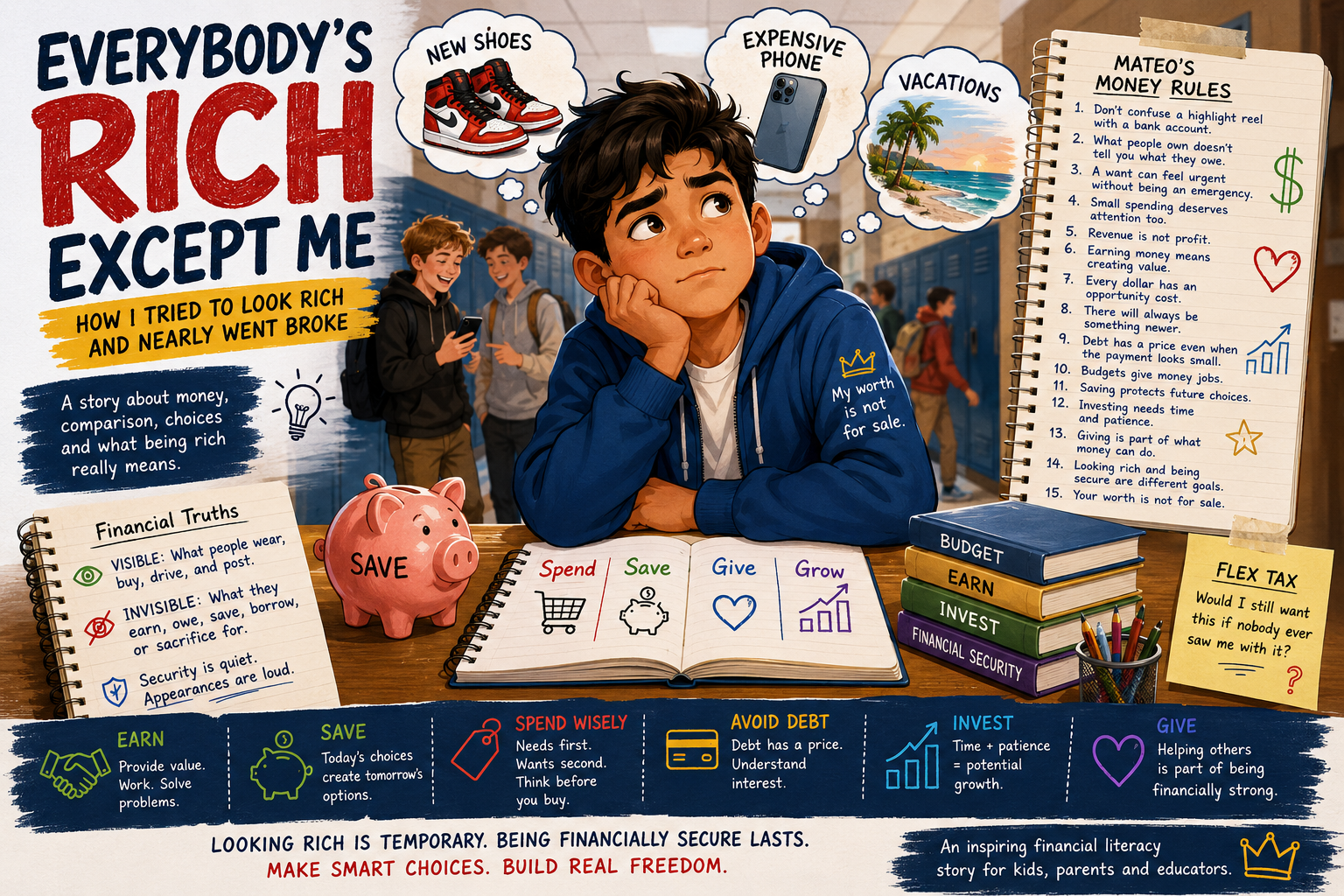
Everybody's Rich Except Me follows eleven-year-old Mateo Rivera as he becomes convinced that everyone around him is richer than he is. Through sneakers, social media, a small snack business, debt, saving and everyday financial choices, Mateo discovers that looking wealthy and being financially secure are very different things.
Financial Literacy for Kids: What Everybody's Rich Except Me Teaches About Money
Kids notice money long before adults may realize it.
They notice who has the newest shoes.
They notice expensive phones.
They notice vacations, gaming rooms, clothes, restaurants and everything their friends post online.
What they usually cannot see is the rest of the financial picture.
They do not know what someone owes.
They do not know whether something was purchased on credit, received as a gift, bought secondhand or saved for over several months.
They do not know whether a family with expensive possessions also feels financial pressure behind closed doors.
That gap between what children can see and what they actually know sits at the center of Everybody's Rich Except Me: How I Tried to Look Rich and Nearly Went Broke.
The illustrated story follows eleven-year-old Mateo Rivera, a funny, observant and competitive middle-school student who suddenly becomes convinced that almost everyone around him is richer than he is.
His journey offers an entertaining way to introduce financial literacy for kids without turning money education into a textbook.
Why Financial Literacy Matters for Kids
Financial literacy is not simply teaching children how to count money.
It can include helping them understand:
- Wants versus needs
- Saving
- Spending
- Budgeting
- Debt
- Interest
- Opportunity cost
- Entrepreneurship
- Profit
- Investing
- Giving
- Social comparison
- Financial security
The earlier children begin understanding these ideas, the more prepared they can become to make thoughtful financial choices as they grow.
Meet Mateo Rivera
At the beginning of the story, Mateo does not think his sneakers are a problem.
Then another student comments on them at school.
Within minutes, Mateo begins noticing everything around him.
Expensive shoes.
New phones.
Premium headphones.
Restaurant breakfasts.
Suddenly, ordinary possessions start looking inadequate.
Mateo reaches what seems to him like an obvious conclusion:
Everybody is rich except me.
The problem is that Mateo is judging financial lives almost entirely through visible possessions.
Lesson 1: A Possession Is Not Proof of Wealth
One of Mateo's earliest discoveries is that visible possessions provide incomplete information.
Someone may own an expensive pair of shoes, but Mateo cannot tell by looking whether those shoes were:
- A birthday gift
- Bought on sale
- Saved for
- Purchased using credit
- Borrowed
- Part of a payment plan
The book summarizes the distinction clearly: visible evidence includes what people wear, buy, drive and post, while invisible information includes what they earn, owe, save, receive as gifts, borrow or sacrifice for. 1
This creates an important financial-literacy lesson:
What someone owns tells you very little about their entire financial life.
Lesson 2: Social Media Is a Highlight Reel
Mateo's comparison problem becomes worse when he begins scrolling through social media.
He sees pools, vacations, new cars, expensive bedrooms, shoes and phones.
Within an hour, his perfectly normal bedroom begins to feel inadequate.
This illustrates how social media can distort financial perception.
People often post the exciting purchase or vacation rather than the saving, borrowing, budgeting or financial tradeoffs behind it.
Children can benefit from learning that a social-media feed is not a complete financial statement.
A photograph can show the vacation.
It cannot show the months someone saved for it.
Lesson 3: Wants Can Feel Like Emergencies
One of the challenges of growing up in a consumer culture is that wanting something can feel urgent.
A new pair of shoes may suddenly seem essential because friends have them.
A newer phone can feel necessary because an older model appears outdated.
Children can learn to pause and ask:
- Is this broken?
- Do I actually need it?
- Is it preventing me from doing something important?
- Or am I comparing myself with someone else?
That pause can create space between desire and spending.
Lesson 4: Small Spending Still Counts
Financial decisions are not limited to large purchases.
Snacks, drinks, apps, games and small impulse purchases can add up.
A useful exercise for children is tracking small purchases for a week and calculating the total.
The purpose is not to make children afraid of spending.
It is to teach awareness.
Money becomes easier to manage when you know where it is going.
Lesson 5: Revenue Is Not Profit
Mateo eventually experiments with entrepreneurship through a small snack business.
He buys inventory, sets prices and makes sales.
But he learns that money coming in is not automatically money earned.
Revenue is the money a business receives.
Costs are what the business spends to create or purchase what it sells.
Profit is what remains after those costs.
Mateo ultimately earns a modest profit from the experiment and begins understanding that money can be created by providing something other people value. 2
Lesson 6: Entrepreneurship Means Creating Value
After his first business experiment ends, Mateo finds other ways to earn money.
He washes a car.
He helps a neighbor move boxes.
He organizes a garage.
He creates a flyer for a youth basketball clinic using his graphic-design skills.
Different tasks produce money because each provides value to someone else.
This helps children understand entrepreneurship beyond the idea of simply getting rich.
Entrepreneurship can involve:
- Solving a problem
- Providing a service
- Creating something useful
- Accepting responsibility
- Managing resources
- Learning from mistakes
Lesson 7: Earning Changes How Spending Feels
When Mateo begins earning his own money, prices start looking different.
A $20 purchase is no longer just $20.
It might represent nearly two hours of work.
A $60 video game can represent several small jobs.
This introduces opportunity cost.
When you spend money on one thing, you give up the opportunity to use that same money for something else.
The book encourages readers to translate large purchases into hours of work or weeks of saving because the true cost can become easier to understand that way. 3
Lesson 8: Lifestyle Inflation Can Move the Finish Line
Mateo eventually buys a good pair of sneakers on sale.
Instead of feeling completely satisfied, something unexpected happens.
Suddenly his backpack looks old.
Then his headphones look outdated.
Then his phone case.
Then his hoodie.
Nothing about those items has actually changed.
His expectations have changed.
This introduces children to the idea of lifestyle inflation: when one upgrade makes everything else feel inadequate and raises the definition of what seems normal.
Mateo realizes he does not have a broken-item problem.
He has a comparison problem. 4
Lesson 9: Debt Is Often Invisible
Mateo later learns about credit cards and debt after overhearing his parents discussing bills.
He discovers that people can possess expensive things before those things have been fully paid for.
A car, phone or piece of furniture might look like evidence of wealth even while payments remain.
The book explains that debt is money owed and interest is the cost of borrowing.
It also teaches an important distinction:
Being able to make a monthly payment is not necessarily the same as comfortably affording the total cost. 5
Lesson 10: Comparison Can Hurt Both People
One of the more surprising moments occurs when Mateo finally visits Jayden's house.
Mateo had built an imaginary financial biography for Jayden based almost entirely on shoes, a phone and social-media impressions.
He discovers that Jayden's family is also dealing with financial pressure.
Some of the expensive items Mateo assumed proved wealth were gifts, upgrades or purchases Jayden had saved for.
Even more importantly, Mateo realizes Jayden had been performing too.
Mateo wanted expensive shoes so others would think he belonged.
Jayden teased Mateo about his shoes partly because other students were watching.
Different performance.
Same audience.
The lesson becomes larger than money:
Treat people like people, not evidence about wealth. 6
Lesson 11: Give Money a Job
Children often hear the word budget and imagine restriction.
But a budget can be taught differently.
A budget simply gives money a purpose before it disappears.
Categories might include:
- Spend
- Save
- Give
- Grow
This teaches that money can support both present enjoyment and future goals.
Lesson 12: Saving Buys Choices
Saving is sometimes explained to children as simply not spending.
A more useful way to frame it is that savings create future choices.
Savings can help with:
- Unexpected expenses
- Future purchases
- Opportunities
- Goals
- Emergencies
Money sitting quietly in savings may not look impressive online.
But its value becomes obvious when life becomes expensive.
Lesson 13: Investing Requires Time
Financial literacy also means understanding that building wealth does not usually happen instantly.
Investing requires patience and includes risk.
Children do not need complex investment strategies to understand the fundamental lesson:
Money has more time to potentially grow when long-term habits begin early.
The emphasis should remain on education, patience and appropriate adult guidance rather than promising returns.
Lesson 14: Giving Is Part of Money Too
The book does not treat money only as something to accumulate.
Money can also be used to help other people.
Teaching children about giving can reinforce the idea that money is a tool.
It can provide security and choices, but it can also create generosity and impact.
Lesson 15: Looking Rich and Being Secure Are Different Goals
This becomes one of Mateo's biggest discoveries.
Looking rich is visible.
Financial security is often invisible.
Looking rich may involve:
- Designer clothing
- Expensive cars
- New electronics
- Luxury vacations
Financial security may involve:
- Savings
- Bills being paid
- Manageable debt
- Emergency money
- Useful skills
- Financial plans
- The ability to handle unexpected expenses
When Mateo asks his father whether he would rather look rich or be secure, the answer is immediate: secure.
Mateo realizes that looking rich requires an audience, while security still works in an empty room. 7
Money Should Never Become a Scoreboard for Human Worth
The most important lesson in the story is not that money does not matter.
It does.
Money can provide food, housing, security, opportunity, generosity and choices.
What Mateo ultimately discovers is that money should not become a ranking system for human beings.
By the end of the story, he understands that expensive possessions do not automatically make one person more successful or valuable than another.
His final realization is simple:
My worth is not for sale.
Mateo's Final Money Rules
By the end of his journey, Mateo has developed a practical set of principles:
1. Never confuse somebody's highlight reel with their bank account.
2. What people own does not tell you what they owe.
3. A want can feel urgent without being an emergency.
4. Small spending deserves attention too.
5. Revenue is not profit.
6. Earning money means creating value.
7. Every dollar has an opportunity cost.
8. There will always be something newer.
9. Debt has a price even when the payment looks small.
10. Budgets give money jobs.
11. Saving protects future choices.
12. Investing needs time and patience.
13. Giving is part of what money can do.
14. Looking rich and being secure are different goals.
15. Your worth is not for sale.
These are the actual closing money principles Mateo develops through the story. 8
The Flex Tax
The book also introduces a simple idea called the Flex Tax.
Before purchasing something mainly to impress other people, ask:
Would I still want this if nobody ever saw me with it?
If the answer changes, part of the purchase may be driven by social pressure rather than genuine usefulness or enjoyment.
That question gives children a practical tool they can remember the next time comparison begins influencing a purchase.
Questions Parents Can Ask After Reading
Parents, teachers and caregivers can extend the lessons by discussing questions such as:
- What is the difference between a want and a need?
- Why can possessions be misleading?
- What does debt mean?
- Why does earned money sometimes feel different?
- What is profit?
- What does opportunity cost mean?
- What does financial security look like?
- How can social media influence spending?
- What does enough mean to you?
- What could you save for?
Financial education becomes more useful when children connect the concepts to everyday life.
Simple Money Activities for Kids
Families can also turn the story into practical activities.
Create Four Money Categories
Use jars, envelopes or a simple spreadsheet for:
Spend → Save → Give → Grow
Track One Week of Spending
Write down every purchase and calculate the total.
Calculate Opportunity Cost
Choose something the child wants and determine how many weeks of allowance, saving or work it would require.
Try a Small Business Project
Help the child identify:
- A customer
- A problem
- A useful product or service
- Costs
- Price
- Rules or permissions
Run the Flex Tax Test
Ask whether the child would still want a purchase if nobody else could see it.
Who Is Everybody's Rich Except Me For?
The book can be especially useful for middle-grade readers beginning to notice financial differences among classmates and online lifestyles.
It combines a fictional story with recurring Mateo's Money Notebook, Money Truth, Think About It and Money Move sections throughout its fifteen chapters. The chapter sequence covers comparison, sneakers, social media, spending, entrepreneurship, lifestyle inflation, debt, budgeting, saving and ultimately the difference between appearances and security. 9
An Illustrated Story About Money, Comparison and What Being Rich Really Means
Everybody's Rich Except Me: How I Tried to Look Rich and Nearly Went Broke follows Mateo Rivera as he moves from financial comparison toward financial understanding.
He does not finish the book as a millionaire.
That is not the point.
He finishes with something more useful for an eleven-year-old:
A better understanding of how money works.
He learns how to earn.
How to save.
How to question appearances.
How to recognize debt.
How to think about opportunity cost.
How to distinguish revenue from profit.
How to recognize lifestyle inflation.
And how to understand that financial progress does not need an audience.
The final money truth captures the larger lesson: money can create security, opportunity, generosity and choices, but it should never become the price tag on a person's worth. 10
Final Takeaway
Financial literacy for kids should not only teach children how money is counted.
It should teach them how money influences decisions, emotions, comparison and opportunity.
Children are growing up surrounded by advertising, influencers, payment plans and highly curated social-media lifestyles.
Giving them a framework for interpreting what they see can be just as valuable as teaching them how to save a dollar.
Everybody's Rich Except Me approaches those lessons through humor, story and Mateo Rivera's very expensive attempt to figure out who is actually rich.
And the answer turns out to be much more complicated than the shoes people wear.
Enjoying the Academy?
Join AurumVault Insider for new practical guides, digital tools, and marketplace releases.
No spam. Unsubscribe anytime. Privacy
By subscribing, you agree to receive AurumVault Insider emails. You can unsubscribe at any time.
Continue your journey
Keep reading
Best Digital Products to Sell in 2026: 25 High-Demand Ideas
Digital products remain one of the most accessible ways to build an online income stream because they can be created once, improved over time and sold repeatedly without physical inventory. These 25 ideas focus on practical, useful products buyers are actively seeking across business, personal finance, content creation, planning, AI, education and lifestyle markets.
Film Distribution Deliverables Checklist: Get Buyer-Ready
Finishing your edit does not automatically mean your film is ready for distribution. Learn how to assess rights, picture masters, audio, captions, music, metadata, sales assets and diligence documents before entering serious buyer conversations.
50 Business Words for Kids: A Simple First Business Dictionary
Children hear words like profit, budget, marketing, investment and negotiation all the time, but those ideas can feel complicated. This guide explains 50 important business concepts in simple language and shows how learning them can help kids understand money, entrepreneurship, customers, leadership and problem-solving.