
Film Distribution Deliverables Checklist: Get Buyer-Ready
Finishing your edit does not automatically mean your film is ready for distribution. Learn how to assess rights, picture masters, audio, captions, music, metadata, sales assets and diligence documents before entering serious buyer conversations.
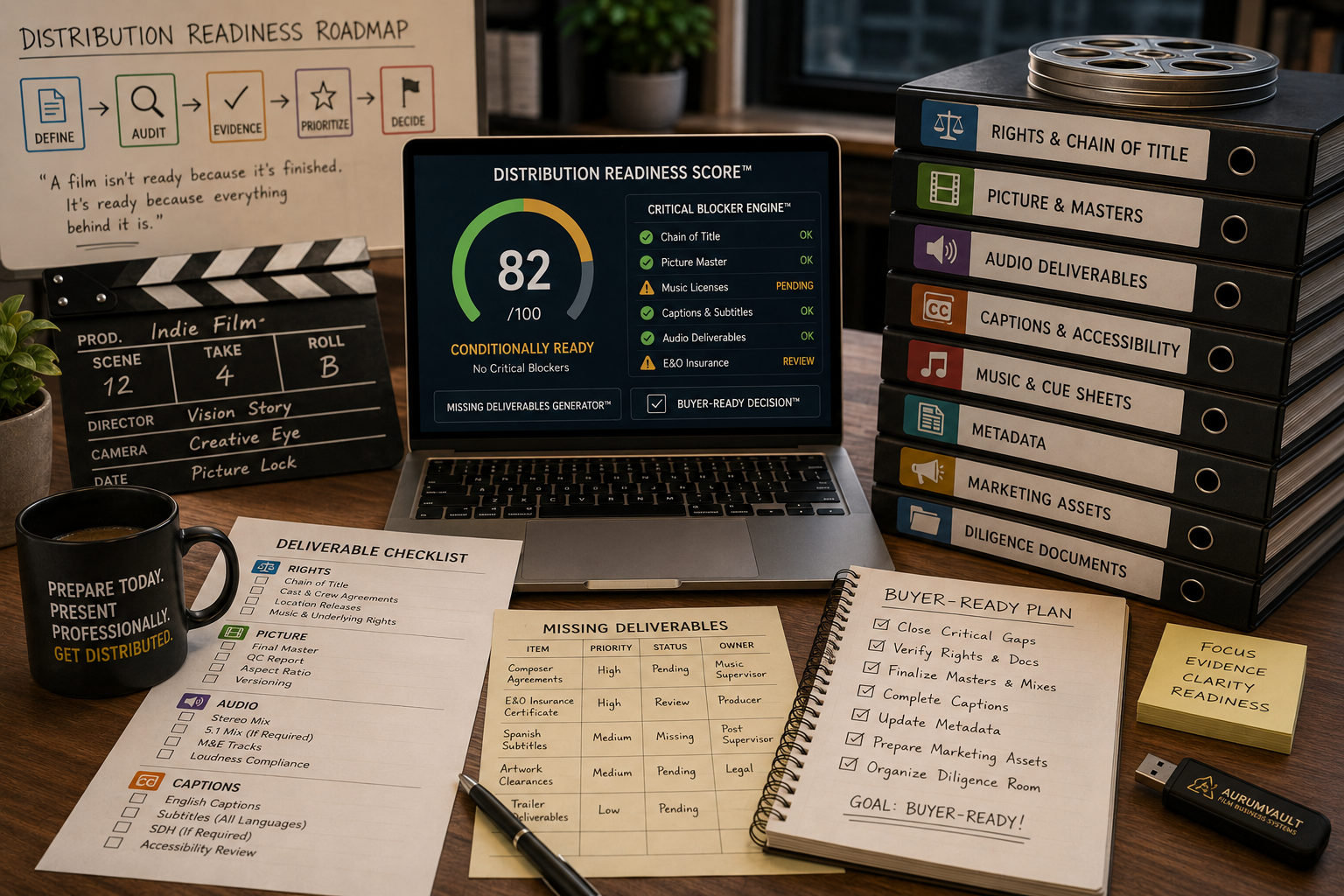
Film Distribution Deliverables Checklist: From Picture Lock to Buyer-Ready
Finishing a movie is a major milestone.
But exporting the final cut does not necessarily mean the film is ready for distribution.
A distributor, sales agent, aggregator, broadcaster or platform may need much more than a playable movie file.
Depending on the project and intended release path, professional diligence can involve:
- Chain of title
- Rights agreements
- Picture masters
- Audio deliverables
- Captions and subtitles
- Accessibility materials
- Music licenses
- Cue sheets
- Metadata
- Artwork
- Marketing assets
- Insurance or clearance documentation
- Organized diligence records
That is why filmmakers should think about distribution readiness separately from creative completion.
The question is no longer only:
Is the movie finished?
It becomes:
Can we prove that the film is organized, cleared, technically usable and ready for a serious buyer conversation?
A File Existing Does Not Automatically Mean It Is Ready
One of the most important distribution-readiness principles is simple:
A deliverable should not be considered READY merely because a file exists.
A stronger definition of ready is that there is reasonable evidence the item is complete, current, organized and suitable for the intended transaction or delivery path.
That distinction matters because an editor may have exported a master that has never been professionally checked.
A producer may remember signing a release that nobody can locate.
A music license may exist but contain territorial limitations.
Captions may have been created against an older cut.
A project can therefore appear complete while still containing significant distribution blockers.
Step 1: Define the Intended Distribution Path
Distribution requirements are not universal.
The first step is defining where the film is realistically intended to go.
Possible paths can include:
- Theatrical
- TVOD
- SVOD
- AVOD
- FAST
- Broadcast
- Educational
- International sales
- Sales-agent representation
- Distributor representation
- Aggregator delivery
- Direct platform distribution
The intended destination changes the questions you need to ask.
For example, the technical and accessibility needs of one buyer may differ significantly from another.
Do not assume that requirements from one platform apply to every distribution opportunity.
The Film Distribution Readiness & Deliverables OS explicitly instructs filmmakers to decide whether they are pursuing a sales agent, distributor, aggregator or direct-platform path and to prepare for the likely diligence conversation before outreach begins. 1
Step 2: Confirm Picture Lock
A changing edit creates unstable downstream deliverables.
Before finalizing expensive or time-consuming materials, verify whether the film is truly picture-locked.
Check:
- Are editorial changes complete?
- Are pickups still planned?
- Are graphics final?
- Are credits final?
- Are there unresolved scene changes?
- Is the runtime stable?
Captions, subtitles, cue sheets, masters and other assets can all be affected by later changes.
The OS specifically warns against finalizing these materials against an unstable cut without a version plan. 2
Step 3: Build the Project Distribution Brain
Create one central distribution record for the project.
Document:
- Official title
- Alternate or localized titles
- Production entity
- Project format
- Completion status
- Intended territories
- Languages
- Primary distribution path
- Secondary paths
- Target buyer types
- Known buyer specifications
- Unknown requirements
This prevents contracts, masters, metadata and delivery records from referring to inconsistent versions of the same project.
Step 4: Audit Chain of Title
Rights issues can stop a distribution opportunity even when the film itself is excellent.
Your chain-of-title review may need to examine:
- Screenplay or story ownership
- Underlying work rights
- Producer or production-entity assignments
- Principal cast agreements
- Appearance releases
- Location releases
- Music rights
- Archival footage
- Photographs
- Artwork
- Third-party visuals
- Name or likeness issues
- Trademark issues
- Copyright records
- AI-generated-material provenance
- Digital-replica or cloned-voice consent where applicable
For critical rights items, do not rely solely on someone's memory that an agreement exists.
Locate the executed document or obtain appropriate professional review.
Step 5: Separate Rights Status From Rights Evidence
For each important rights item, document:
Status → Evidence → Limitation → Owner → Next Action
Useful statuses can include:
- READY
- PENDING
- MISSING
- REVIEW REQUIRED
- NOT APPLICABLE
The purpose is to make uncertainty visible.
A missing contract should not quietly appear green because someone believes it was signed years ago.
Step 6: Review the Final Picture Master
There is an important difference between:
We exported the movie.
and
We have a professionally checked delivery master.
A readiness review should examine areas such as:
- Final picture master exists
- File opens and plays correctly
- Picture lock is confirmed
- Aspect ratio is correct
- Resolution is appropriate
- Frame rate is documented
- Version is clearly identified
- Known technical issues are documented
The OS's picture-deliverables standard explicitly says READY should mean the actual master has been checked—not simply that the editing timeline looks correct. 3
Step 7: Organize Audio Deliverables
A stereo mix may not satisfy every distribution or international-delivery path.
Depending on the receiving party, filmmakers may need to investigate requirements involving:
- Stereo mix
- 5.1 mix
- Dialogue
- Music and effects
- M&E tracks
- Stems
- Channel mapping
- Loudness
- Sync
Do not guess about buyer-specific requirements.
If you do not know whether a buyer requires 5.1, M&E or particular loudness or channel mapping, mark the item for review instead of pretending it is ready. 4
Step 8: Prepare Captions, Subtitles and Accessibility Materials
Accessibility assets can become critical deliverables.
Evaluate:
- Captions
- Subtitle files
- Subtitle languages
- Dialogue accuracy
- Timing
- Speaker identification
- Sound-effect notation where required
- Accessibility expectations for the intended buyer
International goals may introduce additional language requirements.
The OS specifically notes that rights, captions, artwork and metadata may change by territory and recommends identifying likely subtitle or dubbed-language needs early. 5
Step 9: Audit Music Rights and Cue-Sheet Readiness
Music can create serious distribution delays when documentation is incomplete.
Review:
- Composition rights
- Synchronization rights
- Master-use rights
- Composer agreements
- Licensed tracks
- Territory limitations
- Term limitations
- Cue-sheet information
Do not assume that permission to use a track in a festival screening automatically equals worldwide distribution rights.
Rights should be checked against the actual intended exploitation path.
Step 10: Verify Archival and Third-Party Materials
Documentaries and narrative films may include third-party materials such as:
- Archive footage
- News clips
- Photographs
- Artwork
- Screenshots
- Logos
- Recorded media
For each important asset, know:
- Source
- Rights basis
- Territory
- Term
- Restrictions
- Supporting documentation
A visually small asset can still become a major diligence problem if the rights are unclear.
Step 11: Review AI-Generated or Synthetic Material
Modern productions may also contain AI-assisted or synthetic materials.
Document where relevant:
- What was AI-generated
- Which tool was used
- Who created or directed it
- What source material was involved
- What contractual or rights questions exist
- Whether a digital replica or cloned voice was created
- What consent evidence exists
The OS includes separate readiness checks for AI-generated-material provenance and digital-replica or cloned-voice consent.
Step 12: Build Reusable Metadata
Professional distribution relies on accurate information about the film.
Your metadata package may include:
- Official title
- Logline
- Synopsis
- Runtime
- Genre
- Country
- Language
- Cast
- Director
- Producers
- Production company
- Release year
- Credits
- Ratings information where applicable
- Territories
Keep this information consistent across sales materials, artwork, delivery records and platform submissions.
Step 13: Prepare Marketing and Sales Assets
Buyers need to understand the commercial property as well as its technical readiness.
Organize assets such as:
- Poster or key art
- Trailer
- Stills
- Logline
- Short synopsis
- Long synopsis
- Cast information
- Director biography
- Producer information
- Press materials
- Awards or festival information
- Sales deck where appropriate
The final quality gate in the OS specifically checks whether marketing and sales assets can support a professional buyer conversation. 6
Step 14: Build a Distribution Diligence Room
Do not wait until a distributor requests documents to begin hunting through old emails and hard drives.
Create an organized diligence room.
Possible folders might include:
- Corporate documents
- Chain of title
- Cast releases
- Crew agreements
- Location agreements
- Music
- Archive licenses
- Artwork permissions
- Insurance
- Copyright
- Masters
- Audio
- Captions
- Metadata
- Marketing
- QC documentation
The goal is simple:
When someone asks for evidence, you should be able to locate it quickly.
Step 15: Track Missing Deliverables
Once the audit is complete, create a missing-deliverables list.
For every missing or unresolved item, record:
- Deliverable
- Priority
- Current status
- Evidence required
- Owner
- Due date
- Next action
- External review needed
Do not spend hours polishing a low-priority poster variation while a critical rights agreement remains unresolved.
Prioritize blockers first.
Step 16: Use a Distribution Readiness Score Carefully
A readiness score can help summarize a complicated package.
But a score should never hide serious problems.
That is why the OS combines a Distribution Readiness Score™ with a blocker override rather than relying on an average alone.
The Buyer-Ready Decision Engine is specifically designed to convert dozens of deliverables into an executive readiness decision without allowing one serious blocker to disappear inside an otherwise strong score. 7
Step 17: Identify Critical Blockers
Some issues should override the numeric score entirely.
The OS's Critical Blocker Engine™ identifies examples including:
- Unresolved ownership or chain-of-title issues
- Critical music-rights gaps
- An unusable or corrupt master
- Missing required accessibility or delivery assets
- Material E&O or diligence issues requiring professional resolution
A project can therefore score well overall and still be not ready because one serious issue remains unresolved. 8
Step 18: Make a Buyer-Ready Decision
The OS uses the following operational readiness bands:
90–100 with no critical blockers — BUYER READY
75–89 with no critical blockers — CONDITIONALLY READY
50–74 — NOT YET DELIVERABLE
Below 50 — CRITICAL READINESS GAP
Any critical blocker — CRITICAL BLOCKERS
These statuses are designed to turn a long technical audit into a clear operating decision. 9
The score is not a guarantee that a specific buyer will accept the project.
It is a structured way to decide what should happen next.
Step 19: Run a Recurring Readiness Review
While closing the delivery package, schedule a short recurring review.
Ask:
- What changed?
- What became READY?
- What is still blocked?
- What requires outside review?
- What is the highest-value next action?
The OS recommends a recurring 20-minute readiness review built around those questions. 10
This keeps the project moving without letting unresolved deliverables disappear into the background.
Step 20: Run a 30-Day Buyer-Readiness Sprint
Once the full audit is complete, convert it into an execution plan.
A practical sprint might focus on:
Week 1 — Critical Rights
Resolve chain-of-title and other high-impact documentation gaps.
Week 2 — Technical Deliverables
Complete or verify picture, audio, captions and accessibility materials.
Week 3 — Metadata and Diligence
Organize metadata, cue sheets, marketing assets and the diligence room.
Week 4 — Buyer Preparation
Recalculate readiness, review blockers and prepare for professional outreach.
The Film Distribution Readiness & Deliverables OS includes an entire Buyer Outreach & 30-Day Readiness Plan designed to convert the audit into a practical completion sprint before formal distributor or sales-agent diligence. 11
A Practical Film Distribution Deliverables Checklist
Before entering serious buyer conversations, review the following areas:
Distribution Context
- Official project title locked
- Production entity identified
- Picture lock confirmed
- Primary distribution path identified
- Territories documented
- Language requirements considered
- Target buyer type identified
Rights and Chain of Title
- Story or screenplay ownership documented
- Underlying rights documented where applicable
- Cast releases organized
- Location releases organized
- Music rights documented
- Archival rights documented
- Third-party visuals reviewed
- Copyright records organized
- AI or digital-replica issues reviewed where applicable
Picture
- Final master exists
- Master plays correctly
- Correct version confirmed
- Aspect ratio confirmed
- Resolution confirmed
- Frame rate confirmed
- QC issues documented
Audio
- Stereo mix verified
- Additional required mixes identified
- Sync verified
- Buyer-specific requirements confirmed
Captions and Accessibility
- Caption needs identified
- Subtitle requirements identified
- Languages documented
- Accessibility requirements reviewed
Music
- Composition rights documented
- Master-use rights documented
- Cue-sheet requirements addressed
Metadata
- Title
- Runtime
- Genre
- Logline
- Synopsis
- Cast
- Credits
- Languages
- Territories
Marketing and Sales
- Key art
- Trailer
- Stills
- Synopsis
- Bios
- Sales or press materials
Diligence
- Rights documents organized
- Technical deliverables organized
- Evidence attached to READY statuses
- Missing items assigned to owners
- Buyer-specific requirements marked for verification
The Final Buyer-Ready Quality Gate
Before declaring the project ready, ask:
- Are unresolved critical rights or ownership problems being ignored?
- Has the final picture master actually been checked?
- Have required audio deliverables been identified?
- Have caption, subtitle and accessibility needs been evaluated?
- Are music rights and cue-sheet obligations organized?
- Is metadata accurate and reusable?
- Are marketing assets ready for a professional conversation?
- Are diligence documents organized and findable?
- Does the current readiness score reflect evidence rather than optimism?
- Will buyer-specific requirements be verified before delivery?
Those are the core checks used by the OS's final Buyer-Ready Quality Gate. 12
From Picture Lock to Buyer-Ready
The goal of distribution preparation is not to create one imaginary universal delivery package.
Every buyer, contract, platform, territory and release strategy can introduce different requirements.
The goal is to understand the professional process well enough that you can identify what exists, what is missing, what needs specialist review and what must be verified with the actual receiving party.
That is what turns a finished independent film into a more professionally prepared distribution asset.
Build the Complete Readiness System
Film Distribution Readiness & Deliverables OS™ by AurumVault Film Business Systems is designed as a ready-to-use system for getting an independent film buyer-ready, diligence-ready and professionally deliverable. 13
Its roadmap covers eleven operational areas:
- Project Distribution Brain
- Rights & Chain-of-Title Gate
- Picture & Master Deliverables
- Audio Deliverables
- Captions, Subtitles & Accessibility
- Music & Cue Sheet Readiness
- Metadata Completeness
- Marketing & Sales Assets
- Distribution Diligence Room
- Buyer-Ready Decision Engine
- Buyer Outreach & 30-Day Readiness Plan
That full roadmap is built directly into the system. 14
The operating workflow is equally clear:
DEFINE → AUDIT → EVIDENCE → PRIORITIZE → DECIDE
Because a film should not be called ready simply because the edit is finished.
It should be called ready when the evidence supports it.
Educational notice: This article and the Film Distribution Readiness & Deliverables OS™ are educational and organizational resources. They are not legal advice, technical QC certification, E&O clearance, or a guarantee that a distributor, platform, sales agent, broadcaster or insurer will accept a project. Actual requirements should be confirmed with the receiving party and qualified professionals. 15
Enjoying the Academy?
Join AurumVault Insider for new practical guides, digital tools, and marketplace releases.
No spam. Unsubscribe anytime. Privacy
By subscribing, you agree to receive AurumVault Insider emails. You can unsubscribe at any time.
Continue your journey
Keep reading
Financial Literacy for Kids: What Everybody's Rich Except Me Teaches About Money
Everybody's Rich Except Me follows eleven-year-old Mateo Rivera as he becomes convinced that everyone around him is richer than he is. Through sneakers, social media, a small snack business, debt, saving and everyday financial choices, Mateo discovers that looking wealthy and being financially secure are very different things.
Best Digital Products to Sell in 2026: 25 High-Demand Ideas
Digital products remain one of the most accessible ways to build an online income stream because they can be created once, improved over time and sold repeatedly without physical inventory. These 25 ideas focus on practical, useful products buyers are actively seeking across business, personal finance, content creation, planning, AI, education and lifestyle markets.
50 Business Words for Kids: A Simple First Business Dictionary
Children hear words like profit, budget, marketing, investment and negotiation all the time, but those ideas can feel complicated. This guide explains 50 important business concepts in simple language and shows how learning them can help kids understand money, entrepreneurship, customers, leadership and problem-solving.