
Digital Rights Passport: Protect Your Identity, Creative Work & AI Rights
AI can train on content, generate synthetic voices, create digital replicas and transform creative work at unprecedented speed. A Digital Rights Passport provides a structured way to document what you control, what uses you permit, what requires approval and what evidence supports your decisions.
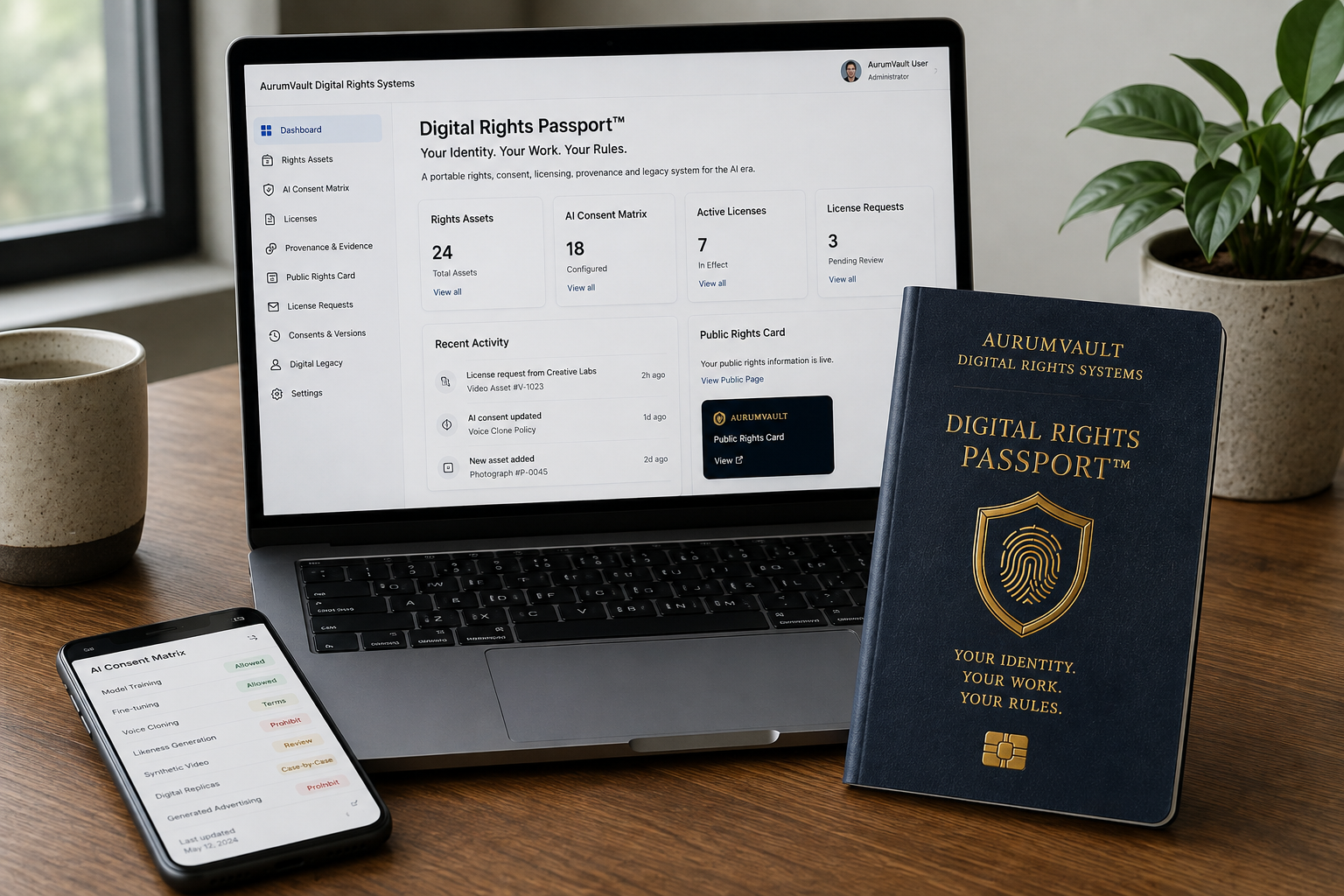
Digital Rights Passport: How to Protect Your Identity, Creative Work and AI Rights
Artificial intelligence has changed what it means to protect a creative identity.
Your digital rights may no longer involve only a photograph, song, book, video or trademark.
They can also involve your voice, likeness, movement, public persona, creative catalog, AI training permissions, synthetic media, digital replicas and even instructions for how these assets should be handled after death or incapacity.
This creates a practical question for creators, athletes, authors, musicians, influencers, entrepreneurs and brands:
Can another person or technology system clearly determine what you allow, what you prohibit, what requires permission and who has authority to make that decision?
That is the problem a Digital Rights Passport is designed to address.
What Is a Digital Rights Passport?
A Digital Rights Passport is a structured record of your identity, the creative or commercial assets you claim or control, how those assets may be used, the AI and synthetic-media uses you permit or restrict, existing licenses, supporting evidence and the appropriate contact for new rights requests.
The AurumVault Digital Rights Passport™ is designed to make this information easier for both humans and machines to understand.
Importantly, it is not a government registry, automatic enforcement mechanism, legal opinion or replacement for copyright or trademark registration.
Instead, think of it as a control surface for your digital rights decisions.
Why Digital Rights Are Becoming More Complicated
Consider a creator who records videos online.
That creator may have several separate assets:
- Their legal or professional name
- Their photograph
- Their face and likeness
- Their recorded voice
- Their synthetic voice
- Their writing
- Their videos
- Their brand
- Their logo
- Their signature
- Their movement or mannerisms
- Their creative catalog
Now introduce artificial intelligence.
A third party might want to use those assets for AI training, fine-tuning, retrieval, advertising, voice cloning, synthetic video, digital replicas or generated commercial content.
A simple statement saying 'I own my content' does not answer all of those questions.
The Digital Rights Passport separates those assets and uses so permissions can be more precise.
The First Principle: Separate Declaration From Proof
One of the most important concepts in digital-rights management is separating a rights declaration from the evidence supporting it.
A declaration answers:
What do I say is allowed, prohibited, licensed, restricted or subject to review?
Evidence answers:
What supports my authority to make that declaration?
For example, you may declare that commercial voice cloning requires written permission.
Supporting evidence might include identity records, contracts, source recordings, registrations, timestamps or other documentation.
Keeping these layers separate makes the rights record more credible and easier to maintain.
1. Build a Rights Asset Registry
The first step is identifying exactly what the passport covers.
A Rights Asset Registry can include:
- Name or stage name
- Likeness
- Voice
- Signature
- Movement or mannerisms
- Biography
- Public persona
- Books
- Music
- Photographs
- Films
- Podcasts
- Courses
- Artwork
- Digital products
- Trademarks
- Logos
- Characters
- Slogans
- Commercial brands
Each important asset should have a stable identifier so permissions, licenses and evidence can reference the same asset.
This is much stronger than placing every creative right under a vague label such as 'content.'
2. Identify Who Has Authority
Owning an asset and having authority to administer or license it are not always the same thing.
A useful rights record asks:
- Who owns the asset?
- Who controls it?
- Who administers it?
- Who can license it?
- Is a representative involved?
- Is an attorney involved?
- Is a company involved?
- Is an estate or trust involved?
The operating discipline behind the Digital Rights Passport is straightforward:
Asset → Authority → Use → Permission → Evidence → Version.
This framework helps turn an abstract rights claim into a structured decision record.
3. Create Explicit AI Consent Rules
Artificial intelligence introduces uses that traditional creator agreements may never have anticipated.
Instead of having one universal 'AI permission,' consider individual decisions for different uses.
Examples include:
- General AI model training
- Fine-tuning
- Retrieval and embeddings
- Evaluation and benchmarking
- Commercial AI outputs
- Synthetic voice
- Voice cloning
- Generated likeness
- Digital replicas
- Synthetic video
- Motion simulation
- Avatars and virtual humans
- Generated advertising
- Personalized content
For each use, a permission might be structured as:
ALLOW
ALLOW WITH TERMS
PROHIBIT
CASE-BY-CASE
CONTACT FOR PERMISSION
That distinction matters because permission for one use should not automatically imply permission for every other AI use.
4. Treat Voice and Likeness as Separate Assets
AI makes voice and likeness particularly important.
Recorded voice, synthetic voice, dubbing and voice-clone training can represent different uses.
Likewise, traditional photography is not necessarily the same as generated likeness or a digital replica.
A Digital Rights Passport can establish separate policies for:
- Voice cloning
- Synthetic voice
- Face generation
- Likeness generation
- Digital replicas
- Synthetic video
- Performance simulation
- Avatars
- Generated advertising
- Posthumous use
This gives creators, performers and public-facing professionals greater clarity over how different aspects of their identity may be used.
5. Document Existing Licenses
Your default preference cannot automatically override rights you have already granted to someone else.
That is why existing licenses should be recorded before publishing new public permissions.
A useful license register can track:
- License ID
- Asset
- Licensee
- Permitted use
- Start and end dates
- Territory
- Exclusivity
- AI or synthetic-media rights
- Compensation
- Controlling agreement
- Current status
This can reveal conflicts before a new license or permission is issued.
6. Create a License Request Process
Instead of receiving vague messages such as:
'Can we use your content?'
A structured license request can require the requester to identify:
- Who they are
- Which asset they want
- Exact intended use
- Whether AI is involved
- Commercial purpose
- Platform or media
- Territory
- Duration
- Sublicensing
- Training or retention
- Derivative outputs
This turns a vague permission request into an informed business decision.
7. Preserve Provenance and Evidence
A rights declaration becomes more useful when supporting evidence can be located.
Evidence may include:
- Contracts
- Registrations
- Original source files
- Timestamps
- Hashes
- Authorization records
- Content Credentials
- Provenance manifests
- License documents
- Approval records
The goal is not to publish every private document.
Instead, the public record can point toward verification while confidential evidence remains protected.
8. Maintain Public and Private Layers
A digital-rights system should not create a privacy problem while attempting to solve a rights problem.
Sensitive identity documents, private contracts, addresses and confidential evidence should not automatically become public.
The public layer might contain:
- Professional identity
- Rights contact
- Public rights URL
- Permission summaries
- AI-use policies
- Effective date
- Current version
Private records can preserve the evidence supporting those declarations.
9. Create a Public Rights Card
A Public Rights Card can give third parties a concise overview of important permissions.
For example, it might identify policies regarding:
- General AI training
- Voice cloning
- Digital replicas
- Generated advertising
- Commercial model output
- Posthumous use
It can also provide a rights contact so someone seeking permission knows where to go next.
The goal is clarity—not automatic legal enforcement.
10. Make Rights Machine-Readable
Humans are no longer the only entities interacting with digital content.
Software platforms, AI systems and automated workflows increasingly process information about content and identity.
That creates an important opportunity: representing rights information in a structured, machine-readable format.
The Digital Rights Passport includes a machine-readable rights mapping that can connect fields such as:
- Passport ID
- Schema version
- Passport version
- Subject name
- Rights contact URI
- Asset IDs
- Permission vocabulary
- Effective timestamp
- Superseded version
- Human-readable passport URL
A structured JSON rights file can complement the human-readable passport.
11. Keep a Consent and Version Ledger
Digital rights are not permanent decisions.
You might permit a use today and change that policy later.
Instead of silently rewriting history, maintain a version ledger documenting:
- What changed
- Previous value
- New value
- Effective date
- Who authorized the change
- Supporting approval or evidence
- Which version was superseded
- Whether the public notice was updated
This creates a traceable history of consent decisions.
12. Consider Platform and Third-Party Dependencies
You may not control every right associated with an asset.
Relevant dependencies might involve:
- Platforms
- Employers
- Sports teams
- Record labels
- Publishers
- Studios
- Agencies
- Collaborators
- Existing licensees
Before making a public declaration, ask whether another contract, platform term or third-party right affects what you can actually authorize.
13. Protect Your Digital Legacy
Digital identity does not necessarily disappear when someone dies or becomes incapacitated.
AI makes this issue even more significant because a person's voice, likeness or creative catalog may remain usable for generations.
A Digital Legacy Directive can document instructions involving:
- Successor or estate contact
- Estate counsel
- Rights entity or trust
- AI training
- Voice cloning
- Digital replicas
- Existing licenses
- New licensing requests
- Archive stewardship
- Revenue administration
This creates a documented starting point for how digital rights should be handled in the future.
Digital Rights for Athletes, Creators and Public Figures
The Digital Rights Passport can be particularly relevant for people whose identity itself has commercial value.
That may include:
- Athletes
- Influencers
- Musicians
- Actors
- Authors
- Podcasters
- Coaches
- Speakers
- Models
- Entrepreneurs
- Digital creators
For these individuals, a face, voice, signature, movement, name or public persona may become commercially valuable independently from any individual piece of content.
AI makes separating those rights increasingly important.
A Practical Digital Rights Checklist
Before publishing a Digital Rights Passport, confirm that:
- Your identity and rights contact are documented
- Important identity and creative assets are registered
- Authority is identified
- High-risk AI uses are explicitly addressed
- Existing licenses have been reviewed
- Important rights claims connect to evidence
- Public and private information are separated
- Consent decisions are versioned
- Machine-readable data matches human-readable declarations
- Digital legacy instructions are documented where appropriate
- Disputed or uncertain rights are marked for review rather than guessed
The Digital Rights Passport itself uses a publishing quality gate based on many of these controls.
What a Digital Rights Passport Does Not Do
A Digital Rights Passport should not be misunderstood as something it is not.
It does not automatically:
- Create copyright ownership
- Register a trademark
- Replace government registration
- Override an existing contract
- Guarantee that another party will comply
- Establish legal ownership simply because something is entered
- Replace an attorney
- Create government-certified identity
Its strength comes from organization, clarity, evidence, consent and version control.
The Future of Digital Rights Is Structured
For years, creators primarily thought about protecting finished works.
AI expands that conversation.
The question is increasingly not only:
Who owns this work?
It is also:
Who can train on it?
Who can generate from it?
Who can clone the voice?
Who can reproduce the likeness?
Who can create a digital replica?
Who can commercially license it?
What happens to those permissions later?
That is why structured digital-rights management may become increasingly important for creators and businesses operating in the AI economy.
Build Your Digital Rights Passport
The AurumVault Digital Rights Passport™ brings these decisions together into one structured system for rights, consent, licensing, provenance and legacy.
Its core philosophy can be summarized in three lines:
YOUR IDENTITY. YOUR WORK. YOUR RULES.
MAKE YOUR RIGHTS CLEAR BEFORE TECHNOLOGY MAKES ASSUMPTIONS.
Rather than relying on scattered contracts, verbal assumptions and forgotten permissions, the goal is to create a maintained record showing what you control, what you permit, what requires approval, what evidence supports your declarations and who should be contacted when someone wants additional rights.
Important notice: The Digital Rights Passport™ is an organizational and educational rights-management system. It is not a government registry, substitute for copyright or trademark registration, legal opinion, automatic enforcement mechanism or guarantee that third parties will comply. High-stakes, disputed or uncertain rights should be independently reviewed by an appropriate qualified professional.
Enjoying the Academy?
Join AurumVault Insider for new practical guides, digital tools, and marketplace releases.
No spam. Unsubscribe anytime. Privacy
By subscribing, you agree to receive AurumVault Insider emails. You can unsubscribe at any time.
Continue your journey
Keep reading
EU Packaging Compliance 2026: PPWR Checklist for Small Brands and Ecommerce
EU packaging compliance can involve far more than choosing recyclable packaging. Small brands selling into European markets may need to understand their economic role, map packaging components, collect supplier evidence, document material data, review recyclability and labeling, track country-level EPR actions and maintain technical records. This guide provides an evidence-first framework for organizing that work.
AI Governance for Small Business: The Complete 2026 Checklist
Small businesses are adopting AI faster than many are creating rules for it. This practical 2026 checklist shows business owners how to inventory AI tools, protect sensitive information, define employee and AI-agent authority, require human approval for consequential actions, evaluate vendors, document incidents and create a manageable AI governance system.
AI Governance in Banking: A Practical Operations Framework
Banking AI governance should go beyond documenting models. This practical framework shows how financial institutions can inventory AI use, classify customer and financial impact, establish authority limits, validate material systems, preserve transaction-level evidence and review complaints, incidents and controls.