
Enterprise AI Governance: From Policy to Runtime Control
Enterprise AI governance should not stop at policies, principles and model inventories. This guide explains how organizations can register AI systems, classify risk, bound authority, govern tools and data, require human approvals, enforce runtime controls, preserve evidence, manage incidents and report from operational records.
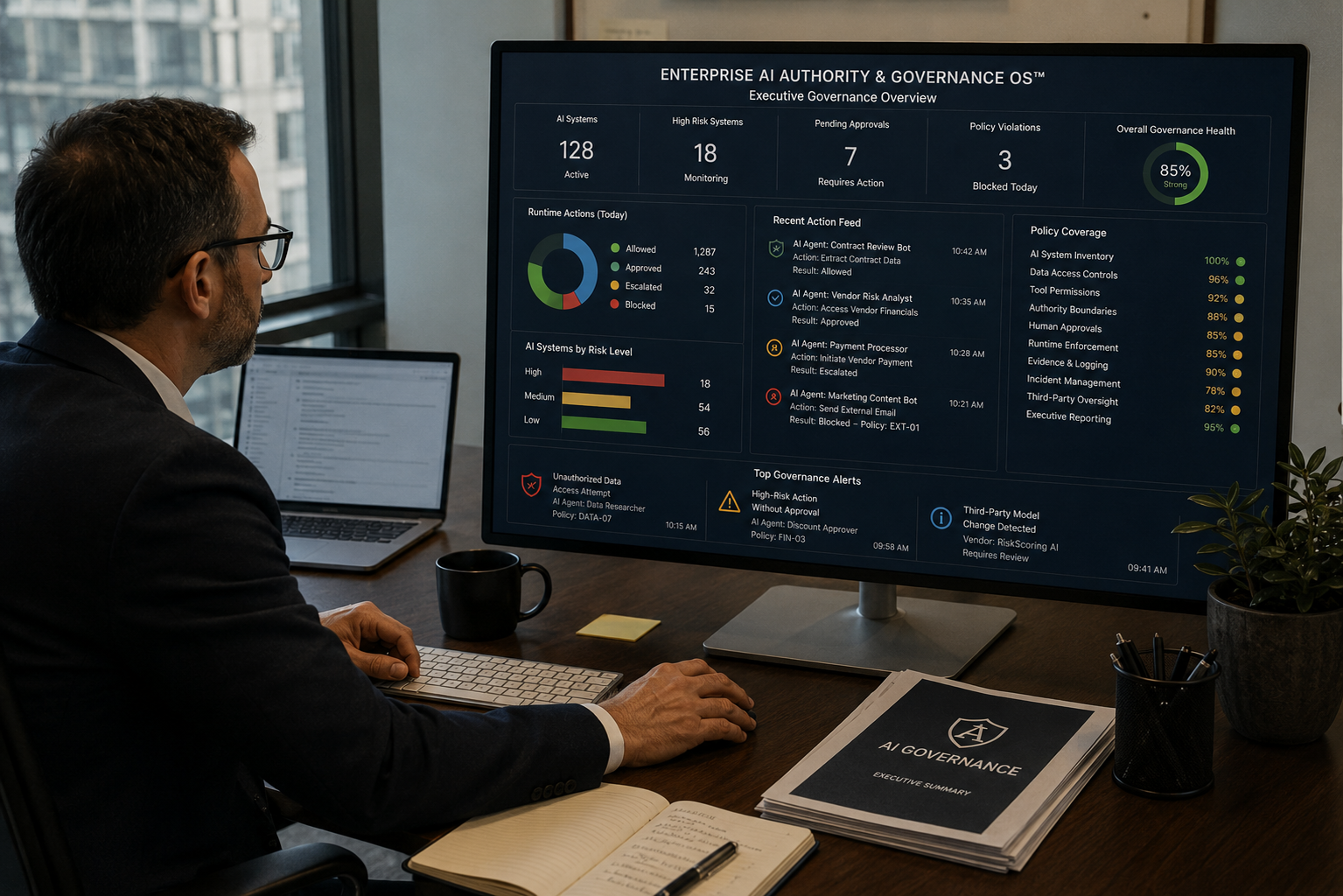
Enterprise AI Governance: From Policy Intent to Runtime Control
Enterprise AI governance is rapidly becoming an operational challenge rather than only a policy challenge.
Organizations are deploying:
- AI assistants
- Copilots
- Agents
- Automations
- Embedded AI
- Third-party AI services
- AI-enabled enterprise applications
As these systems gain access to business data and enterprise tools, governance must answer questions that traditional AI principles alone may not resolve.
For example:
- Which AI system or agent acted?
- Who owns it?
- What was it allowed to do?
- Which tools could it invoke?
- Which data could it access?
- Did a human need to approve the action?
- Which policy applied?
- Was the action allowed, blocked or escalated?
- What actually happened?
- Where is the evidence?
That is the difference between policy intent and runtime control.
A policy can say that consequential AI decisions require human oversight.
An operating system must define where that oversight occurs, who has authority, what prevents execution without approval and what evidence proves the control operated.
Why Enterprise AI Governance Must Move Beyond Policy
Many organizations already have AI principles.
They may include commitments around:
- Fairness
- Privacy
- Transparency
- Security
- Accountability
- Human oversight
Those principles matter.
But enterprise operations require another question:
How are those principles translated into actual system behavior?
If an AI agent can send an external email, modify customer records, issue a refund, move funds, deploy code or accept an agreement, governance cannot remain purely descriptive.
The organization needs enforceable boundaries.
The Core Enterprise AI Governance Question
A practical governance program should be able to answer:
Can the organization prove which AI system or agent acted, what it was allowed to do, which data and tools it accessed, which policy applied, whether a human approved it, what happened and where the evidence lives?
That question sits at the center of the Enterprise AI Authority & Governance OS™ operating lifecycle. 1
The 11-Stage Governance Operating Lifecycle
A mature operating framework can organize governance into eleven stages:
REGISTER → CLASSIFY → BOUND → AUTHORIZE → APPROVE → EXECUTE / BLOCK → MONITOR → ESCALATE → EVIDENCE → AUDIT → IMPROVE
Each stage solves a different operational problem.
1. Register Every Production AI System and Agent
The organization should maintain a persistent system of record for:
- Models
- Applications
- Copilots
- Agents
- Automations
- Embedded third-party AI
For each system, record information such as:
- System or agent name
- Owner
- Business unit
- Lifecycle status
- Model or vendor
- Purpose
- Risk or criticality
- Next review
The objective is visibility.
An organization cannot govern AI systems that nobody knows exist.
2. Assign Durable AI Identities and Accountable Owners
Every production system or agent should have an identifiable owner.
Ownership should not disappear behind a vendor name or technical service account.
The organization should know:
- Which AI worker is acting
- Which business unit owns it
- Which environment it belongs to
- Its lifecycle status
- Who remains accountable
Persistent identity becomes especially important when organizations deploy multiple AI agents capable of acting through shared enterprise tools.
3. Classify Risk and Criticality
Not every AI system deserves the same control environment.
Risk classification can consider factors such as:
- Customer impact
- Data sensitivity
- Financial authority
- Operational consequence
- Reversibility
A system summarizing internal meeting notes should not necessarily have the same authority controls as an agent capable of changing customer records or moving money.
The classification should influence the controls that follow.
4. Define AI Authority Explicitly
One of the most important enterprise governance questions is:
What exactly may this AI system do?
Authority can be organized into levels such as:
- Observe
- Suggest
- Draft
- Execute with approval
- Execute within bounded authority
The key is that technical capability should not automatically equal permission.
An agent may technically be able to call an API that issues refunds.
That does not mean organizational policy should allow unrestricted refund authority.
5. Build an Agent Authority Management Matrix
For every material AI system, explicitly decide whether it may perform actions such as:
- Read approved records
- Write internal records
- Send external email
- Modify customer or account data
- Issue refunds or credits
- Change prices or terms
- Approve expenses
- Move funds
- Execute purchases
- Publish content
- Delete records
- Deploy code or configuration
- Change access permissions
- Accept contracts or agreements
This transforms vague AI autonomy into specific operating boundaries.
6. Create Conditional Authority Envelopes
Authority often should not be simply ALLOW or DENY.
A useful authority envelope can define:
- Action or permission
- Scope
- Systems
- Data
- Monetary or operational threshold
- Preconditions
- When approval is required
- Explicit deny conditions
- Expiration or review date
For example, an AI agent might be authorized to issue a small refund only when defined conditions are satisfied and may require human approval above a threshold.
This creates bounded autonomy rather than unlimited autonomy.
7. Govern Tool and System Access
AI authority also depends on what the system can reach.
Govern which enterprise systems and tools each AI agent may invoke.
A tool-access matrix can apply the same disciplined review to actions such as:
- Customer databases
- Financial systems
- Internal records
- Content publishing
- Procurement
- Code deployment
- Access management
The safest policy is difficult to enforce when an AI system retains unrestricted technical access behind the scenes.
8. Govern Data Access Separately
Tool permissions and data permissions are related but not identical.
Explicitly review access to categories such as:
- Public data
- Internal business data
- Customer PII
- Financial data
- Employee data
- Health or sensitive data
- Credentials and secrets
- Source code
- Contracts and legal information
- Regulated records
- Training and evaluation data
- Third-party confidential data
- Production logs
- Biometric or identity data
Where exceptions are required, document the business need, safeguards, masking, minimization, approver, expiration and evidence.
9. Centralize Human Approval for Consequential Actions
Human oversight should not mean a generic sentence in policy.
Approval should be operational.
For consequential actions, capture:
- Request
- Related system
- Requester
- Approver
- Why approval is required
- Policy or control basis
- Evidence reviewed
- Decision rationale
- Conditions
- Expiration
- Final decision
This creates accountability around who authorized what and why.
10. Translate Policy Into Runtime Enforcement
This is where enterprise governance becomes materially different from documentation-only governance.
Runtime policy enforcement should be capable of:
- Allowing actions
- Blocking actions
- Escalating actions
When an AI system attempts an action, the organization should be able to record:
- Agent or system
- Action attempted
- Tool invoked
- Data or object affected
- Authority at the time
- Policy or control applied
- Human approval
- Execution result
- Evidence or event ID
- Timestamp and environment
A policy becomes substantially more useful when it can influence whether an action actually executes.
11. Preserve a Reconstructable AI Decision and Action Ledger
Consequential AI actions should leave a durable evidence trail.
This does not require exposing private chain-of-thought.
Instead, preserve operational facts such as:
- Which system acted
- What action was attempted
- Which tool was used
- Which object or data was affected
- Which authority applied
- Which policy applied
- Whether a human approved it
- What happened
- Event identifier
- Timestamp
The Enterprise AI Authority & Governance OS™ specifically defines the AI Decision & Action Ledger as a way to preserve reconstructable governance evidence without exposing private reasoning. 2
12. Record Blocked and Escalated Actions
Blocked actions are not failures of governance.
Often, they are evidence that governance worked.
For an attempted action that is blocked or escalated, document:
- Attempted action
- Why it was blocked or escalated
- Control or policy
- Human decision
- Final disposition
- Follow-up or control improvement
These records can reveal recurring pressure against authority boundaries.
13. Control Temporary Authority and Exceptions
Enterprise systems often need exceptions.
The governance problem occurs when temporary permission quietly becomes permanent.
For every exception, record:
- Reason
- Approver
- Conditions
- Evidence
- Expiration
An exception without an expiration or review mechanism can become an invisible expansion of AI authority.
14. Build an AI Kill Switch and Suspension Process
Organizations should know how to suspend a problematic AI system quickly.
For every high-impact system, identify:
- Authorized suspenders
- Trigger conditions
- Technical disable method
- Dependencies
- Blast radius
- Fallback process
- Notification path
- Test date and result
A kill switch that exists only conceptually but has never been tested may not be dependable during an incident.
15. Define Human Escalation Architecture
AI systems should know when the workflow must transfer to a human.
Triggers may include:
- Uncertainty
- Policy boundaries
- Customer harm
- High-impact decisions
- Control failures
- Sensitive situations
The organization should define the responsible owner, required controls and evidence associated with escalation.
16. Govern Vendors and Model Dependencies
Enterprise AI frequently depends on external providers.
Vendor governance should investigate areas such as:
- Vendor and product
- Purpose
- Model or service
- Data collected
- Retention
- Training use
- Security evidence
- Subprocessors
- Deletion options
- Export and portability
- Incident notification
- Contract status
- Concentration risk
- Exit plan
Critically, the organization should not manufacture answers merely to complete an assessment.
If a vendor practice is not verified, record NOT VERIFIED.
17. Adopt Evidence Before Certainty
One of the strongest governance disciplines is accepting incomplete knowledge.
Useful governance states include:
- Unknown
- Not verified
- Disputed
- Unresolved
Do not manufacture:
- Vendor facts
- Legal conclusions
- Control effectiveness
- Model performance
- Risk status
simply because a form feels incomplete.
Evidence should come before certainty. 3
18. Build an Evidence and Control Vault
Governance evidence is most useful when it is organized and traceable.
Link evidence to:
- Policies
- Controls
- Systems
- Approvals
- Validations
- Runtime events
For every evidence item, track:
- Evidence type
- Related control or system
- Status
- Source or location
- Owner
- Date
This makes governance easier to reconstruct during audit, incident review or executive oversight.
19. Establish an AI Incident Command Center
AI incidents can involve:
- Unauthorized actions
- Data exposure
- Policy violations
- Execution errors
- Harmful outcomes
An incident record should capture:
- Severity
- What happened
- Affected systems, users or customers
- Immediate containment
- Authority or policy failure
- Investigation
- Corrective action
Afterward, conduct a postmortem covering:
- Root cause
- Failed or missing control
- Policy or authority change
- Technical or operational change
- Training or owner change
- Follow-up evidence
Governance improves when incidents change the control environment rather than simply being closed.
20. Continuously Test Governance Controls
A documented control is not the same as an effective control.
Continuous testing can evaluate whether areas such as these actually work:
- Registry completeness
- Owner assignment
- Risk classification
- Data permissions
- Tool permissions
- Authority envelopes
- Approval enforcement
- Runtime evidence
- Human escalation
- Kill switch
- Vendor evidence
- Incident follow-through
- Exception expiration
- Executive reporting
The system specifically distinguishes untested controls instead of automatically presenting them as effective. 4
21. Build an Audit Package From Evidence
For internal or external review, organize:
- Audit scope
- Controls tested
- Exceptions or failures
- Evidence package location
- Management response
- Remediation owner
- Due date
This turns governance from a scattered collection of screenshots and spreadsheets into a reviewable evidence package.
22. Report to Executives From Operational Records
Executive AI governance should be based on actual records rather than subjective status summaries.
Leadership should be able to understand:
- Enterprise AI exposure
- Authority violations
- Exceptions
- Incidents
- Evidence gaps
- High-risk systems
- Control failures
- Remediation
The executive decision process can focus on:
- What requires immediate attention
- What should be suspended
- What needs investment
- What can safely scale
- The top governance decisions for the next quarter
Those are explicit executive decision categories in the OS. 5
23. Turn Governance Decisions Into a Versioned Internal Policy
After operational decisions are made, convert them into an internal governance standard.
A policy builder can include:
- AI systems in scope
- Business and risk owners
- Approval authorities
- Prohibited uses
- Runtime logging
- Human escalation
- Incident response
- Kill-switch requirements
- Validation cadence
- Vendor review
- Exception expiration
- Executive reporting
The Enterprise AI Governance Policy Builder is designed to turn authority, data, approval, evidence, incident and audit decisions into a versioned internal standard. 6
24. Keep Policy and Runtime Enforcement Distinct
A policy may say:
'AI cannot execute financial transactions without approval.'
Runtime enforcement should answer:
- Which systems does that apply to?
- What qualifies as a financial transaction?
- Which threshold applies?
- Who approves?
- What happens without approval?
- Is execution technically blocked?
- What evidence proves the decision?
Policy defines intent.
Runtime controls enforce behavior.
Enterprise governance needs both.
25. Use a 30-Day Enterprise Implementation Program
Governance does not need to begin as a multi-year transformation.
A focused implementation can establish the operating discipline in stages.
Week 1 — Discover & Register
- Register AI systems and agents
- Assign owners
- Map tools and data
- Identify uncontrolled external actions
Week 2 — Classify & Bound
Classify risk and define authority, access and approval limits.
Week 3 — Enforce & Evidence
Implement runtime controls, evidence capture, escalation and incident processes.
Week 4 — Audit & Improve
- Run control tests
- Resolve exceptions
- Review incidents
- Prepare executive reporting
The OS specifically includes a four-week implementation program designed to install the discipline without pretending organizational maturity exists before evidence supports it. 7 8
26. Use Reusable Governance Review Records
A reusable governance review should capture the full operating picture for an AI system or agent:
- System, agent or use case
- Owner and business unit
- Risk and criticality
- Data and tools accessed
- Authority and action limits
- Approvals and escalation
- Evidence and logging
- Exceptions and expiration
- Decision and next review
This keeps governance review consistent as the enterprise AI portfolio grows. 9
The Difference Between AI Governance and AI Control
AI governance tells the organization what should happen.
AI control determines what can happen.
A high-quality enterprise program connects the two.
For example:
Policy: High-risk external communications require human approval.
Control: The agent cannot invoke the external-send action until an authorized approval record exists.
Evidence: The event ledger stores the request, approver, policy, decision and execution result.
Audit: Control testing verifies that the approval requirement cannot be bypassed.
That is what moving from policy intent to runtime control actually means.
Enterprise AI Governance Checklist
Before allowing a consequential AI system or agent to scale, confirm:
- The system is registered
- A named accountable owner exists
- Identity and lifecycle status are clear
- Risk and criticality are classified
- Tool permissions are defined
- Data permissions are defined
- Authority limits are documented
- Approval boundaries exist
- Runtime enforcement exists where required
- Human escalation is defined
- Exceptions expire
- Kill procedures exist and are tested
- Vendor dependencies are reviewed
- Runtime actions create evidence
- Incidents have a response path
- Governance controls are tested
- Executive reporting comes from operational records
If several of these answers are unknown, governance work remains unfinished.
Build Enterprise AI Governance Around Evidence, Not Assumptions
The objective of enterprise AI governance should not be to create the appearance of complete control.
It should be to create real, explainable operating boundaries.
A trustworthy program can clearly distinguish:
- Known
- Unknown
- Approved
- Denied
- Allowed within limits
- Escalated
- Blocked
- Tested
- Not tested
- Verified
- Not verified
That level of operational honesty is more valuable than a dashboard filled with unsupported green checkmarks.
Build the Complete Enterprise AI Governance Operating System
Enterprise AI Authority & Governance OS™ — Premium Interactive Edition is an operational control system designed to move organizations from policy intent to runtime control.
It helps enterprises govern:
- Executive AI governance baselines
- AI systems and agent registries
- Agent identity and ownership
- Risk and criticality
- Agent authority
- Tool access
- Data access
- Human approvals
- Runtime policy enforcement
- AI decision and action evidence
- Temporary authority and exceptions
- AI kill switches
- Human escalation
- AI vendors and model dependencies
- Evidence and control records
- AI incidents
- Continuous control testing
- Executive and board oversight
- Enterprise AI policy
- 30-day implementation
Its operating lifecycle is:
REGISTER → CLASSIFY → BOUND → AUTHORIZE → APPROVE → EXECUTE / BLOCK → MONITOR → ESCALATE → EVIDENCE → AUDIT → IMPROVE. 10
The central operating principle is simple:
From policy intent to runtime control.
Because enterprise AI governance should be able to prove not only what the organization intended AI to do—but what the AI was actually allowed to do, what it attempted, who approved it, what happened and where the evidence lives.
Important use notice: Enterprise AI Authority & Governance OS™ provides educational, strategic and operational guidance. It is not legal advice, regulatory certification, a substitute for internal controls or a guarantee of compliance. Enterprise requirements should be validated with qualified organizational, legal, risk, security, compliance and domain professionals. 11
Enjoying the Academy?
Join AurumVault Insider for new practical guides, digital tools, and marketplace releases.
No spam. Unsubscribe anytime. Privacy
By subscribing, you agree to receive AurumVault Insider emails. You can unsubscribe at any time.
Continue your journey
Keep reading
EU Packaging Compliance 2026: PPWR Checklist for Small Brands and Ecommerce
EU packaging compliance can involve far more than choosing recyclable packaging. Small brands selling into European markets may need to understand their economic role, map packaging components, collect supplier evidence, document material data, review recyclability and labeling, track country-level EPR actions and maintain technical records. This guide provides an evidence-first framework for organizing that work.
AI Governance for Small Business: The Complete 2026 Checklist
Small businesses are adopting AI faster than many are creating rules for it. This practical 2026 checklist shows business owners how to inventory AI tools, protect sensitive information, define employee and AI-agent authority, require human approval for consequential actions, evaluate vendors, document incidents and create a manageable AI governance system.
AI Governance in Banking: A Practical Operations Framework
Banking AI governance should go beyond documenting models. This practical framework shows how financial institutions can inventory AI use, classify customer and financial impact, establish authority limits, validate material systems, preserve transaction-level evidence and review complaints, incidents and controls.