
EU Packaging Compliance 2026: PPWR Checklist for Small Brands and Ecommerce (copy)
EU packaging compliance can involve far more than choosing recyclable packaging. Small brands selling into European markets may need to understand their economic role, map packaging components, collect supplier evidence, document material data, review recyclability and labeling, track country-level EPR actions and maintain technical records. This guide provides an evidence-first framework for organizing that work.
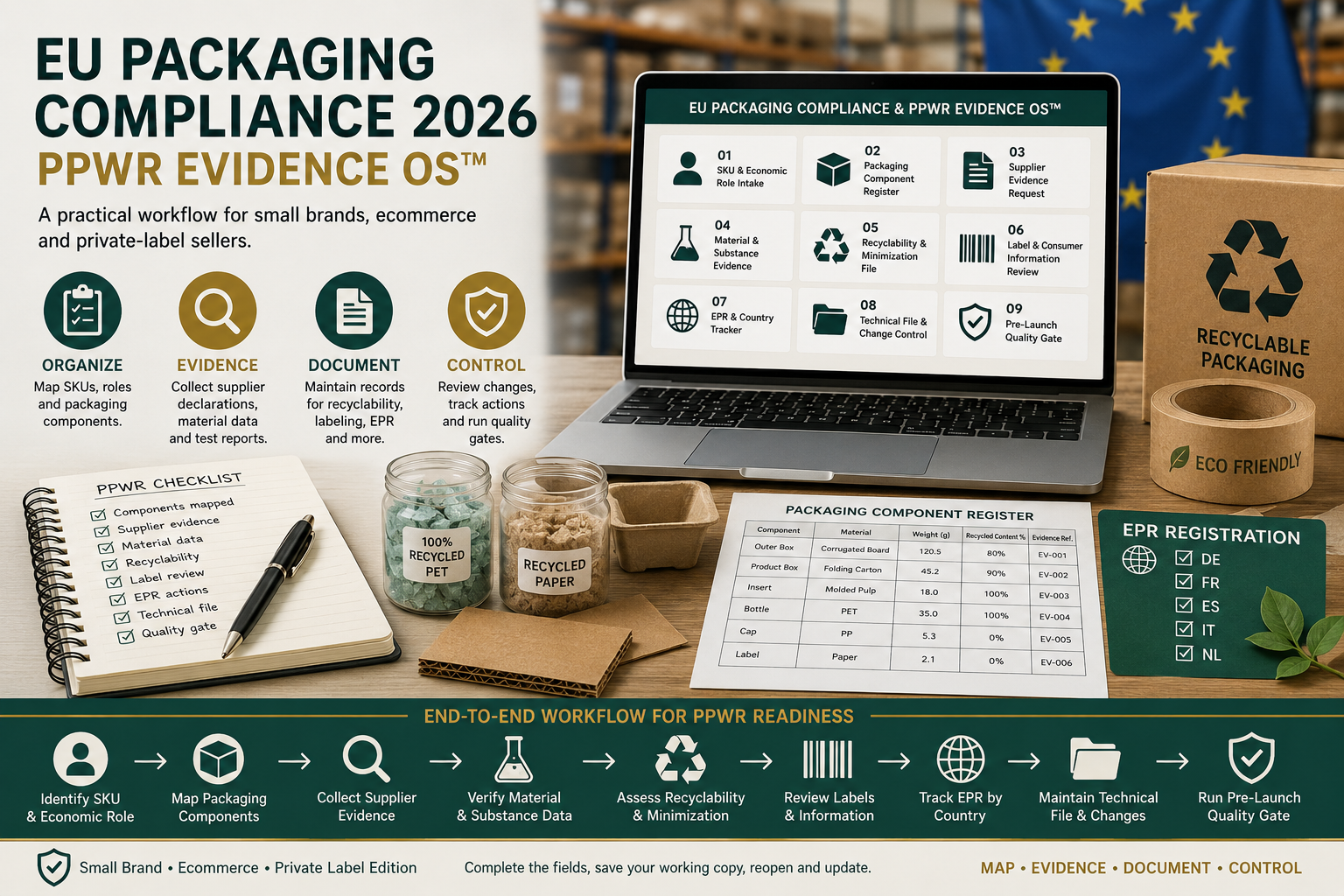
EU Packaging Compliance 2026: A Practical PPWR Checklist for Small Brands and Ecommerce
Selling physical products into the European Union can create a packaging challenge that many growing brands underestimate.
A business may know what product it sells and what box it ships in, yet still have packaging information scattered across supplier emails, invoices, artwork files, spreadsheets and declarations.
When packaging requirements change, the problem becomes larger than simply asking:
Is our packaging recyclable?
Businesses may also need to understand what packaging they place on the market, which materials and components are involved, what evidence suppliers can provide, which economic role applies, what labeling or consumer information needs review, what country-level EPR actions may exist and whether the supporting technical file is organized.
For small brands, ecommerce businesses and private-label sellers, a practical approach to EU packaging compliance in 2026 starts with documentation.
The objective is not to guess whether packaging is compliant.
The objective is to create an organized evidence trail that can be reviewed against the requirements that actually apply to the business.
What Is PPWR?
PPWR refers to the European Union's Packaging and Packaging Waste Regulation.
For businesses, the important operational lesson is that packaging should not be treated as an anonymous box or container surrounding a product.
Packaging can have components, materials, weights, suppliers, claims, labels, evidence requirements and market-specific obligations that need to be understood and documented.
Applicability can vary depending on the business's role, product, packaging type, Member State, date and other requirements.
That means a useful compliance workflow should distinguish between organizing evidence and making a final legal or regulatory determination.
Why Small Ecommerce Brands Need a Packaging Evidence System
Large organizations may have dedicated regulatory, sustainability, procurement and legal teams.
A smaller ecommerce company may have one founder managing suppliers, listings, marketing, inventory and packaging at the same time.
That creates predictable documentation problems.
A supplier declaration may live in an old email.
The weight of a packaging component may exist in one spreadsheet.
Artwork may have been updated without documenting which version was reviewed.
An EPR registration number may be stored in another system.
A recycled-content claim may appear on packaging without a clearly indexed evidence reference.
The individual pieces may exist, but the organization cannot easily connect them.
An evidence-first system creates structure around those pieces.
The Core PPWR Documentation Workflow
A practical packaging workflow can be organized around nine areas:
1. SKU and economic-role intake
2. Packaging component register
3. Supplier evidence requests
4. Material and substance evidence
5. Recyclability and minimization documentation
6. Label and consumer-information review
7. EPR and country tracking
8. Technical-file and change control
9. Pre-launch quality review
These areas form the operating structure of the EU Packaging Compliance & PPWR Evidence OS™.
Step 1: Identify the Product and SKU
Start with the product itself.
For every relevant SKU, record basic information such as:
- Product or SKU name
- Brand or legal entity
- EU markets or Member States
- Relevant economic role
- Whether packaging is placed on the EU market
- Applicability questions requiring further review
Do not begin with assumptions about which rules apply.
Begin by documenting the facts needed to evaluate applicability.
Step 2: Determine Your Economic Role
Businesses operating in the EU packaging ecosystem may encounter different roles, including manufacturer, importer, distributor or other relevant roles.
Your position in the supply chain can affect the questions that need to be evaluated.
For that reason, record the role associated with each relevant product or packaging scenario rather than assuming the entire business always operates under one category.
Where the role is unclear, flag it for qualified review.
Step 3: Build a Packaging Component Register
A product's packaging may consist of more than one component.
For example, an ecommerce product might involve:
- Primary container
- Bottle or jar
- Cap or closure
- Label
- Insert
- Product box
- Protective material
- Shipping carton
- Mailer
- Tape
Create a register that identifies each relevant packaging component separately.
For each component, consider recording:
- Packaging component
- Packaging level or function
- Supplier
- Material composition
- Weight
- Recycled-content claim or percentage
- Evidence reference
This converts packaging from a vague product attribute into a traceable data set.
Step 4: Map Packaging Materials
Once components have been identified, document their material composition.
Depending on the packaging, this could involve paper, cardboard, plastics, glass, metals or combinations of materials.
Avoid relying exclusively on visual assumptions.
If the supplier manufactured the component, request documentation supporting the material information being recorded.
Step 5: Record Packaging Weight
Packaging weight can become important for documentation and reporting workflows.
Maintain consistent measurement records for relevant components.
Where possible, document:
- Component weight
- Unit of measurement
- Source of the measurement
- Date
- Supporting supplier or internal evidence
Consistency matters when the same information later feeds other reporting processes.
Step 6: Validate Recycled-Content Claims
A statement such as 'contains recycled material' should not exist only as marketing copy.
If a recycled-content claim is being made or relied upon, maintain an evidence reference supporting the information.
Useful documentation may identify:
- Component
- Virgin-material weight
- Recycled-material weight
- Claimed percentage
- Supplier declaration or other source
- Reviewer
- Review date
The principle is simple:
Claim and evidence should remain connected.
Step 7: Create a Supplier Evidence Request Process
Small brands frequently depend on packaging suppliers for technical information.
Instead of repeatedly searching old email conversations, create a formal evidence-request record.
Track information such as:
- Supplier and contact
- Component or material
- Evidence requested
- Request date
- Due date
- Whether the evidence was received
- Gap or escalation notes
This makes missing documentation visible.
Without a tracker, an unanswered supplier request can quietly disappear until the business urgently needs the evidence.
Step 8: Maintain Material and Substance Evidence
Material documentation should be organized so the business can identify the evidence supporting important packaging information.
A material evidence record can contain:
- Material or component
- Virgin-material weight
- Recycled-material weight
- Restricted-substance evidence
- Test or declaration source
- Reviewer and review date
Do not automatically treat a supplier statement as proof of every possible regulatory requirement.
Record what the document actually supports and route questions requiring interpretation to an appropriately qualified professional.
Step 9: Review Recyclability
Recyclability is an important part of modern packaging strategy, but businesses should avoid reducing the analysis to a recycling symbol printed on a box.
Maintain records for:
- Design-for-recycling evidence
- Recyclability assessment
- Source of the assessment
- Packaging construction
- Relevant supporting documentation
If an external methodology, laboratory, supplier or other source is used, identify it in the evidence file.
Step 10: Document Packaging Minimization
Another useful documentation area is packaging minimization.
Ask practical questions such as:
- Why is this amount of packaging necessary?
- What function does each component perform?
- Could unnecessary material be removed?
- Has empty space been reviewed?
- Does the packaging protect the product appropriately?
- Is reuse or refill relevant?
Document the rationale rather than relying on memory.
This can be especially useful when packaging designs change over time.
Step 11: Review Empty Space
Ecommerce shipping can involve boxes or mailers significantly larger than the products inside them.
Create an explicit empty-space review in the packaging file.
The review can document:
- Product dimensions
- Packaging dimensions
- Protective-space requirements
- Reasons for additional space
- Potential redesign opportunities
The purpose is to create a documented design decision rather than an unexplained packaging configuration.
Step 12: Evaluate Reuse and Refill Relevance
Not every packaging system will use a reuse or refill model.
However, the question should be evaluated where relevant rather than ignored.
Record whether reuse or refill considerations apply and document the reasoning or evidence supporting that assessment.
Step 13: Review Labels and Consumer Information
Packaging artwork can become another documentation risk.
Brands often maintain multiple versions of a label or package design.
Your review file should identify:
- Packaging or SKU
- Required marking or information being reviewed
- Current artwork or label version
- Evidence or source used for review
- Review status
- Reviewer
- Date
This helps answer a surprisingly important question:
Which exact version of the packaging did we review?
Step 14: Control Artwork Versions
Do not allow files named FINAL, FINAL2 and FINAL-NEW to become your packaging-control system.
Use clear version identifiers and maintain review records.
When artwork changes, determine whether the change affects previously reviewed information.
A minor visual adjustment may have no meaningful compliance impact.
Another change could alter claims, markings, material instructions or consumer information.
Document the distinction.
Step 15: Track EPR by Country
Extended Producer Responsibility, or EPR, should not automatically be treated as one identical EU-wide administrative task.
Maintain a country-level tracker for the Member States relevant to your business.
Useful fields can include:
- Member State
- Responsible entity or role
- Registration or producer ID
- Reporting cadence or deadline
- PRO, scheme or service provider
- Open action
This turns EPR into a manageable operational workflow rather than a collection of disconnected reminders.
Step 16: Do Not Assume One Registration Covers Everything
A business selling into several European markets should avoid assuming that completing one registration automatically resolves every packaging responsibility elsewhere.
Map the countries in which relevant products and packaging are placed on the market and evaluate the applicable obligations for each situation.
When uncertain, record the issue as an open action requiring verification.
Step 17: Build a Packaging Technical File
Evidence becomes more useful when it has a defined home.
Create a technical-file location or ID for each relevant product, packaging family or other logical grouping.
The file can index materials such as:
- Packaging component records
- Supplier documentation
- Material evidence
- Recycled-content evidence
- Recyclability assessments
- Label reviews
- EPR records
- Relevant declarations
- Review records
- Change-control documentation
The objective is traceability.
Someone reviewing the product should be able to understand what packaging is used and locate the evidence supporting the recorded information.
Step 18: Establish Packaging Change Control
Packaging rarely stays unchanged forever.
Suppliers change.
Materials change.
Labels change.
Weights change.
Product dimensions change.
A new country may be added.
Whenever a meaningful packaging change occurs, record:
- Change description
- Impact assessment
- Re-review or approval owner
- Effective date
Then determine which previously completed reviews need to be revisited.
Step 19: Treat Supplier Changes as Evidence Events
A supplier change should not simply replace one vendor name with another.
Ask whether the new supplier changes:
- Material composition
- Packaging weight
- Recycled content
- Supporting declarations
- Restricted-substance evidence
- Recyclability information
- Artwork
- Other technical information
If so, update the supporting evidence file.
Step 20: Create a Pre-Launch Quality Gate
Before launching a relevant product or packaging configuration, run a final documentation review.
A practical gate can verify whether:
- SKU and component register is complete
- Supplier evidence gaps are resolved or formally accepted
- Material data has been reviewed
- Label review is complete
- EPR country actions have been reviewed
- Technical file is indexed
- Final reviewer is identified
- Next review date is scheduled
A quality gate does not replace legal or regulatory review.
It creates an operational checkpoint so important documentation tasks are less likely to be forgotten.
A Practical EU Packaging Compliance Checklist
Use the following framework as an organizational starting point.
Product and Role
- Identify every relevant SKU
- Record the legal entity
- Identify EU markets
- Document the economic role
- Flag applicability questions
Packaging Components
- Identify individual components
- Record packaging level or function
- Identify suppliers
- Record material composition
- Record weight
- Link evidence
Supplier Evidence
- Identify required evidence
- Send documented requests
- Assign due dates
- Record receipt
- Escalate unresolved gaps
Materials
- Document material composition
- Record virgin and recycled material data where relevant
- Index restricted-substance evidence where applicable
- Record tests or declaration sources
- Assign reviewers
Recyclability and Minimization
- Preserve design-for-recycling evidence
- Record recyclability assessments
- Document packaging-minimization rationale
- Review empty space
- Evaluate reuse or refill relevance
Labeling
- Identify current artwork version
- Review relevant markings and information
- Record evidence sources
- Document reviewer and date
EPR
- Track relevant Member States
- Record responsible entities
- Maintain registration or producer IDs
- Track reporting cadence and deadlines
- Record schemes or service providers
- Maintain open actions
Technical File
- Establish a technical-file location
- Index supporting evidence
- Document packaging changes
- Perform impact assessments
- Assign approval ownership
Pre-Launch Gate
- Confirm component register completion
- Review supplier gaps
- Review material data
- Complete label review
- Review EPR actions
- Index technical files
- Record final reviewer
- Schedule the next review
Common Packaging Compliance Documentation Mistakes
Mistake 1: Treating the Product as the Packaging Record
A SKU and its packaging are related but not identical.
Map individual packaging components where appropriate.
Mistake 2: Relying on Supplier Emails
Important evidence should be indexed and traceable rather than buried inside inboxes.
Mistake 3: Making Claims Without Evidence References
If a material or recycled-content claim matters, maintain the source supporting it.
Mistake 4: Forgetting Artwork Version Control
Always identify which packaging or label version was reviewed.
Mistake 5: Treating EPR as a Single Generic EU Task
Track relevant actions by country and role.
Mistake 6: Failing to Re-Review After Changes
A supplier, material, packaging or artwork change can affect previously collected documentation.
Mistake 7: Treating Documentation as Legal Determination
An organized evidence file helps a business prepare for review, but it does not independently determine whether every applicable requirement has been satisfied.
Build Your PPWR Evidence Workflow
The EU Packaging Compliance & PPWR Evidence OS™ is designed for small brands, ecommerce businesses and private-label sellers that need a structured way to organize packaging documentation.
The premium interactive edition provides fillable workflows covering:
- SKU and economic-role intake
- Packaging component register
- Supplier evidence requests
- Material and substance evidence
- Recyclability and minimization
- Label and consumer-information review
- EPR and country tracking
- Technical-file and change control
- Pre-launch quality gate
Instead of keeping packaging information scattered across inboxes, supplier folders and spreadsheets, businesses can create a repeatable workflow around four actions:
MAP → EVIDENCE → DOCUMENT → CONTROL
Who Is the System Designed For?
The workflow is particularly relevant to organizations such as:
- Small product brands
- Ecommerce businesses
- Private-label sellers
- Marketplace sellers
- Import-oriented businesses
- Product operations teams
- Packaging teams
- Founders coordinating multiple suppliers
The appropriate regulatory requirements still need to be evaluated for the individual business, product, role, packaging type, Member State and relevant dates.
Final Takeaway
EU packaging readiness is easier to manage when packaging is treated as structured operational data rather than simply the container a product arrives in.
Start with the SKU.
Identify the business role.
Map every relevant packaging component.
Document materials and weights.
Collect supplier evidence.
Review recyclability and minimization.
Control label versions.
Track EPR actions by country.
Maintain a technical file.
Re-review meaningful changes.
Then run a pre-launch quality gate before treating the documentation process as complete.
The goal is not to manufacture certainty where qualified review is still required.
The goal is to know what you use, what you know, what evidence you have and what still needs to be verified.
MAP. EVIDENCE. DOCUMENT. CONTROL.
Important notice: This article and the EU Packaging Compliance & PPWR Evidence OS™ support packaging documentation and evidence workflows. They are not legal, regulatory, environmental, engineering, laboratory, customs, tax or compliance advice. Applicability can vary by role, product, packaging type, Member State, date and implementing requirements. Validate current requirements using appropriate official sources and qualified professional advice.
Enjoying the Academy?
Join AurumVault Insider for new practical guides, digital tools, and marketplace releases.
No spam. Unsubscribe anytime. Privacy
By subscribing, you agree to receive AurumVault Insider emails. You can unsubscribe at any time.
Continue your journey
Keep reading
EU Packaging Compliance 2026: PPWR Checklist for Small Brands and Ecommerce
EU packaging compliance can involve far more than choosing recyclable packaging. Small brands selling into European markets may need to understand their economic role, map packaging components, collect supplier evidence, document material data, review recyclability and labeling, track country-level EPR actions and maintain technical records. This guide provides an evidence-first framework for organizing that work.
AI Governance for Small Business: The Complete 2026 Checklist
Small businesses are adopting AI faster than many are creating rules for it. This practical 2026 checklist shows business owners how to inventory AI tools, protect sensitive information, define employee and AI-agent authority, require human approval for consequential actions, evaluate vendors, document incidents and create a manageable AI governance system.
AI Governance in Banking: A Practical Operations Framework
Banking AI governance should go beyond documenting models. This practical framework shows how financial institutions can inventory AI use, classify customer and financial impact, establish authority limits, validate material systems, preserve transaction-level evidence and review complaints, incidents and controls.