
Financial Literacy for Kids: How to Teach Children About Money
Financial literacy can begin long before adulthood. Discover practical ways parents and caregivers can teach children about earning, saving, spending, budgeting, banking, investing, and making thoughtful money choices.
Financial Literacy for Kids: How to Teach Children About Money
Children learn how to read, write, count, communicate, and solve problems—but one important life skill can sometimes receive much less attention: how to manage money.
Financial literacy for kids is about helping children understand what money is, where it comes from, what happens when they spend it, why saving matters, and how thoughtful financial decisions can affect their future.
Children do not need complicated financial formulas to begin learning. Some of the most valuable lessons can start with a dollar bill, a savings jar, a trip to the store, or a conversation about why a family chooses one purchase instead of another.
The goal isn't to turn children into financial experts overnight. It is to give them a foundation they can continue building throughout their lives.
What Is Financial Literacy for Kids?
Financial literacy is the ability to understand and make informed decisions about money.
For children, that starts with simple concepts such as:
- What money is
- How people earn money
- The difference between needs and wants
- How spending works
- Why people save
- What a budget does
- How banks work
- What borrowing means
- Why debt must be repaid
- How money can potentially grow through investing
- How to recognize scams and protect money
These concepts are connected. A child who understands that money is limited can better understand why people budget. Once budgeting makes sense, saving toward a goal becomes easier to understand. Later, those lessons can provide a foundation for learning about bank accounts, credit, investing, and financial responsibility.
Why Teaching Kids About Money Matters
Children encounter money decisions earlier than many adults realize.
They see prices in stores. They watch adults use debit and credit cards. They encounter advertisements in games, apps, videos, and social media. Some receive allowance or money for birthdays and holidays.
Without financial education, money can appear almost unlimited—especially when purchases happen by tapping a card or pressing a button.
Teaching children how money actually works helps connect those purchases with earning, planning, saving, and decision-making.
Instead of simply hearing, 'We can't buy that,' a child can gradually learn to ask better questions:
Do I need it?
Do I really want it?
How much does it cost?
Do I have enough money?
Should I save for something more important?
Those questions represent the beginning of financial literacy.
Start by Teaching Where Money Comes From
One of the first money lessons children can learn is that money usually comes from providing work, skills, products, or services.
Parents can demonstrate this through everyday examples. Adults receive income from jobs. A business earns money by selling products or services. A child might earn money by completing an agreed-upon task or operating a small lemonade stand with adult supervision.
This creates an important connection:
Money represents value, work, and choices.
When children understand that earning money requires effort, they may begin thinking differently about how quickly they spend it.
Teach the Difference Between Needs and Wants
Understanding needs and wants is one of the strongest foundations for smart money decisions.
A need is something important for living, safety, health, or everyday responsibilities. Food, basic clothing, shelter, and necessary school supplies are common examples.
A want is something enjoyable or desirable that a person can live safely without.
That doesn't make wants bad.
The lesson is about priorities.
When shopping, parents can turn ordinary decisions into short learning exercises. Ask a child whether an item is a need or a want and why.
Over time, children begin recognizing that money spent on one thing cannot simultaneously be spent on something else.
Show Kids How Saving Works
Saving becomes much easier for children to understand when they can see progress.
Suppose a child wants something that costs $30.
Instead of purchasing it immediately, help the child create a savings goal. If they save $5 at a time, they can watch their progress move from $5 to $10, $15, $20, $25, and eventually $30.
That simple experience teaches several lessons at once:
- Patience
- Goal setting
- Delayed gratification
- Planning
- Consistency
A transparent savings jar, written savings tracker, or child-friendly savings account can make progress visible.
Introduce Budgeting in a Simple Way
The word 'budget' can sound complicated, but the basic concept is simple.
A budget is a plan for money.
Children can practice with three or four categories such as:
Save — Spend — Give — Goal
If a child receives $20, help them decide how much should go into each category before spending anything.
There doesn't have to be one perfect percentage. The important lesson is learning to make a plan before the money disappears.
This teaches children that budgeting isn't necessarily about saying no to everything they enjoy. It's about deciding intentionally where money should go.
Let Children Practice Making Small Money Decisions
Experience can be one of the best teachers.
Give children opportunities to make age-appropriate financial choices.
If they have $10 available and want two different items that together cost $15, don't immediately solve the problem for them. Help them compare their choices.
They might choose one item, save more money, find a less expensive alternative, or decide neither purchase is worth it.
Small decisions provide practice before the financial consequences become much larger in adulthood.
Teach Kids to Compare Price, Cost, and Value
Price and value aren't always the same thing.
A less expensive product isn't automatically the best purchase, and an expensive product isn't automatically better.
Children can learn to consider:
- Price
- Quality
- Usefulness
- How long something may last
- Whether they will actually use it
For example, compare two school supplies or toys and ask which provides better value and why.
These conversations help children become more thoughtful consumers.
Explain Banks and Bank Accounts
As children get older, introduce the idea that money doesn't always have to remain as physical cash.
Banks and other financial institutions provide ways for people to store and manage money.
Children can gradually learn vocabulary such as:
- Bank
- Bank account
- Savings account
- Checking account
- Deposit
- Withdrawal
- Debit card
If your child has a savings account, consider showing them how deposits increase the balance. This makes digital money feel more concrete.
Explain Credit and Debt Before Children Need Them
Credit can be especially confusing because a card can make a purchase look effortless.
Children should understand that borrowing money doesn't make something free.
A loan creates an obligation to repay money. Credit cards can also create debt when borrowed balances aren't repaid.
A simple explanation might be:
Borrowing lets you use someone else's money now, but you agree to pay it back later according to the terms of the agreement.
That basic principle can prepare children for more advanced lessons about interest and credit scores later.
Introduce Investing as a Long-Term Concept
Saving and investing are related, but they aren't identical.
Saving generally means setting money aside for future use. Investing means putting money into an asset with the expectation that it may increase in value or produce income, while accepting that losses are also possible.
Children don't need to begin by analyzing complicated investments.
Start with the idea of ownership and growth.
You might explain that a stock can represent a small ownership interest in a company. Some investments may increase in value, some may generate income, and some may lose value.
This also creates an opportunity to introduce the relationship between risk and return.
Teach Children About Scams and Digital Money
Modern financial literacy also requires digital awareness.
Children increasingly encounter online games, digital purchases, virtual currencies, advertisements, and messages asking them to click links or provide information.
Teach them never to assume that every offer online is legitimate.
Useful habits include:
- Don't share passwords
- Don't provide financial information without a trusted adult
- Be cautious about unexpected links
- Question offers promising easy or guaranteed money
- Ask an adult before making online purchases
Learning how to protect money is just as important as learning how to earn it.
Make Money Conversations Normal
Children benefit when money isn't treated as a mysterious subject that adults never discuss.
That doesn't mean parents need to disclose every detail of household finances.
Instead, use everyday situations as teaching opportunities.
At the grocery store, compare prices.
Before a family outing, discuss the budget.
When saving for something, explain the goal.
When an advertisement appears, talk about how advertising encourages people to spend.
When receiving change, let children count it.
Short conversations repeated over time can make financial education feel natural rather than intimidating.
10 Money Skills Every Child Can Begin Learning
A strong early financial education can focus on ten practical skills:
1. Recognizing different forms of money
2. Understanding how money is earned
3. Separating needs from wants
4. Comparing prices
5. Saving toward goals
6. Creating a simple budget
7. Making thoughtful purchases
8. Understanding banks and accounts
9. Understanding borrowing and debt
10. Recognizing financial scams
Children can then build on these foundations as they become ready for concepts such as interest, compound interest, investing, stocks, dividends, insurance, credit scores, entrepreneurship, and financial planning.
A Simple Weekly Money Activity for Families
Try creating a short weekly 'money moment.'
Choose one money word each week and spend five or ten minutes discussing it.
For example:
Week 1: Money — What is money used for?
Week 2: Earn — What are different ways people earn money?
Week 3: Save — What would you like to save for?
Week 4: Budget — How could you divide $20 responsibly?
Week 5: Need vs. Want — Sort everyday purchases into the two categories.
After several months, a child can develop an impressive vocabulary without the lessons feeling like traditional financial coursework.
Building Financial Confidence One Word at a Time
Financial literacy isn't one lesson. It's a collection of habits, vocabulary, experiences, and decisions that develop over time.
A child who learns what it means to earn money can begin understanding why saving matters. A child who learns to save can begin setting goals. A child who understands goals can learn to budget. From there, concepts such as banking, borrowing, investing, risk, credit, business, and generosity become easier to understand.
The objective isn't simply to teach children how to have more money.
It's to help them learn how to make thoughtful decisions with the money they have.
Continue the Learning with My First Money Dictionary
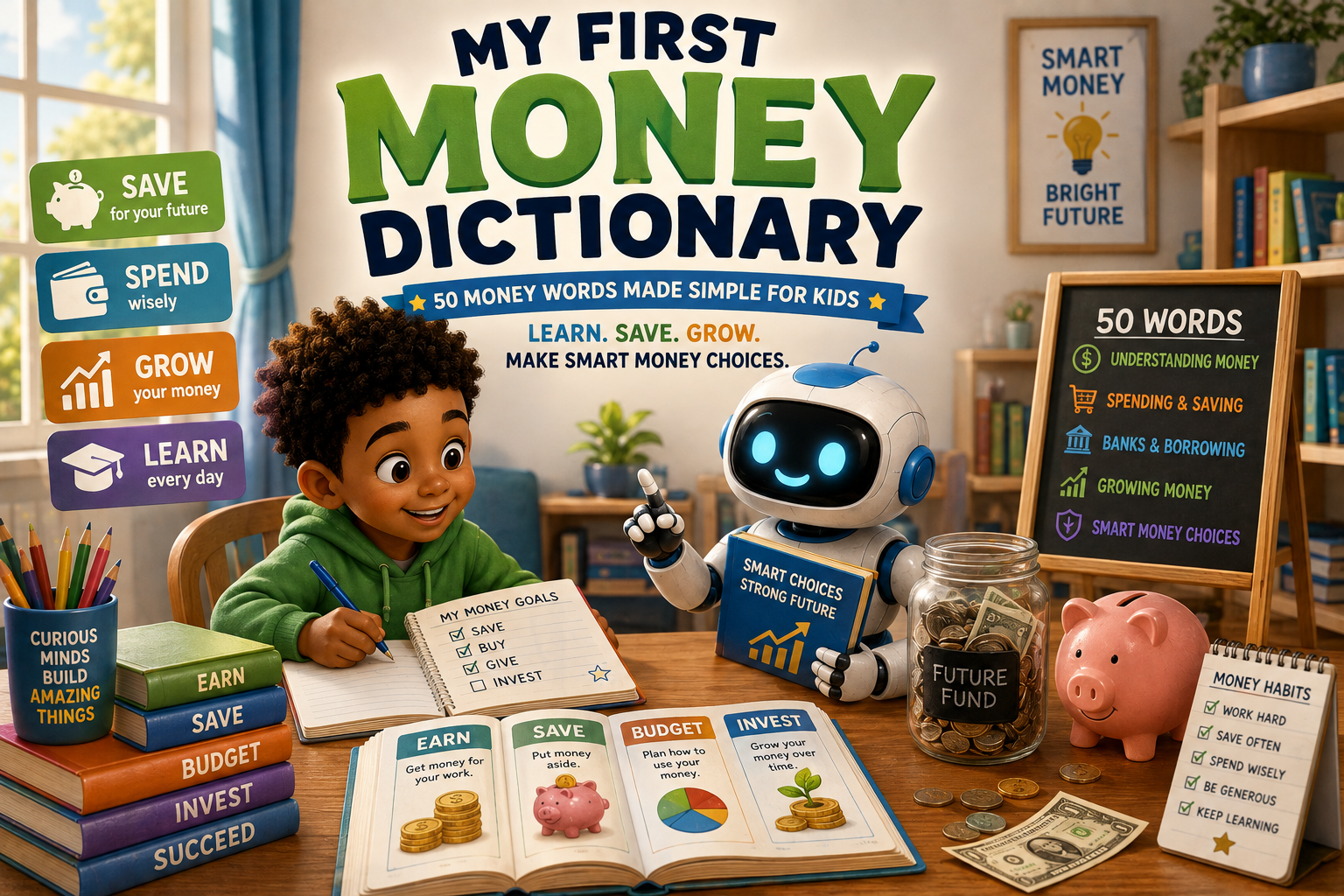
For families looking for a structured introduction to money vocabulary, My First Money Dictionary: 50 Money Words Made Simple for Kids introduces children to 50 foundational financial terms across five areas: understanding money, spending and saving, banks and borrowing, growing money, and smart money choices.
Each concept is presented through a simple definition, visual example, familiar comparison, picture lesson, and practical Money Smart Tip—making financial concepts easier for young learners to understand and discuss with an adult.
Start with one word. Ask one question. Practice one smart money habit.
Those small lessons can become financial skills a child carries for years.
Enjoying the Academy?
Join AurumVault Insider for new practical guides, digital tools, and marketplace releases.
No spam. Unsubscribe anytime. Privacy
By subscribing, you agree to receive AurumVault Insider emails. You can unsubscribe at any time.
Continue your journey
Keep reading
EU Packaging Compliance 2026: PPWR Checklist for Small Brands and Ecommerce
EU packaging compliance can involve far more than choosing recyclable packaging. Small brands selling into European markets may need to understand their economic role, map packaging components, collect supplier evidence, document material data, review recyclability and labeling, track country-level EPR actions and maintain technical records. This guide provides an evidence-first framework for organizing that work.
AI Governance for Small Business: The Complete 2026 Checklist
Small businesses are adopting AI faster than many are creating rules for it. This practical 2026 checklist shows business owners how to inventory AI tools, protect sensitive information, define employee and AI-agent authority, require human approval for consequential actions, evaluate vendors, document incidents and create a manageable AI governance system.
AI Governance in Banking: A Practical Operations Framework
Banking AI governance should go beyond documenting models. This practical framework shows how financial institutions can inventory AI use, classify customer and financial impact, establish authority limits, validate material systems, preserve transaction-level evidence and review complaints, incidents and controls.