
GLP-1 Weight Loss: Benefits, Risks & What to Know
GLP-1 medications have transformed modern weight management, but dramatic weight-loss headlines tell only part of the story. Here is what to understand about results, side effects, costs, maintenance, and weight regain before making a decision.
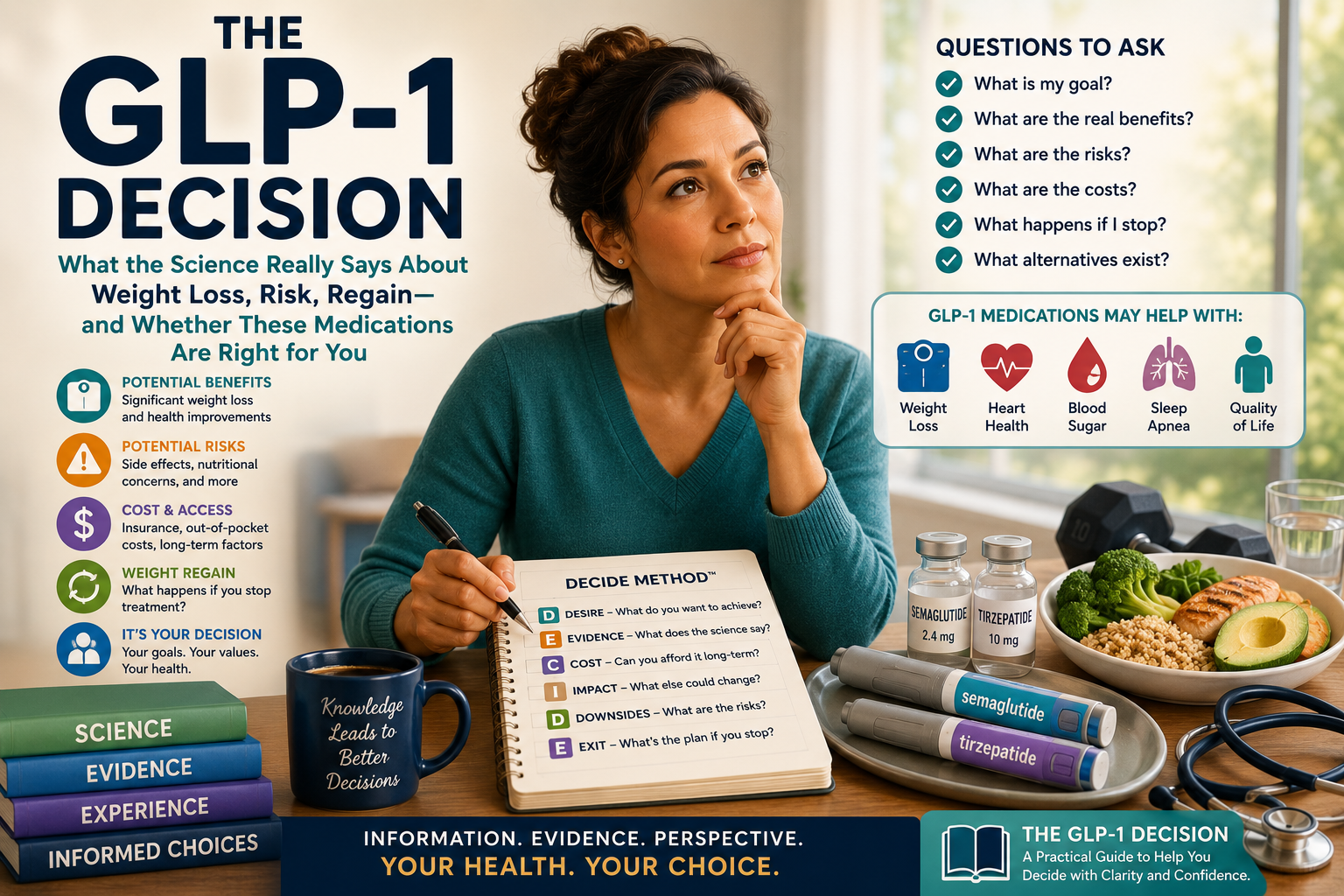
GLP-1 Weight Loss: Benefits, Risks & What to Know Before You Decide
GLP-1 medications have changed the conversation around weight loss.
For years, people struggling with obesity were often given advice that sounded deceptively simple: eat less and move more. Today, medications such as semaglutide and tirzepatide have demonstrated that pharmacological treatment can produce substantial weight reduction for some people.
But there is an important difference between asking whether GLP-1-based treatments can work and asking whether a particular treatment is appropriate for a particular person.
The second question is much more complicated.
A thoughtful decision requires looking beyond dramatic before-and-after photographs. It means understanding potential benefits, side effects, cost, nutrition, muscle and physical function, long-term maintenance, and what may happen if treatment stops.
What Are GLP-1 Medications?
GLP-1 stands for glucagon-like peptide-1. It is not something invented in a laboratory from nothing. The human body naturally produces GLP-1 after nutrients enter the gastrointestinal tract.
GLP-1 participates in several physiological processes involving glucose regulation, gastrointestinal function, appetite, and food intake.
Modern medications can provide longer-lasting pharmacological activation of this biological system.
Semaglutide acts through the GLP-1 receptor. Tirzepatide is different because it activates both GIP and GLP-1 receptors.
Although these medications are frequently grouped together in everyday conversation, the specific molecule, product, approved indication, dose, safety information, and supporting evidence matter.
How Do GLP-1 Medications Help With Weight Loss?
One common misconception is that these medications simply 'burn fat.'
That is not an accurate description.
Their effects include influencing biological pathways related to appetite and food intake. For some patients, this can make sustained reductions in food intake easier to achieve.
Some people describe experiencing less persistent mental chatter about food—often informally called 'food noise.'
The important point is that medication does not eliminate the principles of energy balance. Instead, it can change some of the biological conditions influencing eating behavior and appetite.
How Much Weight Can People Lose?
Large clinical trials helped transform expectations for medication-based obesity treatment.
In the STEP 1 trial, participants assigned to semaglutide 2.4 mg experienced an average body-weight reduction of about 14.9% at 68 weeks, compared with about 2.4% with placebo.
In SURMOUNT-1, average weight reduction reached approximately 20.9% at 72 weeks among participants receiving the 15-mg tirzepatide dose, compared with approximately 3.1% with placebo.
Those results are significant—but averages are not promises.
Two people taking the same medication can experience very different outcomes. Clinical trials describe what happened across groups of participants under defined conditions. They do not provide an exact forecast for an individual.
GLP-1 Benefits Can Go Beyond the Scale
Weight is only one possible treatment outcome.
Research in defined patient populations has examined cardiovascular outcomes, physical function, sleep apnea, heart failure symptoms, kidney disease, and other health measures.
However, this is an area where headlines can become misleading.
A benefit demonstrated in one carefully defined population should not automatically be assumed to apply equally to everyone.
This leads to a better question than simply asking, 'How much weight can I lose?'
Ask instead:
What health outcome am I actually trying to improve?
What Are the Common GLP-1 Side Effects?
GLP-1-based treatment can be effective while also causing adverse effects.
Commonly reported gastrointestinal problems include:
- Nausea
- Diarrhea
- Vomiting
- Constipation
- Abdominal discomfort
Persistent gastrointestinal symptoms can affect hydration and nutrition and may require medical attention.
There are also more serious safety considerations associated with particular medications and individual health circumstances. Product-specific prescribing information and an individual's medical history matter when evaluating these risks.
This is one reason social-media anecdotes should not substitute for medical evidence or individualized clinical advice.
What About Muscle and Lean Mass?
The bathroom scale measures total mass. It cannot tell you whether weight change came from fat, lean tissue, water, or other components.
Substantial weight reduction can include some loss of lean mass.
But 'lean mass' and 'skeletal muscle' are not interchangeable terms.
Strength, mobility, and physical function therefore deserve attention alongside the number on the scale, particularly for older adults or people with lower muscle reserves.
When medically appropriate, resistance exercise can be an important strategy for supporting strength and physical function during intentional weight reduction.
Can Appetite Suppression Go Too Far?
Less hunger can be helpful. But nutritional requirements do not disappear simply because appetite becomes quieter.
For some people, strong appetite suppression can make it more difficult to consume adequate food, protein, fluids, and micronutrients.
Persistent vomiting or diarrhea can also contribute to dehydration.
The goal of treatment should not simply be to become extremely good at avoiding food.
The goal is improved health while remaining adequately nourished.
What Happens When You Stop a GLP-1 Medication?
This may be one of the most important questions to understand before treatment begins.
Randomized withdrawal evidence shows that substantial weight regain can occur after effective semaglutide or tirzepatide treatment is withdrawn.
In the STEP 1 extension, participants regained roughly two-thirds of their previous semaglutide-associated weight loss on average during the year following treatment withdrawal.
That does not mean every individual will regain the same amount.
It also does not prove addiction.
A more useful interpretation is that removing an effective treatment can remove some of the treatment effect.
This makes maintenance planning important before—not merely after—someone reaches a desired weight.
Does GLP-1 Treatment Have to Be Forever?
'Forever' may be the wrong question.
A better question is:
What long-term strategy will be necessary to maintain the benefits that matter to me?
Obesity is often managed as a chronic condition, and long-term pharmacotherapy may be appropriate for some patients.
That does not mean every person must remain on one exact medication at one exact dose indefinitely.
Treatment duration and medication decisions should be individualized with an appropriately qualified healthcare professional.
Don't Forget the Financial Cost
Treatment cost can become a major part of the decision.
Actual out-of-pocket expenses can depend on insurance coverage, deductibles, authorization requirements, pharmacy pricing, savings programs, formulation, and indication.
Coverage can also change.
Someone considering treatment should therefore think beyond the first prescription and ask whether the expected financial burden is sustainable over time.
A Better Way to Think About the GLP-1 Decision
The question does not have to be reduced to 'GLP-1s are amazing' or 'GLP-1s are dangerous.'
Both extremes remove information people need to make thoughtful decisions.
A more useful framework is to consider six areas:
Desire
What are you actually trying to accomplish?
Evidence
What does reliable evidence say about that goal and people with circumstances similar to yours?
Cost
What will treatment require financially and practically?
Impact
What could change beyond the number on the scale?
Downsides
Which risks, adverse effects, and burdens matter to you?
Exit
What happens if treatment succeeds, fails, becomes unaffordable, causes unacceptable side effects, or needs to stop?
These six areas form the DECIDE Method™ presented in The GLP-1 Decision.
Seven Questions to Ask Before a Prescription
Consider discussing these questions with an appropriately qualified healthcare professional:
1. What health problem are we trying to improve?
2. Why might this treatment be appropriate for me?
3. What benefits are reasonably supported for someone with my health profile?
4. Which risks or contraindications matter specifically in my situation?
5. What alternatives should I understand?
6. How will we determine whether treatment is helping enough to continue?
7. What is the plan if treatment works, does not work, becomes intolerable, becomes unaffordable, or has to stop?
The Most Important GLP-1 Question May Not Be 'Does It Work?'
Modern weight-management medications have produced results significant enough to change expectations about obesity treatment.
But treatment effectiveness is only one part of a good decision.
The more useful question is:
What could this treatment reasonably do for me—and what might it ask of me in return?
That question leaves room for benefits without turning medication into a miracle. It leaves room for risks without turning medication into a horror story.
And most importantly, it leaves room for the individual making the decision.
Your answer may ultimately be yes, no, not yet, or 'I need more information.' The objective is not reaching a predetermined answer. The objective is making a decision you understand.
Learn More: The GLP-1 Decision
The GLP-1 Decision: What the Science Really Says About Weight Loss, Risk, Regain—and Whether These Medications Are Right for You by Delvin Hale explores the science and decision-making questions surrounding modern GLP-1-based weight treatment.
The book also includes the GLP-1 DECIDE Method™ and a practical decision toolkit designed to help readers organize their goals, concerns, costs, questions, and long-term considerations before discussing treatment with a qualified healthcare professional.
Medical disclaimer: This article provides general educational information and is not individualized medical advice, diagnosis, or treatment. Medication decisions should be made with an appropriately qualified healthcare professional using current product-specific information.
Enjoying the Academy?
Join AurumVault Insider for new practical guides, digital tools, and marketplace releases.
No spam. Unsubscribe anytime. Privacy
By subscribing, you agree to receive AurumVault Insider emails. You can unsubscribe at any time.
Continue your journey
Keep reading
EU Packaging Compliance 2026: PPWR Checklist for Small Brands and Ecommerce
EU packaging compliance can involve far more than choosing recyclable packaging. Small brands selling into European markets may need to understand their economic role, map packaging components, collect supplier evidence, document material data, review recyclability and labeling, track country-level EPR actions and maintain technical records. This guide provides an evidence-first framework for organizing that work.
AI Governance for Small Business: The Complete 2026 Checklist
Small businesses are adopting AI faster than many are creating rules for it. This practical 2026 checklist shows business owners how to inventory AI tools, protect sensitive information, define employee and AI-agent authority, require human approval for consequential actions, evaluate vendors, document incidents and create a manageable AI governance system.
AI Governance in Banking: A Practical Operations Framework
Banking AI governance should go beyond documenting models. This practical framework shows how financial institutions can inventory AI use, classify customer and financial impact, establish authority limits, validate material systems, preserve transaction-level evidence and review complaints, incidents and controls.