
GLP-1 Weight Loss Medications: Benefits, Risks, Regain & What to Know Before You Decide
GLP-1 medications have changed expectations for medical weight management, but dramatic before-and-after photos tell only part of the story. Understanding benefits, side effects, costs, maintenance, nutrition, weight regain, and your personal goals can help you have a better conversation with a qualified healthcare professional.
GLP-1 Weight Loss Medications: Benefits, Risks, Regain & What to Know Before You Decide
Few developments have changed the weight-loss conversation as quickly as GLP-1-based medications.
Semaglutide and tirzepatide have become subjects of clinical research, news headlines, celebrity conversations, social-media transformations, controversy, and millions of personal questions.
And perhaps the biggest question is surprisingly simple:
Should I consider one?
There is no universal answer.
These medications can produce substantial weight reduction for many people, but understanding whether treatment makes sense requires looking beyond dramatic before-and-after photographs.
The more useful conversation includes the evidence, potential health benefits, side effects, nutrition, strength, cost, long-term maintenance, what may happen after treatment stops, and what you actually want treatment to accomplish.
This article provides general educational information and is not individualized medical advice. Medication decisions should be made with an appropriately qualified healthcare professional who understands your medical history and circumstances.
What Are GLP-1 Medications?
GLP-1 stands for glucagon-like peptide-1, a hormone your body naturally produces.
GLP-1 participates in several physiological processes involving glucose regulation, gastrointestinal function, appetite, and food intake.
Modern medications can provide longer-acting pharmacological activation of this biological system.
Semaglutide is one example.
Tirzepatide is somewhat different. Although frequently grouped into the broad cultural category of 'GLP-1 drugs,' tirzepatide activates both GIP and GLP-1 receptors.
Understanding these distinctions matters because molecule, brand, dose, approved indication, and supporting evidence are related—but they are not interchangeable concepts.
Do GLP-1 Medications Actually Work for Weight Loss?
Large randomized clinical trials have demonstrated substantial average weight reductions with modern obesity medications.
In the STEP 1 trial, 1,961 adults with overweight or obesity without diabetes participated in a study of semaglutide 2.4 mg alongside lifestyle intervention.
At 68 weeks, average body-weight change was approximately 14.9% with semaglutide compared with 2.4% with placebo.
The SURMOUNT-1 trial studied tirzepatide in adults with obesity, or overweight with at least one weight-related complication, without diabetes.
At 72 weeks, average weight reduction reached approximately 20.9% with the 15-mg tirzepatide dose, compared with 3.1% with placebo.
Those results helped transform expectations for pharmacological obesity treatment.
But there is an essential qualification:
An average is not a promise.
Clinical trials describe what happened across groups of participants under specific conditions. They cannot predict exactly what will happen to one individual.
Two people receiving treatment can experience substantially different results.
GLP-1 Medications Don't Simply 'Melt Fat'
One misconception worth correcting is the idea that these medications directly enter the body and burn fat.
That is not how they work.
GLP-1-based treatment influences biological pathways involved in appetite, satiety, food intake, glucose regulation, and other physiological processes.
For some people, one noticeable effect is a reduction in persistent thoughts about food—an experience commonly described as reduced 'food noise.'
When appetite and food intake decrease sufficiently over time, sustained negative energy balance can produce weight loss.
The medication changes some of the biological conditions influencing food intake. It does not make energy balance irrelevant.
Why Losing Weight Is More Complicated Than 'Eat Less, Move More'
Energy balance matters.
But human appetite and body-weight regulation are influenced by much more than a simple decision about how much food to eat.
Appetite, satiety, food-seeking behavior, genetics, sleep, environment, medications, reward pathways, energy expenditure, habits, and social circumstances can interact continuously.
When body weight decreases, physiological adaptations can also occur that favor increased appetite and energy conservation.
This helps explain why maintaining substantial weight loss can be difficult for some people.
Recognizing the biology does not mean behavior is irrelevant.
It means behavior occurs inside biology.
Benefits May Extend Beyond the Scale
The conversation around GLP-1 medications often focuses almost entirely on pounds lost.
But body weight isn't necessarily the only clinically meaningful outcome.
Research has examined outcomes involving cardiovascular health and other obesity-related conditions in defined populations.
For example, the SELECT trial studied adults with established cardiovascular disease and overweight or obesity without diabetes. Major cardiovascular events occurred less frequently among participants receiving semaglutide than placebo.
That does not mean every person taking semaglutide receives the same cardiovascular benefit.
The population being studied matters.
This is an important principle when reading GLP-1 headlines: always ask who was actually studied?
A better treatment question may therefore be:
What health outcome am I actually trying to improve?
What Are the Common GLP-1 Side Effects?
Gastrointestinal adverse effects are among the most commonly reported problems associated with semaglutide- and tirzepatide-based weight treatment.
These can include:
- Nausea
- Diarrhea
- Vomiting
- Constipation
- Abdominal discomfort
Common does not mean unimportant.
Persistent gastrointestinal symptoms can interfere with eating, nutrition, or hydration and may require medical attention.
Current product-specific prescribing information also contains important warnings, contraindications, and precautions that should be reviewed with a healthcare professional.
Individual risk can depend on medical history, other medications, the particular product, and additional health circumstances.
What About Muscle Loss?
When someone loses a substantial amount of body weight, not everything lost is necessarily body fat.
The scale measures mass. It cannot tell you how much change came from fat, lean tissue, water, or other body compartments.
This creates another important distinction:
Lean mass is not the same thing as skeletal muscle.
In a body-composition substudy associated with SURMOUNT-1, approximately three-quarters of the weight lost with tirzepatide was fat mass and approximately one-quarter was lean mass.
That does not mean one-quarter of the weight lost was skeletal muscle.
Preserving strength, mobility, and physical function can therefore be important parts of a broader weight-management strategy.
Resistance exercise is one of the better-supported behavioral strategies for supporting strength and attenuating loss of fat-free mass during intentional weight reduction, although an appropriate exercise program depends on individual health and physical capacity.
Eating Less Shouldn't Become Not Eating Enough
Appetite and nutritional requirements are not the same thing.
If treatment substantially suppresses appetite, some people may find it more difficult to consume adequate energy, protein, fluids, or micronutrients.
Persistent vomiting or diarrhea can also contribute to dehydration and volume depletion.
This doesn't mean everyone taking a GLP-1 needs the same diet or supplement program.
Nutrition needs differ according to age, body size, health conditions, activity, energy intake, kidney function, and other factors.
The objective isn't to become extraordinarily good at avoiding food.
The objective is improved health while remaining adequately nourished.
What Happens When You Stop a GLP-1?
This is one of the most important questions to understand before treatment begins.
Clinical trial evidence indicates that substantial weight regain can occur after effective treatment is withdrawn.
In an extension of STEP 1, participants regained roughly two-thirds of their previous semaglutide-associated weight loss on average during the following year after treatment withdrawal.
Other randomized withdrawal research involving semaglutide and tirzepatide has demonstrated similar overall patterns: people who continued treatment generally maintained benefits better than groups from whom active treatment was withdrawn.
Again, an average does not predict exactly what will happen to a particular person.
And weight regain after withdrawal does not automatically establish addiction.
A more useful interpretation may be that an ongoing treatment effect has been removed.
This is why maintenance deserves discussion before treatment stops—and ideally before treatment begins.
Will You Have to Take a GLP-1 Forever?
'Forever' may not be the most useful way to frame the question.
A better question is:
What long-term strategy would be required to maintain the benefits that matter to me?
Obesity is often managed as a chronic condition, and long-term pharmacotherapy may be appropriate for many patients.
That does not mean every individual must remain on one exact medication at one exact dose indefinitely.
Treatment duration and medication decisions require individualized clinical care.
Patients should not independently change doses, dosing intervals, formulations, or medications based on generalized information online.
Don't Forget the Financial Cost
A medication can work clinically and still become unsustainable financially.
Actual out-of-pocket costs can depend on insurance coverage, deductibles, coinsurance, prior authorization, indication, pharmacy, formulation, and available savings programs.
And 'covered' doesn't necessarily mean affordable.
Before beginning treatment, consider asking:
- What will this realistically cost me each month?
- Does the price depend on temporary savings?
- What happens if my insurance changes?
- What alternatives would we discuss if treatment became unaffordable?
Cost isn't a moral issue.
It is a practical part of treatment sustainability.
Define Success Before You Start
Before focusing on a goal weight, consider what you're actually hoping treatment will change.
Maybe the goal is better mobility.
Maybe it's improved metabolic health.
Maybe it's reducing appetite.
Maybe appearance matters to you.
Maybe you want to participate more comfortably in activities you've been avoiding.
Several motivations can coexist.
The important thing is understanding them.
Ask yourself:
If nobody could see that my body changed, would I still want treatment?
And:
If my health improved significantly but I never reached my dream weight, would treatment still feel worthwhile?
Those questions can reveal what success actually means to you.
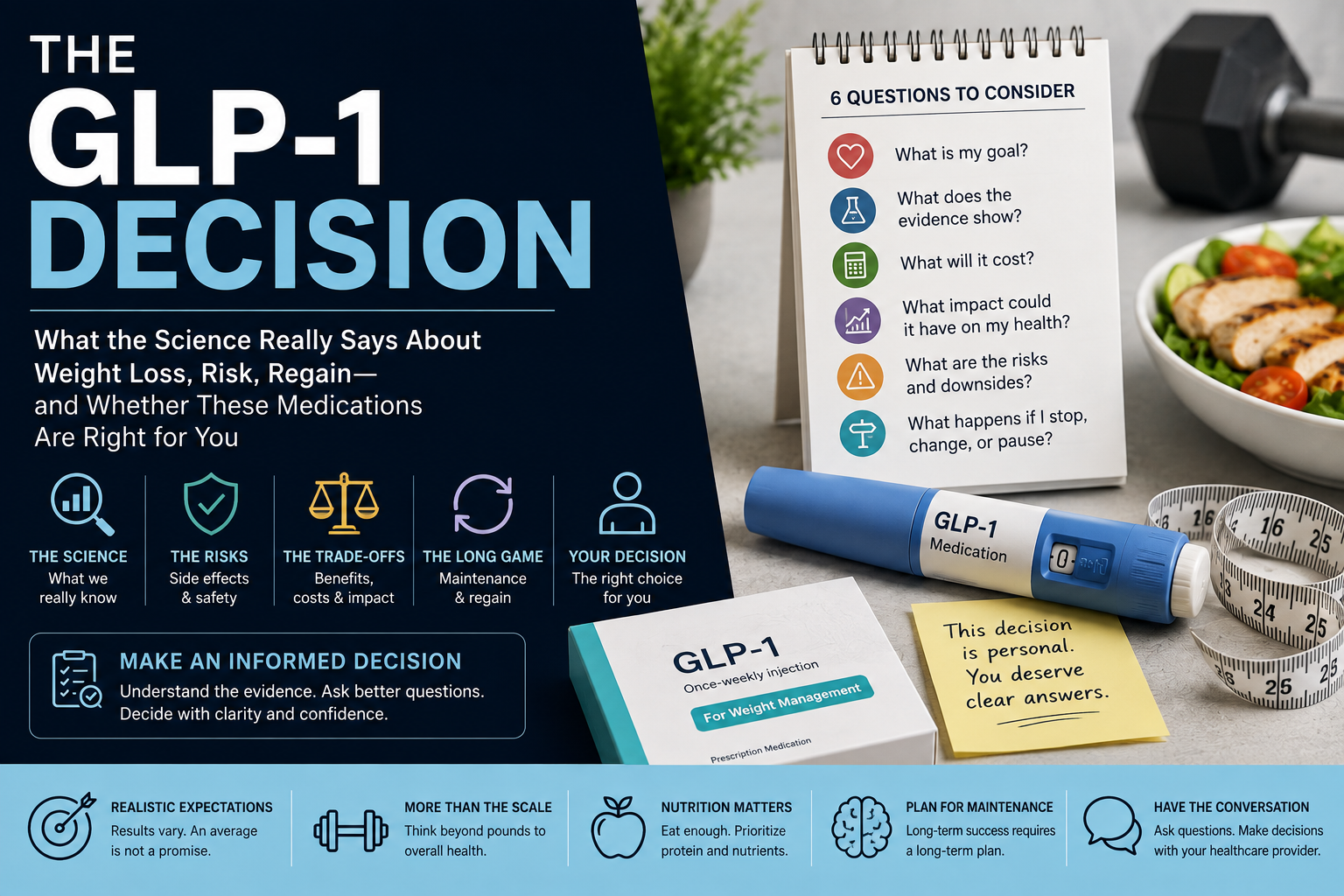
Six Questions to Consider Before Making a GLP-1 Decision
A useful way to organize the decision is through six areas:
1. Desire
What are you actually trying to accomplish?
2. Evidence
What does reliable evidence say about your goal and a population relevant to you?
3. Cost
What would treatment require financially and practically?
4. Impact
What might change beyond the number on the scale?
5. Downsides
Which risks, adverse effects, tradeoffs, and burdens matter to you?
6. Exit
What happens if treatment works, doesn't work, becomes unaffordable, causes unacceptable adverse effects, or eventually stops?
These six areas form the GLP-1 DECIDE Method™, an educational framework presented in The GLP-1 Decision.
It isn't a diagnostic test or prescription algorithm. Its purpose is to organize the questions that can otherwise become buried beneath headlines, social-media claims, fear, and excitement.
Questions to Ask Your Healthcare Professional
A productive GLP-1 conversation can include questions such as:
1. What health problem are we trying to improve?
2. Why might this treatment be appropriate for me?
3. What benefits are reasonably supported for someone with my health profile?
4. Which risks or contraindications matter in my situation?
5. What alternatives should I understand?
6. How will we determine whether treatment is helping enough to continue?
7. What is our plan if treatment works, doesn't work, becomes intolerable, becomes unaffordable, or has to stop?
The prescription should ideally come from a thoughtful conversation—not replace one.
How to Read GLP-1 Headlines More Carefully
GLP-1 medications generate enormous online attention, which makes distinguishing evidence from exaggeration especially important.
Before accepting a headline or viral post, ask:
- Who was studied?
- Which medication and dose were studied?
- What outcome was measured?
- What was the comparison group?
- How large was the absolute benefit or harm?
- Was the evidence randomized, observational, mechanistic, or anecdotal?
- Does the headline claim more than the research actually demonstrated?
- Is the information current?
A dramatic personal story can show what happened to one person.
It cannot establish how frequently the same outcome occurs across a population.
The Decision Doesn't Have to Be Yes or No
One of the biggest mistakes in the GLP-1 conversation is treating the decision as two opposing camps.
Take it.
Don't take it.
But there is another legitimate answer:
Not yet.
You may need more information. You may need to clarify insurance coverage. You may need medical evaluation. You may want another professional opinion. You may need to understand your alternatives or long-term maintenance plan.
The objective shouldn't be reaching the fastest answer.
It should be reaching a decision you understand.
Go Deeper With The GLP-1 Decision
For readers who want to explore these questions in greater depth, The GLP-1 Decision: What the Science Really Says About Weight Loss, Risk, Regain—and Whether These Medications Are Right for You provides an evidence-informed framework for thinking through modern weight-management medications.
The book examines:
- How GLP-1-based medications work
- Semaglutide and tirzepatide weight-loss evidence
- Benefits beyond the scale
- Common adverse effects and risk considerations
- Body composition and lean mass
- Nutrition during appetite suppression
- Exercise and physical function
- Psychological and social aspects of major weight loss
- Treatment costs and access
- What research shows about weight regain after stopping
- Long-term maintenance
- The GLP-1 DECIDE Method™
- Questions to discuss before a prescription
- What to consider if your answer is yes, no, or not yet
The book also includes a practical GLP-1 Decision Toolkit designed to help readers organize their goals, concerns, costs, questions, maintenance considerations, and next steps before discussing treatment with an appropriately qualified healthcare professional.
Final Thoughts
GLP-1 medications have changed what is possible in medical weight management for many people.
But effectiveness alone doesn't make an individual treatment decision.
Benefits matter.
Risks matter.
Nutrition matters.
Strength matters.
Cost matters.
Maintenance matters.
And your reasons for considering treatment matter.
The most useful question may not be simply:
'Do GLP-1 medications work?'
It may be:
'What could this treatment reasonably do for me—and what might it ask of me in return?'
That is a much more personal question.
And it deserves a thoughtful answer.
Enjoying the Academy?
Join AurumVault Insider for new practical guides, digital tools, and marketplace releases.
No spam. Unsubscribe anytime. Privacy
By subscribing, you agree to receive AurumVault Insider emails. You can unsubscribe at any time.
Continue your journey
Keep reading
Athlete Endorsement Deals: Protect Your Rights & Brand
A professional athlete's commercial value extends far beyond a playing contract. Learn how to organize name, likeness, voice, content, endorsements, licensing, paid media, group rights, AI permissions, exclusivity and post-career assets before granting another company access to your identity.
How to Use Meta AI for Business Without Losing Control
Meta AI can help creators and small businesses analyze content, plan campaigns, organize customer questions and streamline routine work. The bigger challenge is using it with clear data boundaries, verified inputs, human review and defined authority.
How to Turn Content Creation Into a Real Business: A Digital Creator Operating System
Successful creators do more than publish content. They build systems around their audience, offers, products, partnerships, revenue, and operations. This guide explains how to start turning your creative work into a more organized and sustainable business.