
How to Create a Vertical Microdrama: From Idea to Screen
Vertical microdramas combine scripted storytelling with mobile-first viewing, fast episodic pacing, strong hooks, and repeatable production. This guide walks through the process from concept and story architecture to production, distribution, audience analytics, monetization, and long-term IP.
How to Create a Vertical Microdrama: From Idea to Screen
Vertical video is no longer limited to dances, commentary, product demonstrations, and quick social clips.
Scripted storytelling is moving onto the phone screen too.
A vertical microdrama is an episodic scripted story designed specifically for mobile-first viewing, often using the 9:16 vertical frame, shorter episodes, fast hooks, continuing storylines, emotional escalation, and strong reasons to watch the next episode.
But creating a successful vertical drama series requires more than filming a traditional scene sideways.
You need a story that can sustain episodes, characters viewers care about, production discipline, mobile-first visual choices, a release strategy, audience measurement, and a plan for what happens if the project gains traction.
Here is a practical framework for building one.
What Is a Vertical Microdrama?
A vertical microdrama is a serialized scripted story created around the viewing behavior and visual constraints of mobile devices.
Instead of treating the phone as a smaller television, creators design around the phone from the beginning.
That affects:
- Framing
- Character proximity
- Dialogue
- Episode length
- Pacing
- Hooks
- Reveals
- Cliffhangers
- Production design
- Release cadence
- Audience retention
The format can be produced as live action, AI-generated video, animation, a hybrid workflow, or another creator-defined production model.
The important point is that the story and production system should match the format.
Step 1: Decide What You Are Actually Building
Before writing Episode 1, define the project's purpose.
Ask yourself whether the series is primarily:
- A proof of concept
- An audience-building experiment
- A commercial property
- A long-term intellectual property asset
- A pitch vehicle
- A direct-to-audience series
This matters because a proof of concept may require three excellent episodes, while a long-term commercial property needs a story engine capable of sustaining dozens of episodes.
Also define what success means.
Success might involve creative quality, audience growth, episode completion, revenue, licensing interest, sponsorship opportunities, or the ability to expand the property later.
If you do not define success early, it becomes difficult to know whether the series is actually working.
Step 2: Build the Story Engine Before the Episode Count
One of the easiest ways to create a weak microdrama is to begin by saying:
'I need 50 episodes.'
The better question is:
What creates Episode 2, Episode 10, Episode 30, and potentially Episode 100?
A sustainable story engine usually needs:
- A protagonist with a powerful external goal
- An internal need or unresolved wound
- An opposing force with real leverage
- A central conflict that cannot be solved easily
- Escalating stakes
- Secrets or unanswered questions
- Relationship tension
- A repeatable source of new complications
Your story should naturally generate additional episodes rather than requiring filler to reach a target number.
Step 3: Write a Strong Logline
Before building hundreds of scenes, make sure you can explain the series clearly.
A practical logline should identify:
Protagonist + Goal + Obstacle + Stakes
For example:
'A struggling event planner discovers that the billionaire client who could save her business is the same man whose family destroyed her father's company—and accepting his offer could expose a secret she has spent ten years hiding.'
The exact genre can vary.
Romance, thriller, crime, family drama, revenge, mystery, faith, comedy, fantasy, and business drama can all work.
What matters is clarity and a conflict with enough pressure to produce continuing story.
Step 4: Define the Audience Promise
Why should someone return tomorrow?
Your audience promise describes the recurring experience viewers should expect.
Maybe the show consistently delivers:
- Romantic tension
- Betrayal
- Revenge
- Mystery
- Power shifts
- Family secrets
- Emotional revelations
- Suspense
- Wish fulfillment
- Moral conflict
Every episode does not have to feel identical.
But viewers should understand what emotional experience the series consistently gives them.
If the promise changes randomly, retention becomes harder.
Step 5: Create a Binge Question
Strong serialized storytelling often revolves around a question the viewer urgently wants answered.
Examples include:
- Will she discover who betrayed her?
- Is he actually the father?
- Who is secretly controlling the company?
- Will they end up together?
- Who committed the crime?
- What is hidden in the inheritance?
The question should deepen as the season progresses.
Reveal enough to reward viewers, but introduce new complications so the story continues moving forward.
Step 6: Design Specifically for the Phone Screen
Vertical storytelling has different visual priorities from traditional widescreen production.
The 9:16 frame rewards:
- Strong faces
- Close emotional reactions
- Clear foreground action
- Vertical architecture
- Doorways
- Hallways
- Staircases
- Windows
- Phones
- Character height differences
- Layered compositions
Before production, test your concept for:
- First-frame strength
- Phone-size clarity
- Dialogue versus action balance
- Vertical visual opportunities
- Mobile viewing risks
A scene may look beautiful on a television and still feel confusing on a phone.
Step 7: Build Characters for Episodic Pressure
A useful character profile should go deeper than age, occupation, and appearance.
Ask:
- Who is this person publicly?
- Who are they privately?
- What do they want?
- What do they need emotionally?
- What are they afraid of?
- What secret are they protecting?
- What contradiction makes them interesting?
- What would cause them to make a bad decision?
Vertical drama moves quickly, so character motivations need to be understandable without becoming simplistic.
Viewers should quickly understand what each major character wants—and why those desires collide.
Step 8: Escalate Instead of Repeating
A common short-form storytelling mistake is repeating the same argument across multiple episodes.
Escalation means the situation changes.
For example:
Episode 1: She suspects her partner is lying.
Episode 2: She finds evidence.
Episode 3: She confronts the wrong person.
Episode 4: The real betrayer discovers she is investigating.
Episode 5: Someone destroys the evidence.
Each episode changes the story.
A strong series does not simply delay the answer. It makes the path toward the answer increasingly complicated.
Step 9: Treat the First Three Episodes Like a Pilot Arc
Your first three episodes carry a heavy burden.
Episode 1 must stop the viewer.
Episode 2 must prove there is more story.
Episode 3 should make stopping difficult.
By the end of the third episode, the audience should understand enough about the protagonist, conflict, stakes, and unanswered question to want to continue.
If viewers cannot explain what the story is about after three episodes, the concept may need more development.
Step 10: Stress-Test the Series Before Full Production
Before committing significant money or time, ask whether the story can genuinely sustain the planned length.
Test it at different scales.
30-Episode Test
What drives Episodes 1–10?
How does the story escalate through Episodes 11–20?
What major payoff or turn occurs in Episodes 21–30?
60-Episode Test
How does the original story engine evolve rather than simply repeat?
100-Episode Test
What new conflicts can enter?
Can the characters continue evolving?
How will you prevent filler?
If you cannot answer those questions, do not assume more episodes automatically mean more value.
Step 11: Create a Production System
Once the story is ready, turn creative development into an actual production workflow.
Track:
- Episodes ready
- Storyboards
- Production schedule
- Locations
- Cast
- Wardrobe
- Props
- Shot requirements
- Editing
- Quality control
- Approvals
Production should operate from authoritative versions of the script, character information, continuity decisions, and episode plans.
This prevents one department from working from Version 4 while another is producing Version 7.
Step 12: Batch Production When It Makes Sense
Microdramas can involve many episodes, so production efficiency matters.
Look for episodes that share:
- Locations
- Cast
- Wardrobe
- Props
- Lighting setups
- Production requirements
Those episodes may be candidates for batch shooting.
The objective is not simply to film everything as fast as possible.
It is to reduce unnecessary setup time and cost without damaging continuity or performance quality.
Step 13: Build Approval Gates
Creators often lose control of complicated projects because decisions keep changing.
Use clear status language such as:
Hold → Conditional → Approved / Greenlight
Before moving a major story or episode into production, review areas such as:
- Story
- Character
- Continuity
- Production feasibility
- Cost
- Mobile format
- Rights
- Required approvals
When something becomes locked, changing it later should be intentional rather than accidental.
Step 14: Decide Your Distribution Strategy
Do not wait until production is complete to ask where the series belongs.
Possible distribution paths can include:
- Direct social publishing
- Creator-owned channels
- Mobile-first platforms
- Streaming opportunities
- Licensing
- Platform partnerships
- Multiple-channel strategies
Research potential distribution partners based on:
- Format fit
- Audience fit
- Rights requirements
- Submission or contact path
- Commercial terms
Avoid assuming one specific distributor is the only path to market.
Step 15: Treat the Project as an Asset
A microdrama is not only a collection of videos.
It can become intellectual property.
That means maintaining organized versions of:
- Story documents
- Character canon
- Scripts
- Production masters
- Agreements
- Pitch assets
- Marketing materials
- Rights information
Think beyond Episode 1.
Ask whether the property could later support:
- Another season
- A spin-off
- Licensing
- Adaptation
- Sponsorship
- Brand partnerships
- International versions
- Other commercial opportunities
Step 16: Build the Launch Before the Premiere
Launching should be treated as a campaign rather than simply pressing Publish.
Your launch plan may include:
- Teasers
- Character introductions
- Trailers
- Countdown content
- Press or media outreach
- Community questions
- Polls
- Fan theories
- Calls to action
Protect important reveals while giving viewers enough information to become curious.
A strong launch creates anticipation before Episode 1 arrives.
Step 17: Measure More Than Views
Views matter, but they are not the only signal of whether a microdrama is working.
Track metrics such as:
- Total views
- Watch time
- Completion rate
- Likes
- Comments
- Shares
- New followers
- Next-episode continuation
- Revenue
Episode-level analytics can help answer a more useful question:
Where did people stop caring?
A drop-off may point to problems involving:
- Hook strength
- Story clarity
- Character connection
- Emotional intensity
- Cliffhanger quality
- Technical quality
Step 18: Use the First Episodes as Validation
Instead of assuming the complete season must be produced before learning anything, treat early performance as evidence.
Review your first three episodes.
Look at:
- Average views
- Completion
- Continuation to the next episode
- Shares
- Comments
- Follower growth
- What viewers loved
- What confused them
Then make a decision:
Proceed → Rework → Redevelop
That is much more disciplined than continuing simply because the original plan said 60 episodes.
Step 19: Optimize Based on Evidence
Maintain an optimization log.
For each change, record:
Issue → Evidence → Change → Result → Keep / Revert / Test Again
For example:
Issue: Viewers drop during the opening 10 seconds.
Evidence: Episodes 6–8 show unusually weak early retention.
Change: Begin Episode 9 directly on the confrontation instead of using an establishing scene.
Result: Completion improves.
Decision: Continue testing faster openings.
Now creative improvement becomes measurable rather than based entirely on instinct.
Step 20: Track Revenue and Commercial Performance
If the project has commercial goals, measure those separately from audience popularity.
Potential revenue categories may include:
- Sponsorship
- Licensing
- Platform revenue
- Other project-specific revenue streams
Also track:
- Cost per episode
- Production days
- Reshoots
- Quality-control pass rate
- Break-even status
- Most expensive production problems
A series with strong views but unsustainable production economics still has a business problem.
Step 21: Decide Whether the Property Deserves a Season 2
At the end of a season, evaluate four major areas.
Audience
Did the audience grow, complete episodes, share the series, and ask for more?
Story
Do the characters and central story still have meaningful potential?
Financial
Did the project generate revenue or demonstrate realistic commercial potential?
Production
Can you make another season efficiently and at acceptable quality?
Your decision may be:
Renew → Rework → Spin-Off → Pause → End
Ending a weak concept can be a better business decision than forcing another season.
What About AI-Generated Vertical Microdramas?
AI can support parts of the development and production workflow, but it needs controls.
Possible AI-assisted areas include:
- Writing development
- Storyboards
- Images
- Video generation
- Voice
- Visual effects
- Marketing
- Analytics
For AI-generated or hybrid productions, consistency becomes especially important.
Creators may need to lock:
- Character identity
- Face
- Wardrobe
- Voice
- Camera style
- Lighting
- Locations
- Visual continuity
AI outputs should still be reviewed against story canon, character identity, intended style, rights considerations, and human approval requirements.
The Real Difference: Stop Treating Each Episode as a Separate Project
A vertical microdrama can involve story development, dozens of episodes, characters, continuity, scripts, production schedules, budgets, pitches, distribution, launch campaigns, analytics, optimization, and revenue decisions.
Trying to manage all of that through scattered notes and individual documents creates unnecessary risk.
The stronger approach is to treat the series as one connected operating system.
Story decisions should flow into character architecture.
Character decisions should flow into episodes.
Episodes should flow into production.
Production should flow into launch.
Launch data should flow back into optimization and future seasons.
Build From Idea to Screen With Vertical Microdrama Creator OS™
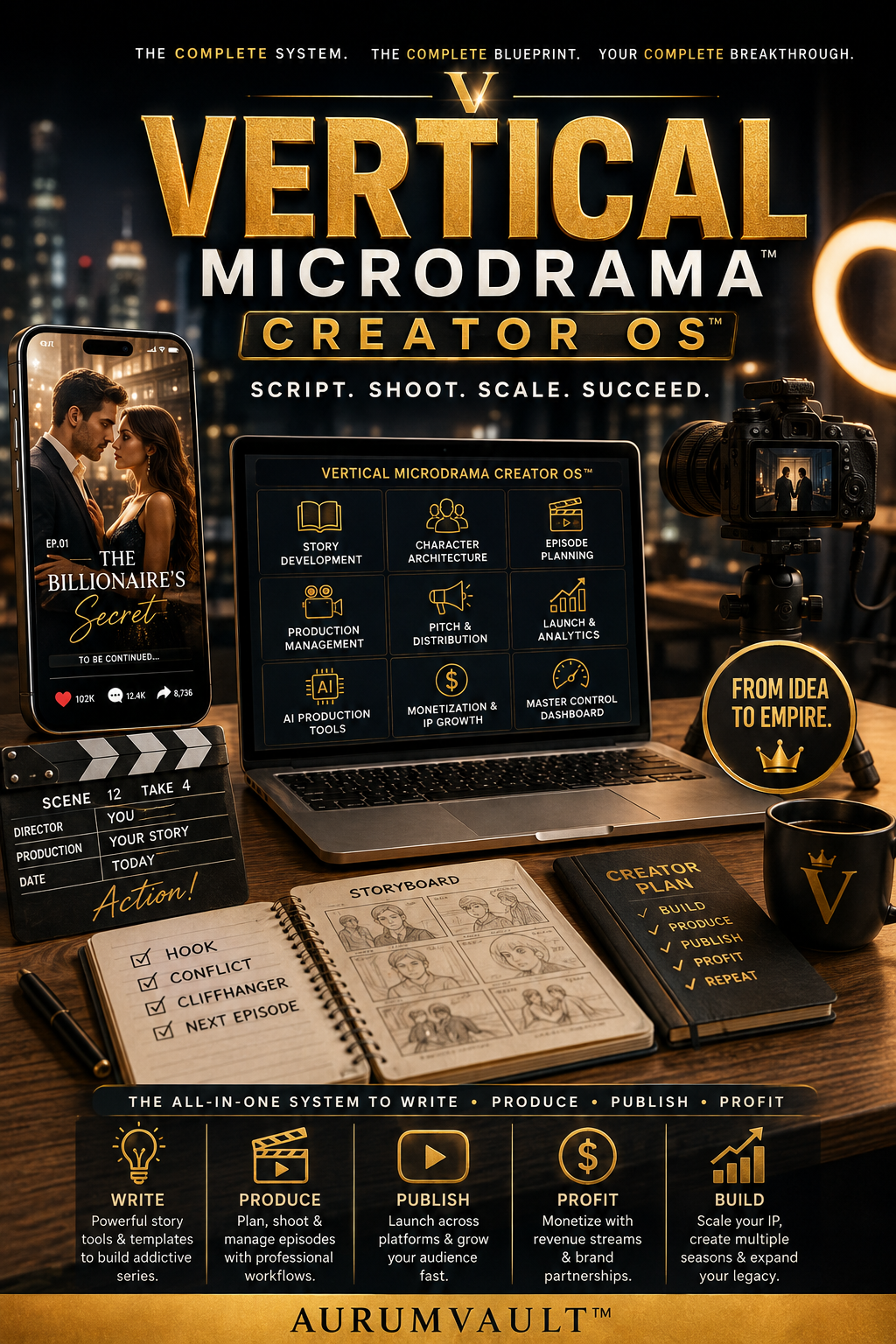
For creators who want a complete system rather than a collection of disconnected worksheets, Vertical Microdrama Creator OS™ — Master Edition by AurumVault Professional Creator Systems is built specifically around mobile-first episodic production.
The system moves creators through project setup, story development, character architecture, episode planning, production, pitch and distribution, launch and analytics, AI-assisted production, and season/IP expansion.
It also includes operational controls such as dashboards, milestone tracking, risk registers, approvals, version control, greenlight gates, story scorecards, episode approval, performance analysis, retention diagnosis, optimization tracking, and commercial review.
The objective is bigger than simply making a short video.
It is to help creators build a repeatable process for developing a story, producing the property, publishing it, measuring what happens, and deciding what deserves to grow.
Script. Shoot. Scale. Succeed.
Enjoying the Academy?
Join AurumVault Insider for new practical guides, digital tools, and marketplace releases.
No spam. Unsubscribe anytime. Privacy
By subscribing, you agree to receive AurumVault Insider emails. You can unsubscribe at any time.
Continue your journey
Keep reading
Athlete Endorsement Deals: Protect Your Rights & Brand
A professional athlete's commercial value extends far beyond a playing contract. Learn how to organize name, likeness, voice, content, endorsements, licensing, paid media, group rights, AI permissions, exclusivity and post-career assets before granting another company access to your identity.
How to Use Meta AI for Business Without Losing Control
Meta AI can help creators and small businesses analyze content, plan campaigns, organize customer questions and streamline routine work. The bigger challenge is using it with clear data boundaries, verified inputs, human review and defined authority.
How to Turn Content Creation Into a Real Business: A Digital Creator Operating System
Successful creators do more than publish content. They build systems around their audience, offers, products, partnerships, revenue, and operations. This guide explains how to start turning your creative work into a more organized and sustainable business.