
How to Create an Influencer Media Kit That Gets Brand Deals
A strong influencer media kit does more than display follower counts. It shows brands who you are, who you reach, what you offer, how you price your work, and why partnering with you makes business sense.
How to Create an Influencer Media Kit That Gets Brand Deals
If you want to work with brands, one of the most valuable business assets you can create is a professional influencer media kit.
A media kit is often the first structured look a brand gets at your creator business.
It can help answer important questions before a partnership conversation even begins:
- Who are you?
- What kind of content do you create?
- Who is your audience?
- Which platforms do you use?
- How large and engaged is your audience?
- What services do you offer?
- What do you charge?
- Have you worked with brands before?
- What results can you show?
- How can a brand contact you?
But a strong media kit should do more than look attractive.
It should help a brand understand your business value.
What Is an Influencer Media Kit?
An influencer media kit is a professional presentation of your creator brand, audience, performance, services, experience, and partnership opportunities.
Think of it as part portfolio, part business profile, and part sales document.
A polished media kit can help creators communicate their value more efficiently when pitching brands, responding to inbound opportunities, negotiating partnerships, or presenting campaign results.
The strongest media kits are clear, current, easy to review, and backed by real information.
1. Start With Your Creator Profile
Your media kit should quickly explain who you are.
Include details such as:
- Creator or brand name
- Professional name
- Primary niche
- Secondary niches
- Location or market
- Business email
- Website or portfolio
- Management or agent information, if applicable
- Primary social handle
- Creator type
Then include a short bio that explains what you create and what makes your work different.
Avoid writing a biography that is so long that the important information gets buried.
A strong creator bio should help a brand understand your identity in seconds.
2. Define Your Positioning
Brands are not only evaluating your follower count.
They are trying to understand where you fit.
A useful creator positioning section can define:
- Your mission
- Your audience promise
- Your positioning statement
- Why brands work well with you
For example, instead of saying:
'I create lifestyle content.'
You might position yourself more specifically:
'I create practical lifestyle content for busy women who want attainable beauty, wellness, and home recommendations.'
That tells a potential partner much more about the audience and the type of collaboration that could make sense.
3. Show Your Content Categories and Brand Identity
Your media kit should also make your content style easy to understand.
Common creator categories can include:
- Beauty
- Fashion
- Lifestyle
- Fitness
- Wellness
- Food
- Travel
- Parenting
- Business
- Finance
- Technology
- Education
- Entertainment
- Gaming
- Books
- Personal development
You can also describe your brand personality using words such as professional, educational, inspirational, conversational, luxury, bold, family-friendly, authentic, or editorial.
Consistency matters.
A brand should be able to look at your media kit and feel that it belongs to the same creator they see on social media.
4. Include Platform-Specific Performance Metrics
A generic follower total does not tell the whole story.
Different platforms produce different kinds of audience behavior.
For Instagram, useful metrics may include:
- Followers
- Monthly reach
- Monthly impressions
- Average Reel views
- Average Story views
- Likes
- Comments
- Shares
- Saves
- Engagement rate
- Link clicks
For TikTok, you may want to include average video views, shares, profile views, top video views, posting frequency, and engagement rate.
For YouTube, useful information can include subscribers, average video views, monthly views, watch time, CTR, Shorts performance, and posting frequency.
Creators with podcasts, newsletters, Facebook communities, or other platforms can include those metrics as well.
The goal is not to fill the page with every number available.
Show the information most relevant to a brand evaluating your audience and content performance.
5. Explain Who Your Audience Is
Follower count alone does not tell a brand whether your audience matches its target customer.
Include audience information such as:
- Age distribution
- Gender distribution
- Primary countries
- Primary cities or markets
- Audience interests
- Common product categories
- Buying fit
This section can be especially valuable because a smaller creator with a highly relevant audience may be more attractive to a particular brand than a larger creator with poor audience fit.
Brand partnerships work best when the creator, audience, and product make sense together.
6. Show Engagement, Not Just Size
Brands often want to know whether people actually respond to your content.
Useful engagement data may include:
- Reach
- Likes
- Comments
- Shares
- Saves
- Clicks
- Engagement rate
You can also identify:
- Your strongest platform
- Your strongest content format
- Most shared content
- Most saved content
- Most clicked content
This helps show how your audience interacts with your work rather than reducing your creator business to one follower number.
7. Build a Clear Services Menu
A brand should not have to guess what you offer.
Your services might include:
- Instagram Reel
- Instagram post
- Carousel
- Story package
- TikTok video
- YouTube integration
- Dedicated YouTube video
- YouTube Short
- UGC video
- UGC photos
- Product photography
- Product demo
- Product review
- Podcast mention
- Newsletter feature
- Event appearance
- Brand ambassador partnership
- Affiliate partnership
- Custom campaign
You do not need to offer everything.
Choose the services that fit your strengths and audience.
8. Create an Influencer Rate Card
Pricing is one of the most uncomfortable parts of creator work for many people.
A rate card can help organize your starting rates before a brand conversation begins.
For each service, you might track:
- Deliverable
- Platform
- Base rate
- Number of revisions
- Turnaround time
- Notes
It can also help to distinguish between a starting rate and a final quote.
Why?
Because a campaign involving broad usage rights, exclusivity, fast turnaround, multiple revisions, paid advertising, or raw footage may deserve a different price from a simple organic post.
9. Do Not Forget Usage Rights
One of the biggest mistakes newer creators can make is treating the content creation fee as the entire value of the deal.
A brand may want to use your content beyond your own social account.
Additional rights may include:
- Organic brand usage
- Paid advertising
- Website or e-commerce use
- Email marketing
- Print or retail use
- Whitelisting
- Raw footage
- Exclusivity
Usage duration and territory can also matter.
If a brand wants to use your face, voice, image, or content commercially for months after the original post, that may change the business value of the agreement.
Creators should understand what rights are being requested before agreeing to terms.
10. Build a Brand Outreach Pipeline
A media kit becomes more valuable when it supports an actual outreach process.
Instead of randomly emailing brands, create a partnership pipeline.
A simple workflow might look like:
Researching → Ready to Pitch → Pitched → Follow-Up → Negotiating → Accepted → Active → Completed
For each prospective brand, track:
- Brand name
- Industry
- Contact
- Why the partnership fits
- Current status
- Next action
That turns brand outreach into a repeatable business process instead of relying on memory or scattered DMs.
11. Personalize Your Brand Pitch
Generic outreach is easy to ignore.
A stronger pitch shows that you understand the brand.
Before reaching out, research:
- The brand's products
- Current campaigns
- Target audience
- Social content
- Creator partnerships
- Why your audience is relevant
- A potential campaign angle
Your pitch should quickly communicate:
Why this brand + why your audience + why this idea + why now.
Then make the next step easy.
12. Manage Campaigns Like a Business
Getting the deal is not the end of the process.
Once a partnership is accepted, you need a system for managing it.
A campaign brief can track:
- Brand
- Campaign name
- Campaign contact
- Campaign objective
- Product or service
- Start and end dates
- Total compensation
- Payment due date
- Platforms
- Success metrics
- Required talking points
- Claims or words to avoid
This helps prevent important requirements from disappearing inside long email threads.
13. Track Deliverables and Approvals
Campaigns can involve multiple pieces of content, deadlines, revision rounds, and approval stages.
Track each deliverable so you know:
- What needs to be created
- When it is due
- Whether the brand has reviewed it
- Whether revisions are required
- Whether final approval has been received
- When it should be published
A professional creator should know the status of every active campaign without searching through dozens of messages.
14. Use a Pre-Publish Checklist
Before sponsored content goes live, review the campaign requirements carefully.
Your checklist might include:
- Partnership disclosure is clear
- Sponsored-content settings are used where required
- Claims are supportable
- Correct brand is tagged
- Product name is accurate
- Required hashtags are included
- Correct links are added
- Discount codes are verified
- Final content is approved
- Publish date and time are confirmed
- Caption is proofread
- Thumbnail or cover is correct
Creators should also follow applicable laws, advertising disclosure requirements, platform rules, and campaign instructions.
15. Report Campaign Results
A professional partnership does not necessarily end after the post goes live.
Brands may want to understand what happened.
Track campaign performance using relevant metrics such as:
- Reach
- Views
- Engagement rate
- Clicks
- Conversions
- Revenue, when available
This information can help you build future case studies and strengthen your position when negotiating another campaign.
16. Build Case Studies From Strong Campaigns
When a campaign performs well, turn it into a business asset.
A useful creator case study can include:
- Brand
- Campaign
- Campaign goal
- Creator strategy
- Deliverables
- Results
- Key takeaway
- Brand feedback
Case studies help future partners see evidence of what you can do rather than relying entirely on self-description.
17. Track Contracts, Invoices, and Payments
Creators are running businesses, even when the work looks creative from the outside.
You should know:
- Which campaigns have contracts
- Which invoices have been sent
- Payment due dates
- Whether payment has arrived
- Which usage rights remain active
- Whether exclusivity is still in effect
- Whether a partnership is ready for renewal
A completed campaign is not truly complete if the deliverables are done but the invoice has not been paid.
18. Track Usage Rights and Exclusivity Dates
Usage rights can continue long after content is posted.
Record:
- Brand
- Campaign
- Content covered
- Usage type
- Usage start
- Usage end
- Territory
- Usage fee
- Exclusivity category
- Exclusivity end date
- Whitelisting start and end dates
- Renewal notes
This makes it easier to know when rights expire or when there may be an opportunity to renegotiate.
19. Build a Renewal Strategy
One successful partnership can be more valuable than constantly starting from zero with new brands.
Track previous collaborators and look for opportunities to reconnect.
A simple renewal tracker might include:
- Brand
- Last campaign
- Last deal
- Renewal opportunity
- Contact date
- Status
Strong creator businesses build relationships, not just one-time transactions.
20. Treat Your Media Kit as a Living Business Document
Do not create your media kit once and forget about it.
Update it when:
- Your audience grows
- Your engagement changes
- You add a new platform
- Your rates change
- You complete a strong campaign
- You gain new testimonials
- Your niche evolves
- Your services expand
Brands should receive a current representation of your creator business—not statistics from a year ago.
What Makes a Great Influencer Media Kit?
A great media kit should be:
- Professional
- Easy to scan
- Visually consistent
- Accurate
- Current
- Focused on audience value
- Clear about services
- Clear about contact information
- Supported by real metrics
- Easy to update
But the biggest shift is this:
Stop thinking of your media kit as a résumé. Start thinking of it as part of your creator business system.
It should help you build, price, pitch, partner, and grow.
Build Your Creator Partnership System
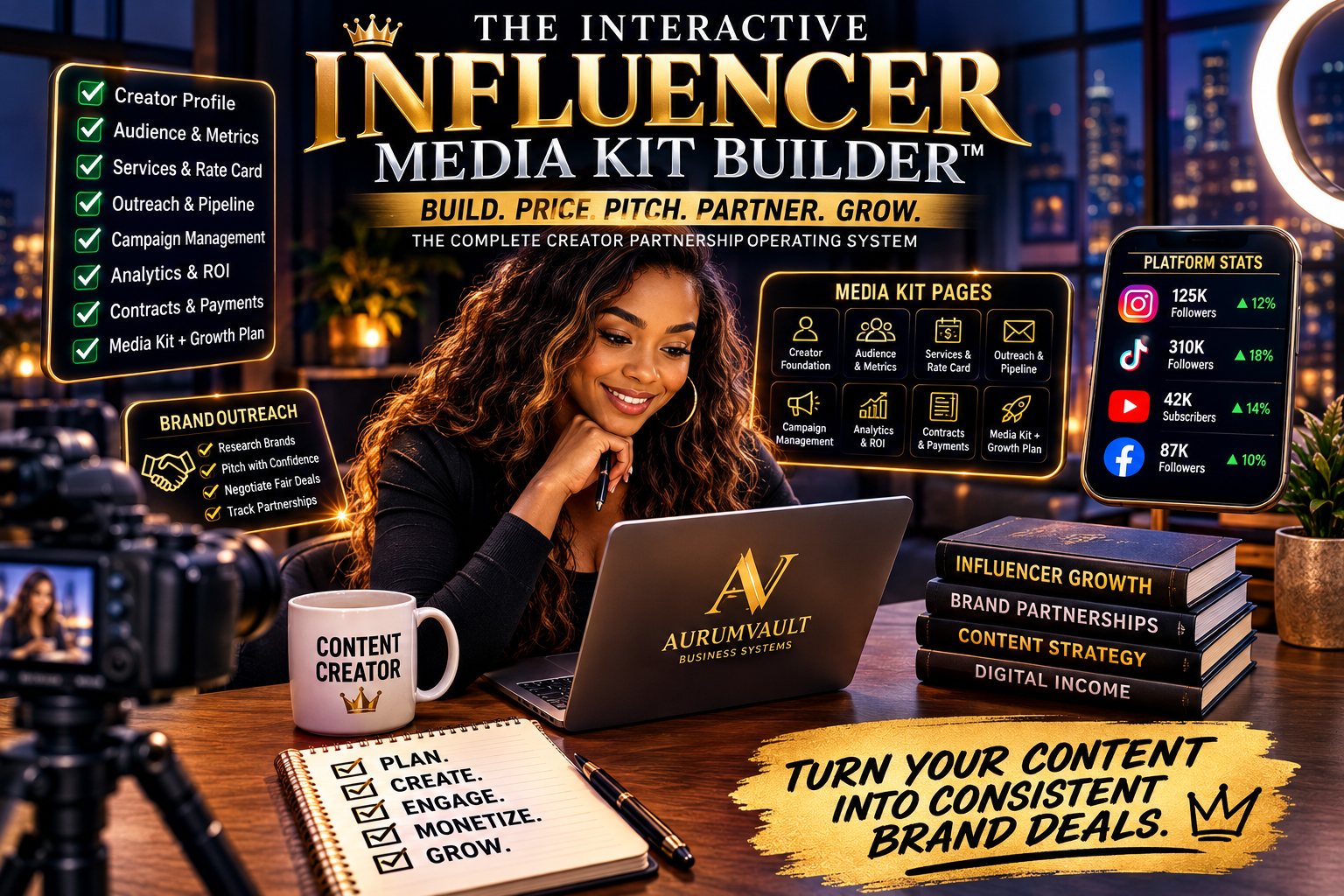
For creators who want more than a static media kit template, The Interactive Influencer Media Kit Builder™ by AurumVault is designed as both a presentation-ready media kit and a creator partnership operating system.
It helps creators organize their profile, audience data, platform metrics, services, rate cards, campaign extras, usage rights, brand outreach, negotiations, accepted campaigns, approvals, analytics, case studies, contracts, invoices, payments, renewals, and 90-day growth planning.
The goal is to help you manage the complete partnership journey:
Build. Price. Pitch. Partner. Grow.
Because getting brand deals is only part of becoming a professional creator.
The bigger opportunity is building a system that helps you manage those opportunities well.
Enjoying the Academy?
Join AurumVault Insider for new practical guides, digital tools, and marketplace releases.
No spam. Unsubscribe anytime. Privacy
By subscribing, you agree to receive AurumVault Insider emails. You can unsubscribe at any time.
Continue your journey
Keep reading
Athlete Endorsement Deals: Protect Your Rights & Brand
A professional athlete's commercial value extends far beyond a playing contract. Learn how to organize name, likeness, voice, content, endorsements, licensing, paid media, group rights, AI permissions, exclusivity and post-career assets before granting another company access to your identity.
How to Use Meta AI for Business Without Losing Control
Meta AI can help creators and small businesses analyze content, plan campaigns, organize customer questions and streamline routine work. The bigger challenge is using it with clear data boundaries, verified inputs, human review and defined authority.
How to Turn Content Creation Into a Real Business: A Digital Creator Operating System
Successful creators do more than publish content. They build systems around their audience, offers, products, partnerships, revenue, and operations. This guide explains how to start turning your creative work into a more organized and sustainable business.