
How to Create a Social Media Content Plan That Actually Works
Posting more isn't always the answer. A strong social media content plan gives every post a purpose, helps you stay consistent, and shows you what is actually driving engagement, leads, and growth.
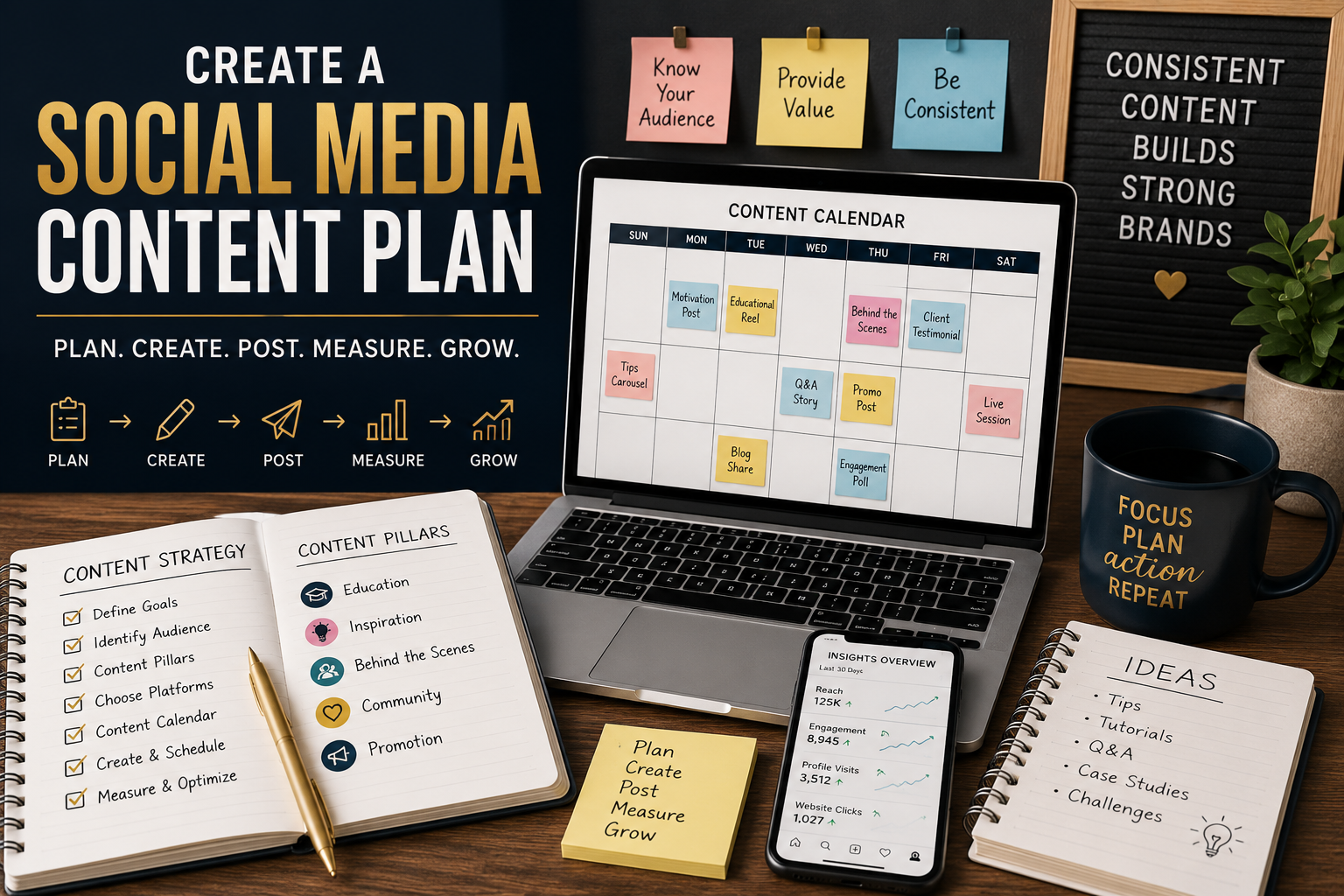
How to Create a Social Media Content Plan That Actually Works
Posting on social media can look deceptively simple. Choose a photo, write a caption, add a few hashtags, and hit publish.
But when you're using social media to build a brand, attract customers, grow an audience, or sell a product, random posting can quickly become exhausting.
The problem usually isn't a lack of ideas. It's a lack of a system.
A social media content plan gives your content direction. Instead of asking, “What should I post today?” every morning, you know who you're trying to reach, what you want to communicate, where you should publish it, and what result you're trying to achieve.
Here's how to build one.
What Is a Social Media Content Plan?
A social media content plan is a structured approach to deciding what you will publish across your social platforms and why.
It connects several important pieces of your marketing:
- Your target audience
- Your business or brand goals
- Your content topics
- Your social platforms
- Your posting schedule
- Your calls to action
- Your performance metrics
Think of your plan as the bridge between your overall social media strategy and the individual posts your audience actually sees.
Step 1: Start With Your Audience
Before creating content, get clear about who you're creating it for.
Trying to speak to everyone often produces generic content that connects with no one.
Start by answering a few questions about your ideal audience:
- What problem are they trying to solve?
- What are they trying to achieve?
- What frustrates them?
- What do they want to learn?
- Which social platforms do they use?
- What might prevent them from buying?
- What style of communication resonates with them?
This information should influence everything from your topics to your captions.
For example, content aimed at first-time entrepreneurs may need more educational explanations and practical examples than content created for experienced business owners.
The goal isn't simply to know demographic information. You want to understand what makes your audience stop scrolling and pay attention.
Step 2: Decide What You Want Social Media to Accomplish
More followers can be useful, but follower count shouldn't automatically be your primary goal.
Ask what social media needs to accomplish for your brand.
Your goal might be to:
- Increase brand awareness
- Build an engaged community
- Generate leads
- Drive website traffic
- Sell products or services
- Establish authority
- Grow an email list
- Increase customer retention
Once you know the goal, you can choose better metrics.
If your objective is generating leads, for example, likes may be less important than link clicks, inquiries, downloads, or conversions.
Step 3: Create Your Content Pillars
Content pillars are the core subjects your brand consistently talks about.
Instead of generating unrelated ideas every week, you create content around a small group of themes connected to your audience and expertise.
A financial education creator might use pillars such as budgeting, credit, saving, investing, and financial mindset.
A fitness brand might focus on workouts, nutrition, recovery, motivation, and client transformations.
Three to five strong content pillars are usually enough to create variety without making your brand feel scattered.
For each pillar, identify its purpose and several possible topics. This gives you a reusable source of ideas whenever you plan a new week or month.
Step 4: Give Each Platform a Purpose
You don't necessarily need to be everywhere.
Instagram, Facebook, TikTok, YouTube, LinkedIn, and Pinterest can serve different audiences and different business objectives.
For each platform you use, define:
- Your primary goal
- Your intended audience
- Your posting frequency
- Your strongest content formats
- Your primary call to action
- The metric you'll use to evaluate performance
This prevents you from blindly copying the same strategy across every platform.
You can still repurpose content, but adapt it to how people consume information on each platform.
Step 5: Build a 30-Day Content Calendar
Once your foundation is established, turn your strategy into a schedule.
A monthly content calendar lets you see the bigger picture before you begin creating individual posts.
Choose a primary campaign or focus for the month and then create a healthy content mix.
That mix might include:
- Educational content
- Promotional content
- Engagement posts
- Behind-the-scenes content
- Social proof
- Community or lifestyle content
This is important because a social account filled entirely with promotional posts can become repetitive. Likewise, an account that only educates without ever giving the audience a next step may struggle to generate business results.
Balance matters.
Step 6: Turn the Monthly Plan Into Weekly Actions
A monthly calendar provides direction. Your weekly plan makes it executable.
For every planned post, determine:
- Day
- Platform
- Format
- Topic or hook
- Call to action
- Status
This simple workflow can dramatically reduce the daily pressure of deciding what to create.
Instead of planning and producing at the same moment, you separate the thinking from the execution.
Step 7: Plan Individual Posts Before Creating Them
Before opening your camera or design software, outline the purpose of the post.
Identify the content pillar, topic, hook, CTA, caption or script, and visual requirements.
The hook deserves particular attention.
Your audience encounters enormous amounts of content. The opening sentence, headline, image, or first few seconds of a video must give them a reason to continue.
Instead of beginning with a generic introduction, lead with the problem, benefit, question, or insight most likely to matter to your audience.
Step 8: Build a Bank of Ideas Before You Need Them
One of the easiest ways to become inconsistent is to wait until posting day to think of an idea.
Create an idea bank instead.
Whenever you notice a customer question, interesting trend, common mistake, useful tip, objection, story, or lesson, save it.
Over time, your idea bank becomes one of your most valuable content resources.
You can do the same with calls to action and caption concepts so you're not starting from zero every time you create something.
Step 9: Repurpose Your Best Content
You don't have to create every piece of content from scratch.
One strong idea can often become several assets.
A long educational video could become short clips, a carousel, a quote graphic, a Facebook post, a LinkedIn post, an email, or a blog article.
Repurposing doesn't mean publishing identical material everywhere. It means extracting additional value from ideas that deserve more than one appearance.
Step 10: Measure What Actually Works
Publishing is only half of the process.
Your analytics tell you what your audience is responding to.
Depending on your goals, useful metrics may include:
- Reach
- Impressions
- Engagement
- Saves
- Shares
- Link clicks
- Leads
- Conversions
- Sales
Look for patterns rather than obsessing over one post.
Which topics consistently perform well? Which hooks earn attention? Which platforms generate leads? Which calls to action produce clicks or conversions?
Those answers should influence what you create next.
Think in 90-Day Growth Cycles
Social media growth rarely comes from one viral post.
A better approach is to think in 90-day cycles.
Set a goal, execute your strategy, measure the results, identify what's working, and make adjustments.
Over time, this creates a feedback loop:
Plan → Create → Post → Measure → Improve → Repeat
That's much more sustainable than constantly chasing trends without understanding whether they're helping your business.
The Real Goal Is Consistency With Purpose
A content plan isn't supposed to remove creativity from social media. It's supposed to give creativity direction.
You can still experiment. You can still respond to trends. You can still publish spontaneous ideas.
The difference is that your overall strategy no longer depends on inspiration arriving at the perfect moment.
When you understand your audience, establish clear content pillars, assign each platform a purpose, schedule your ideas, and measure the results, social media becomes less chaotic and more intentional.
Put the System Into Practice
If you want to organize these steps in one place, The Interactive Social Media Content Planner™ by AurumVault is designed around this workflow.
It brings together audience profiles, content pillars, platform strategy, 30-day calendars, weekly planning, individual post planning, campaign planning, idea and caption banks, keyword tracking, asset repurposing, analytics, lead tracking, and a 90-day growth plan.
Instead of treating social media as an endless stream of individual posts, you can manage it as a complete system.
The goal is simple: Plan. Create. Post. Measure. Grow.
Enjoying the Academy?
Join AurumVault Insider for new practical guides, digital tools, and marketplace releases.
No spam. Unsubscribe anytime. Privacy
By subscribing, you agree to receive AurumVault Insider emails. You can unsubscribe at any time.
Continue your journey
Keep reading
Athlete Endorsement Deals: Protect Your Rights & Brand
A professional athlete's commercial value extends far beyond a playing contract. Learn how to organize name, likeness, voice, content, endorsements, licensing, paid media, group rights, AI permissions, exclusivity and post-career assets before granting another company access to your identity.
How to Use Meta AI for Business Without Losing Control
Meta AI can help creators and small businesses analyze content, plan campaigns, organize customer questions and streamline routine work. The bigger challenge is using it with clear data boundaries, verified inputs, human review and defined authority.
How to Turn Content Creation Into a Real Business: A Digital Creator Operating System
Successful creators do more than publish content. They build systems around their audience, offers, products, partnerships, revenue, and operations. This guide explains how to start turning your creative work into a more organized and sustainable business.