
How to Get Brand Deals as a Creator and Protect Your Value
Getting a brand email is exciting, but a professional creator partnership involves much more than agreeing to post. Learn how to verify opportunities, evaluate brand fit, price deliverables and rights, negotiate terms, manage production, invoice correctly and turn strong campaigns into repeat business.
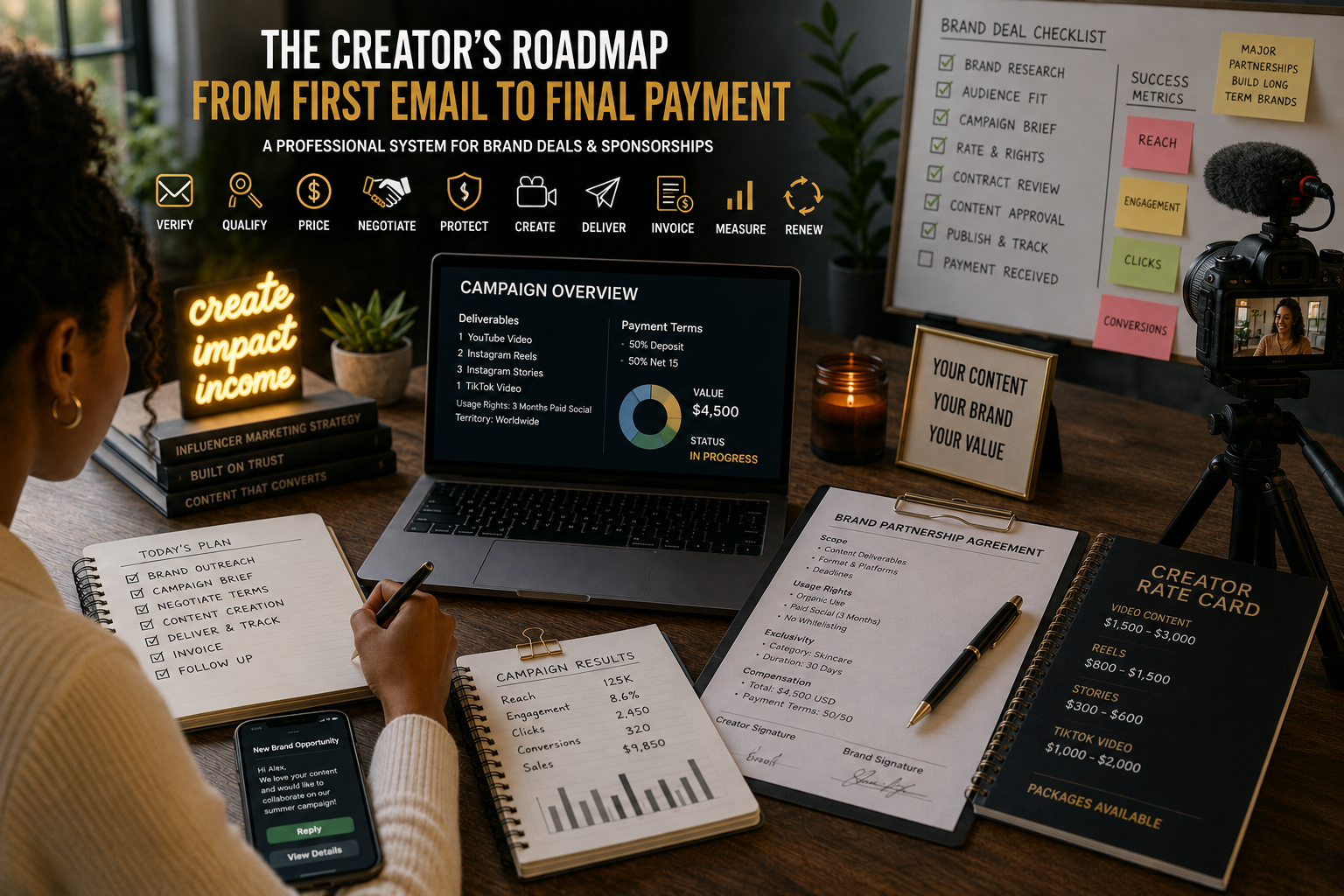
How to Get Brand Deals as a Creator and Protect Your Value
The first brand email can feel like a major milestone.
A company noticed your content.
They want to work with you.
Maybe they are offering money, free products, affiliate commission, or a larger sponsorship opportunity.
But a brand partnership is not just an exciting email.
It is a business transaction.
A professional creator needs to understand much more than what content the brand wants posted.
A strong brand-deal process may involve:
- Verifying the brand
- Qualifying the opportunity
- Reviewing audience fit
- Pricing deliverables
- Pricing usage rights
- Understanding exclusivity
- Negotiating terms
- Reviewing the agreement
- Managing production
- Handling approvals
- Publishing correctly
- Preserving delivery evidence
- Invoicing
- Tracking payment
- Measuring performance
- Following up for renewal
The more organized this process becomes, the easier it is to protect your value and build better long-term brand relationships.
1. Do Not Treat Every Brand Email as a Good Opportunity
A brand contacting you does not automatically mean you should accept the deal.
Start by asking:
- Is the company legitimate?
- Does the product fit my audience?
- Does the partnership fit my brand?
- What exactly are they asking for?
- What rights do they want?
- What is the compensation?
- Are there unusual restrictions?
- Could the partnership damage audience trust?
Professional creators qualify opportunities before they negotiate them.
2. Verify the Brand First
Creator sponsorship scams are real.
Before clicking unfamiliar links or sharing sensitive information, verify the opportunity independently.
Look at:
- Company website
- Official email domain
- Verified social accounts
- Contact person's role
- Public campaign information
- Brand history
- Whether the company actually works with creators
Be cautious if someone asks for passwords, account-access codes, unusual payments, gift-card purchases or sensitive information unrelated to the partnership.
Your brand-deal workflow should include a clear verification and red-flag check before negotiations move forward.
3. Define Your Ideal Brand Profile
The best sponsorship is not necessarily the brand offering the most money.
Define what a strong brand fit looks like for your creator business.
Consider:
- Audience relevance
- Product quality
- Brand reputation
- Values alignment
- Content fit
- Compensation
- Creative freedom
- Long-term relationship potential
This gives you a standard for evaluating opportunities instead of making every decision emotionally.
4. Protect Audience Trust
Your audience is one of your most valuable business assets.
Before accepting a partnership, ask:
Would I still feel comfortable recommending this product if there were no sponsorship involved?
That does not mean every partnership must involve a product you have used for years.
It means you should understand what you are promoting and avoid creating a recommendation you cannot stand behind.
Short-term sponsorship revenue is rarely worth long-term loss of credibility.
5. Capture the Entire Campaign Scope
Before discussing price, understand what the brand actually wants.
The campaign scope may involve:
- Number of videos
- Number of posts
- Stories
- Reels
- TikTok content
- YouTube integrations
- Photos
- Raw footage
- Live appearances
- Link placement
- Newsletter mentions
- Product photography
- UGC-style content
- Revision rounds
Two campaigns that both say 'one video' may involve very different amounts of work.
Get the scope clear first.
6. Separate Deliverable Pricing From Rights Pricing
One of the most important creator-business concepts is this:
Creating the content and licensing the content are not necessarily the same thing.
A brand may pay you to create a Reel.
But it may also want the right to:
- Repost it
- Use it on its website
- Run it as an advertisement
- Use it in paid social campaigns
- Keep it for several months
- Use raw footage
- Use it in other territories
Those rights can create additional commercial value.
Do not automatically bundle unlimited usage into a basic content fee unless you intentionally choose to do so.
7. Understand Usage Rights
Usage rights describe how the brand may use your content.
Questions may include:
- Where may the content be used?
- For how long?
- Organic use or paid advertising?
- Which platforms?
- Which countries?
- Can the brand edit the content?
- Can it sublicense the content?
- Can it use your name or likeness separately?
The Creator Brand Deal & Sponsorship OS includes a dedicated Usage Rights Clause Review so creators can record the current agreement language, their understanding, risks, questions and next contract action. 1
8. Treat Raw Footage as a Separate Asset
Brands may ask for unedited footage from a campaign.
Raw footage can be valuable because the brand may be able to create additional advertising or marketing assets from it.
That request deserves its own review.
Clarify:
- What footage is included?
- How may it be used?
- For how long?
- Can it be edited into new ads?
- Can your voice or image be used separately?
- Is additional compensation appropriate?
The OS treats raw-footage licensing as a distinct commercial consideration rather than assuming it is automatically included. 2
9. Understand Exclusivity
An exclusivity clause can limit your ability to work with competing brands.
Before agreeing, identify:
- Which competitors are covered
- Which product categories are covered
- How long the restriction lasts
- Which platforms are affected
- Whether existing partnerships are excluded
Broad exclusivity can reduce your future earning opportunities.
The longer and broader the restriction, the more carefully it should be evaluated.
10. Price the Whole Deal
Creator pricing should consider more than follower count.
Depending on the campaign, pricing factors may include:
- Production effort
- Creative complexity
- Audience quality
- Platform
- Deliverable quantity
- Usage rights
- Exclusivity
- Campaign duration
- Turnaround time
- Revision requirements
- Travel
- Raw footage
- Paid-ad use
- Your experience
There is no universal creator rate that fits every deal.
The important thing is knowing what you are being paid for.
11. Know Your Minimum Acceptable Deal
Before negotiations begin, decide what matters most.
Identify:
- Preferred rate
- Minimum acceptable rate
- Usage-right boundaries
- Exclusivity limits
- Maximum revision rounds
- Payment terms
- Deal-breakers
This prevents you from making every decision in the middle of a negotiation.
12. Negotiate the Terms, Not Just the Fee
A higher fee can still be attached to a weak agreement.
Review the entire package.
Important terms may include:
- Deliverables
- Compensation
- Payment schedule
- Usage rights
- Exclusivity
- Revision rights
- Approval process
- Cancellation
- Deadlines
- Ownership
- Disclosure requirements
- Termination
Sometimes improving one of these terms is more valuable than increasing the headline fee.
13. Read the Contract Carefully
A creator contract is not just paperwork that arrives after the deal.
It defines the commercial relationship.
Compare the contract with what was actually negotiated.
Ask:
- Are the deliverables correct?
- Is compensation correct?
- Are deadlines correct?
- Are usage rights what we discussed?
- Is exclusivity broader than expected?
- Are revisions limited?
- Are cancellation terms clear?
- Are payment terms clear?
For consequential legal questions, consult a qualified professional.
14. Document Uncertainty Instead of Guessing
If a contract term is unclear, flag it.
If the brand's usage request is unclear, ask.
If the campaign scope is incomplete, do not quietly assume what they meant.
The OS repeatedly uses statuses such as:
READY / VERIFIED
REVIEW / NEGOTIATE
HOLD / BLOCKED
That structure encourages creators to surface open questions instead of treating uncertainty as approval. 3
15. Build a Production Workflow
Once the agreement is finalized, move into production deliberately.
Track:
- Brief
- Deliverables
- Required talking points
- Prohibited claims
- Product information
- Deadlines
- Draft versions
- Revisions
- Approval status
- Publication date
The goal is to prevent details from getting lost across email threads and DMs.
16. Keep Version Control
If a brand requests changes, keep track of which version is current.
A simple naming system can prevent the wrong file from being published or delivered.
Record:
- Version
- Date
- Requested changes
- Approval status
- Final version
This becomes especially important when campaigns include several assets.
17. Manage Brand Approvals
If the agreement allows pre-publication review, document the approval process.
Track:
- Date submitted
- Feedback received
- Revision requested
- Revision completed
- Final approval
Avoid making unnecessary changes based on informal comments that were not part of the agreed approval process.
18. Follow Required Sponsorship Disclosures
Sponsored content may require disclosure.
Use clear disclosure practices appropriate to the platform, jurisdiction and campaign.
Do not hide the commercial relationship simply because the post looks more natural without a disclosure.
Audience transparency is part of professional creator operations.
19. Save Proof of Delivery
Once the content goes live, preserve evidence.
That may include:
- Live URL
- Screenshot
- Publication date
- Story screenshot
- Content file
- Approval record
- Delivery email
Do not rely on memory months later.
Delivery evidence can become important when invoicing, reporting or resolving disagreements.
20. Invoice Professionally
A sponsorship is not complete when the post goes live.
It is complete when the agreed work is finished and payment obligations are satisfied.
Your invoice should accurately reflect the agreement.
Typical information may include:
- Creator or business name
- Brand
- Campaign
- Invoice number
- Date
- Deliverable description
- Amount
- Payment terms
- Required payment instructions
The OS includes an Invoice Line-Item Builder specifically for organizing campaign amounts, current status, financial risk and next actions. 4
21. Track Receivables Until Payment Arrives
Sending the invoice is not the same as receiving payment.
Track:
- Invoice sent date
- Amount due
- Due date
- Payment status
- Follow-up date
- Amount received
- Remaining balance
The OS includes a Payment Evidence Vault so creators can preserve the verified record of what was due, what happened and what financial action comes next. 5
22. Create a Process for Late or Disputed Invoices
Sometimes invoices become late or disputed.
Keep the communication professional and documented.
Organize:
- Agreement
- Invoice
- Delivery evidence
- Approval records
- Communication history
- Payment terms
The Creator Brand Deal & Sponsorship OS includes a dedicated Disputed Invoice Workflow for managing these situations systematically. 6
23. Measure Campaign Performance
After publication, document the campaign results available to you.
Possible metrics include:
- Views
- Reach
- Impressions
- Engagement
- Saves
- Shares
- Clicks
- Conversions
- Sales
- Watch time
- Audience response
Avoid promising outcomes you cannot control.
Measure what actually happened.
24. Compare Sponsored Performance With Your Organic Baseline
A campaign result means more when it has context.
Compare sponsored content with your normal performance where appropriate.
For example:
- Typical Reel reach
- Typical engagement
- Typical video views
- Typical click-through
The OS includes an Organic Baseline Comparison so performance can be interpreted against the creator's own normal results rather than viewed as an isolated number. 7
25. Preserve Performance Evidence
Performance data can strengthen future negotiations.
Save:
- Screenshots
- Analytics exports
- Brand reports
- Campaign summaries
- Conversion information when available
A creator who can demonstrate verified results has stronger evidence when discussing future partnerships.
26. Build a Brand CRM
Treat brand contacts as business relationships.
Track:
- Brand
- Agency
- Contact
- Role
- Campaign history
- Rates
- Results
- Communication
- Follow-up date
- Renewal opportunities
Good relationships can compound.
A successful campaign today may become a larger partnership later.
27. Ask for the Renewal
Many creators spend all their energy finding new brands and very little nurturing brands that already know their work.
After a successful campaign, follow up professionally.
Share relevant performance information and ask whether the brand has upcoming campaigns where another collaboration may fit.
Repeat business can be more efficient than constantly starting from zero.
28. Build a Commercial Scorecard
Evaluate the overall quality of the partnership—not only the campaign views.
Consider:
- Revenue
- Time required
- Rights granted
- Exclusivity
- Production difficulty
- Brand communication
- Payment reliability
- Audience response
- Strategic value
- Renewal potential
The OS's Creator Commercial Scorecard is designed around verified results, context, limitations and next action rather than relying only on surface-level performance. 8
29. Record What You Learned
After every partnership, document lessons.
Ask:
- Was the price adequate?
- Did production take longer than expected?
- Were the usage rights reasonable?
- Was the approval process smooth?
- Did the brand pay on time?
- Would I work with them again?
- What should I change next time?
Over time, these lessons become your creator-business intelligence.
30. Think Beyond the Sponsored Post
A professional brand-deal system follows the entire commercial lifecycle.
The Creator Brand Deal & Sponsorship OS organizes that lifecycle as:
CAPTURE → QUALIFY → PRICE → NEGOTIATE → DOCUMENT → PRODUCE → DELIVER → PROVE → COLLECT → RENEW 9
That means the work does not begin when you press Record.
And it does not end when you press Publish.
Build the Entire Partnership With Creator Brand Deal & Sponsorship OS™
Creator Brand Deal & Sponsorship OS™ — Master Edition by AurumVault Professional Creator Systems is a 180-page interactive operating system built to manage creator partnerships from opportunity through final payment and renewal.
It helps creators organize:
- Brand verification
- Opportunity qualification
- Sponsorship scam red flags
- Brand fit
- Audience trust
- Deal economics
- Deliverable pricing
- Usage rights
- Raw-footage licensing
- Exclusivity
- Negotiation
- Contract review
- Production
- Brand approvals
- Publication
- Disclosure
- Delivery evidence
- Invoicing
- Payment tracking
- Performance evidence
- Brand CRM
- Renewals
The system's final completion audit specifically checks whether the creator has addressed brand verification, qualification, pricing, usage rights, exclusivity, negotiation, contract review, production, approval, disclosure, invoicing, payment, performance evidence, CRM and renewal before closing the partnership. 10
The principle is simple:
Treat brand partnerships like the business transactions they are.
From the first brand email to the final payment—and ideally the next partnership.
Enjoying the Academy?
Join AurumVault Insider for new practical guides, digital tools, and marketplace releases.
No spam. Unsubscribe anytime. Privacy
By subscribing, you agree to receive AurumVault Insider emails. You can unsubscribe at any time.
Continue your journey
Keep reading
Financial Literacy for Kids: What Everybody's Rich Except Me Teaches About Money
Everybody's Rich Except Me follows eleven-year-old Mateo Rivera as he becomes convinced that everyone around him is richer than he is. Through sneakers, social media, a small snack business, debt, saving and everyday financial choices, Mateo discovers that looking wealthy and being financially secure are very different things.
Best Digital Products to Sell in 2026: 25 High-Demand Ideas
Digital products remain one of the most accessible ways to build an online income stream because they can be created once, improved over time and sold repeatedly without physical inventory. These 25 ideas focus on practical, useful products buyers are actively seeking across business, personal finance, content creation, planning, AI, education and lifestyle markets.
Film Distribution Deliverables Checklist: Get Buyer-Ready
Finishing your edit does not automatically mean your film is ready for distribution. Learn how to assess rights, picture masters, audio, captions, music, metadata, sales assets and diligence documents before entering serious buyer conversations.