
How to Learn Coding as a Beginner: A Simple Guide
Coding doesn't have to begin with complicated terminology. Learn the fundamental concepts behind programming with a simple, beginner-friendly approach designed to take you from confusion to building your first program.
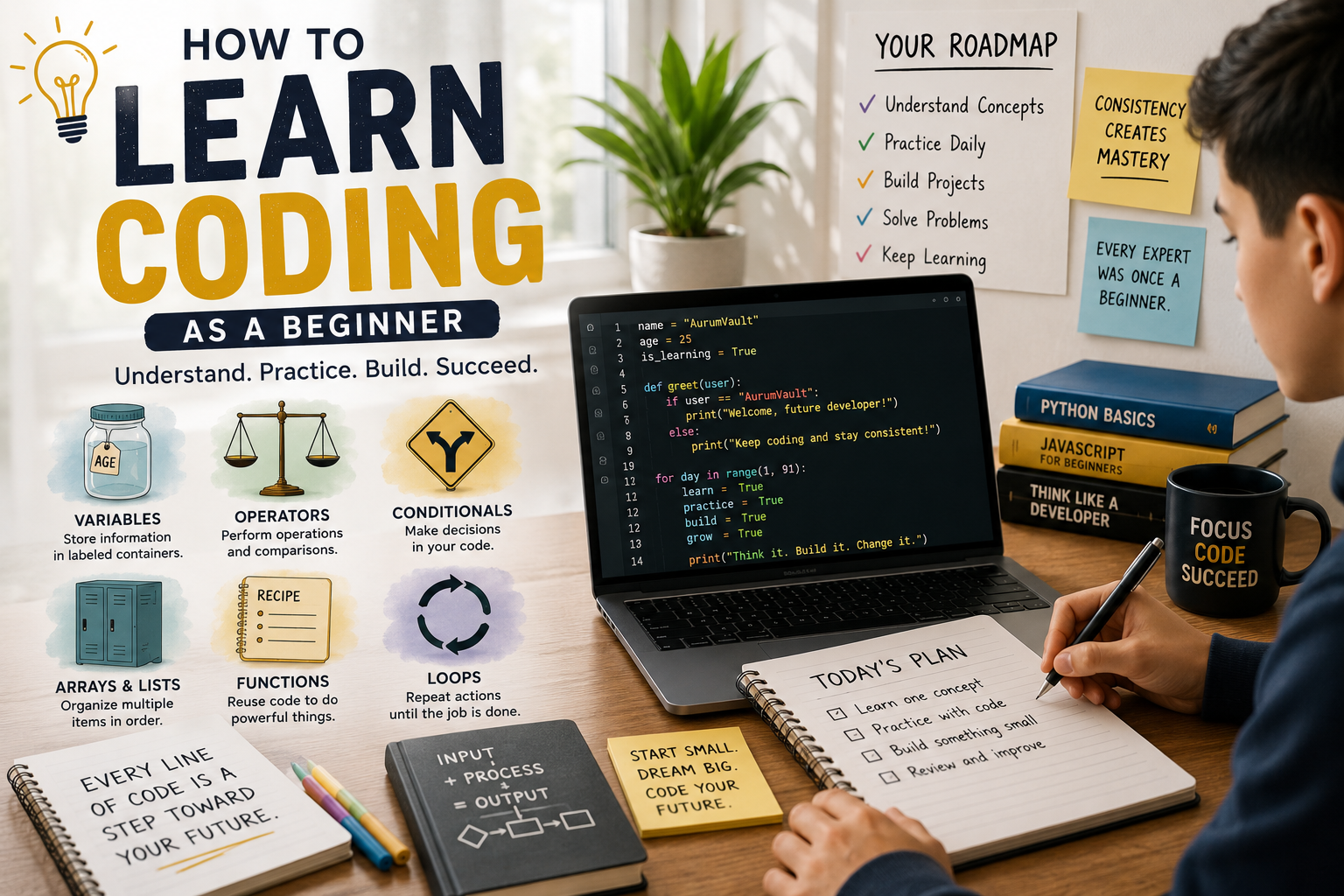
How to Learn Coding as a Beginner: Start With What You Already Know
Learning to code can feel intimidating when you're starting from zero.
Open almost any programming tutorial and you're immediately introduced to unfamiliar words: variables, strings, functions, arrays, conditionals, operators, loops, and syntax.
It can feel like learning an entirely new language before you even understand what you're trying to build.
But coding doesn't have to begin with memorizing complicated terminology.
At its core, coding is simply giving a computer clear instructions.
Once you understand that idea, programming becomes much easier to approach.
You Don't Have to Be a Computer Person to Learn Coding
One of the biggest misconceptions about programming is that you need to be exceptionally good at mathematics or technology before you can learn.
You don't.
Programming is largely about learning how to break a problem into smaller instructions.
Think about giving someone directions. You might tell them to leave the house, turn right, drive two blocks, turn left at the traffic light, and stop at the building on the corner.
You just created something surprisingly similar to a program.
There is a starting point, a sequence of instructions, and an expected result. A computer simply requires those instructions to be written much more precisely.
Start With Programming Concepts Before Memorizing Code
Beginners sometimes make the mistake of trying to memorize programming syntax immediately.
A better approach is to understand what the concepts actually do.
For example, programmers use something called a variable.
That may sound technical, but imagine a labeled jar. The label tells you what's stored inside.
A jar labeled AGE might contain the number 25. Later, its contents could change to 26 while the label remains AGE.
That's essentially what a variable does in a computer program: it gives information a name so the program can remember and use it.
Once you understand the idea, code such as `age = 25` becomes much less mysterious.
Understand Data Types
Computers also need to know what kind of information they're working with.
Some information is numerical. Some is text. Some represents a simple true-or-false decision.
These are examples of data types.
Imagine returning to those labeled jars. A jar containing numbers behaves differently from one containing words. The same principle applies in programming.
The number `5` isn't necessarily treated the same as the text `"5"`.
Understanding this distinction early can prevent many common beginner mistakes.
Learn How Programs Make Decisions
Programs become especially useful when they can make decisions. This is where conditionals come into play.
Think of a conditional as reaching a fork in the road.
You might make a decision such as: If it is raining, take an umbrella. Otherwise, leave the umbrella at home.
Software makes decisions in a similar way.
An application might determine:
- If the password is correct, allow access.
- If the shopping cart is empty, disable checkout.
- If the user's score reaches 100, unlock the next level.
Behind many sophisticated applications are thousands of simple decisions like these working together.
Learn Loops, Functions, and Lists
As you progress, you'll encounter several other foundational programming concepts.
Loops allow computers to repeat an instruction until a particular condition is reached.
Functions let programmers create reusable instructions instead of rewriting the same steps repeatedly.
Lists and arrays allow programs to organize multiple pieces of related information.
These ideas may sound technical when presented as definitions. They're much easier to understand when connected to everyday concepts.
A function can be thought of like a recipe card. A list can resemble a row of labeled lockers. A loop is like repeating a chore until the job is finished.
Once the concept makes sense, learning the programming syntax becomes the second step rather than the first.
Which Programming Language Should a Beginner Learn?
There isn't one perfect programming language for everyone.
Two popular starting points are Python and JavaScript.
Python is known for relatively readable syntax and is widely used in automation, data analysis, artificial intelligence, backend development, and other areas.
JavaScript powers much of the interactive behavior people experience on websites and is also used for server-side and application development.
Instead of spending months trying to choose the perfect language, choose one that supports the kinds of things you eventually want to build.
Your first language isn't your last language. The important skill is learning how programming works.
Build Something Earlier Than You Think You Should
Reading about programming isn't enough. Eventually, you have to build.
Your first project doesn't need to be an app with thousands of users.
Start small.
Build a program that asks someone's name and displays a personalized message. Then create one that makes a decision. Then create one that remembers information.
Each project teaches you something that another hour of passive reading cannot.
Programming starts becoming real when you see the computer respond to instructions you wrote.
A Different Way to Learn Coding
This beginner-first philosophy is the foundation of Code Like You Already Know How: A Beginner's Guide to Coding and Building Your Future.
Instead of assuming readers already understand programming terminology, the book connects coding concepts to things they already recognize.
Variables become labeled jars. Operators become a scale that tells the truth. Conditionals become forks in the road. Functions become reusable recipe cards. Lists and arrays become rows of lockers.
The book progresses from understanding how computers follow instructions to reading real code, writing programs, choosing a first programming language, and developing a structured path forward.
The goal isn't simply to memorize code. It's to understand why the code works.
Start Building Your Coding Foundation
You don't need to understand everything about programming before beginning.
You need one concept. Then another. Then another.
Eventually those concepts start connecting, and what once looked like an impossible wall of symbols begins looking like instructions you can actually read.
Think it. Build it. Change it.
That's where learning to code begins.
Enjoying the Academy?
Join AurumVault Insider for new practical guides, digital tools, and marketplace releases.
No spam. Unsubscribe anytime. Privacy
By subscribing, you agree to receive AurumVault Insider emails. You can unsubscribe at any time.
Continue your journey
Keep reading
Financial Literacy for Kids: What Everybody's Rich Except Me Teaches About Money
Everybody's Rich Except Me follows eleven-year-old Mateo Rivera as he becomes convinced that everyone around him is richer than he is. Through sneakers, social media, a small snack business, debt, saving and everyday financial choices, Mateo discovers that looking wealthy and being financially secure are very different things.
Best Digital Products to Sell in 2026: 25 High-Demand Ideas
Digital products remain one of the most accessible ways to build an online income stream because they can be created once, improved over time and sold repeatedly without physical inventory. These 25 ideas focus on practical, useful products buyers are actively seeking across business, personal finance, content creation, planning, AI, education and lifestyle markets.
Film Distribution Deliverables Checklist: Get Buyer-Ready
Finishing your edit does not automatically mean your film is ready for distribution. Learn how to assess rights, picture masters, audio, captions, music, metadata, sales assets and diligence documents before entering serious buyer conversations.