
How to Make a Documentary: From Research to Release
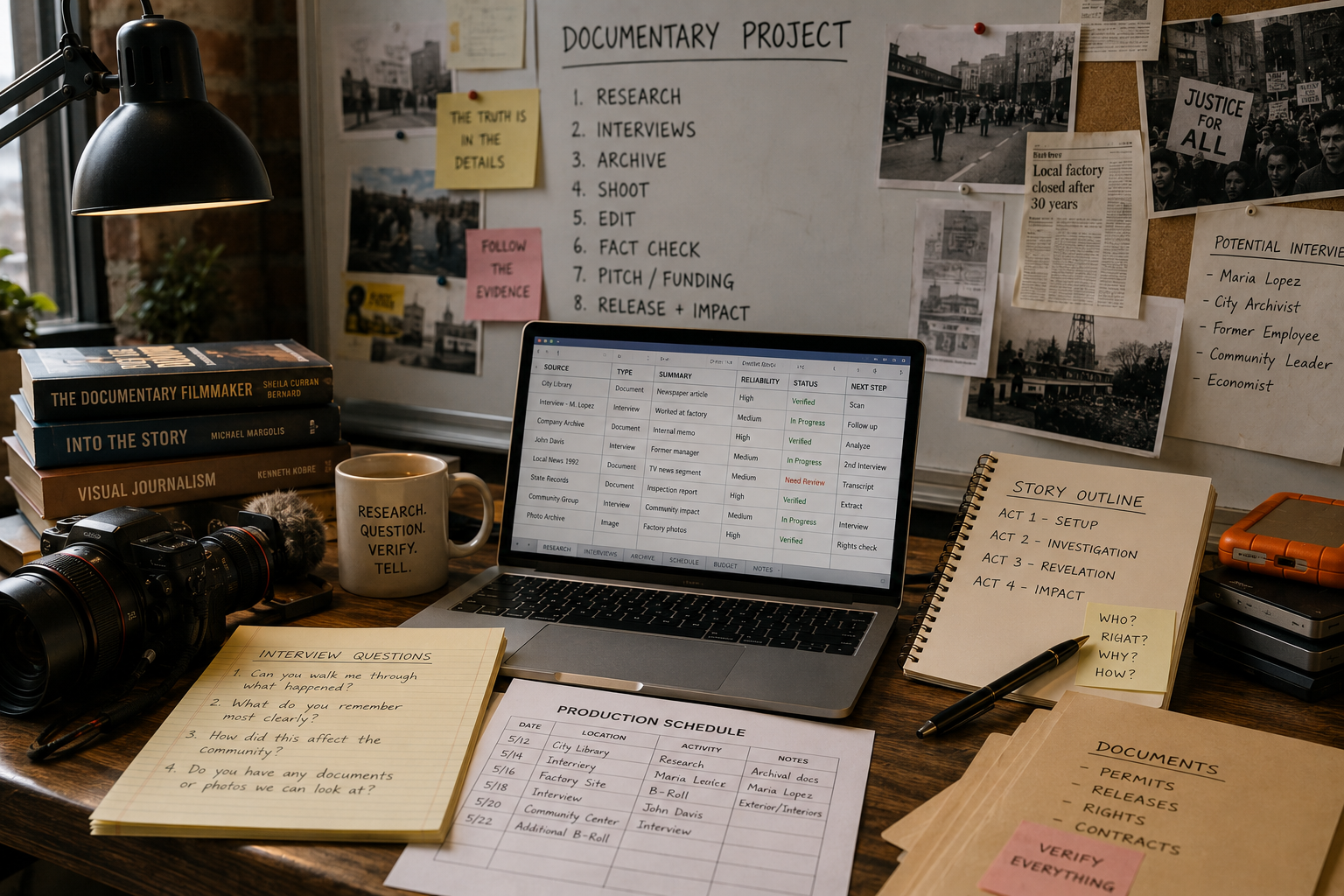
Making a documentary requires much more than pointing a camera at an interesting subject. This guide walks through the complete process of defining the story, researching sources, verifying claims, interviewing subjects, managing field production, editing, funding, pitching, distribution and impact.
How to Make a Documentary: From Research to Release
A compelling documentary can begin with something surprisingly small.
A question.
A person.
An event.
A contradiction.
An injustice.
A historical discovery.
A community undergoing change.
A story you cannot stop thinking about.
But finding an interesting subject and making a professional documentary are two very different things.
Documentary filmmaking involves much more than taking a camera into the field.
It can require:
- Research
- Sources
- Interviews
- Evidence
- Verification
- Chronology
- Archival material
- Rights
- Field production
- Transcripts
- Fact-checking
- Editorial judgment
- Funding
- Pitching
- Festivals
- Distribution
- Impact planning
The strongest documentary projects connect those moving parts into one disciplined workflow.
Here is a practical way to approach the process.
1. Start With the Central Question
Before thinking about camera gear, trailers or festivals, define the central question driving the documentary.
A documentary is usually stronger when the filmmaker knows what they are trying to understand rather than beginning with a predetermined conclusion.
Examples might include:
- What really happened?
- Why did this happen?
- Who was affected?
- What changed afterward?
- Why has this story remained hidden?
- What does this person's experience reveal about a larger issue?
Your central question becomes a filter for research, interviews, scenes and editorial decisions.
If a piece of information does not help explore the central question, ask whether it belongs in the film at all.
2. Define the Documentary's Purpose
The central question explains what you are investigating.
The purpose explains why the documentary should exist.
Ask:
- What do I want the audience to understand?
- What emotional experience should the film create?
- What larger issue does the story illuminate?
- What would be lost if this story were never documented?
- Why is this filmmaker or team positioned to tell it?
Purpose does not require advocacy.
A documentary can investigate rather than persuade.
But the filmmaker should understand why the project matters.
3. Ask Why the Story Matters Now
Timing can influence both editorial relevance and distribution potential.
Ask:
- Why now?
- Has something recently changed?
- Is an anniversary approaching?
- Is the issue becoming more urgent?
- Is new evidence available?
- Is a generation of witnesses disappearing?
- Is public interest increasing?
A strong 'why now' does not have to depend on headlines.
Sometimes the urgency is simply that access or evidence may not remain available forever.
4. Define the Subject and the World
A documentary subject exists inside a larger environment.
Map the people, institutions, places, events and forces surrounding the story.
For each important person or source, document:
- Who they are
- Why they matter
- What they know
- What has been verified
- What remains uncertain
- Sensitive issues or limitations
- What follow-up may be required
This prevents a documentary from becoming dependent on one charismatic interview or one version of events.
5. Identify Your Point of View
Every documentary has a point of view, even when the filmmaker is trying to be fair and evidence-driven.
Point of view can be influenced by:
- Who receives screen time
- Which questions are asked
- Which evidence is included
- Which scenes are selected
- How chronology is structured
- Which voices are absent
- How music and editing shape emotion
The goal is not pretending perspective does not exist.
The goal is understanding it well enough to make deliberate editorial choices.
Ask:
What assumptions am I bringing into this project?
That question can improve both research and fairness.
6. Define the Audience Promise
A documentary should make an implicit promise to the viewer.
Maybe the film promises to:
- Investigate a mystery
- Reveal an overlooked story
- Follow a person's transformation
- Explore a hidden community
- Reconstruct a historical event
- Examine conflicting accounts
- Document a disappearing world
The promise helps determine what belongs in the film.
If the trailer promises an investigation but the final documentary becomes mostly biography, the audience may feel misled.
7. Assess Your Access Advantage
Access can determine whether a documentary is merely interesting or genuinely distinctive.
Ask:
- Which people can you realistically interview?
- Which locations can you enter?
- Which archives can you access?
- Which private materials may become available?
- Are you connected to a community other filmmakers are not?
- Does someone trust you enough to allow long-term observation?
Exclusive access is not required for every documentary.
But filmmakers should understand what access makes their project uniquely valuable.
8. Identify Access Dependency Risk
The opposite question matters just as much.
What happens if your key access disappears?
Imagine the documentary depends on one subject agreeing to participate and that person withdraws halfway through production.
Can the project continue?
Document major dependencies such as:
- Key interview subjects
- Private archives
- Locations
- Institutional cooperation
- Family permission
- Event access
- Specialized experts
Then build alternatives where possible.
The earlier you identify dependency risk, the easier it is to manage.
9. Build a Research Command Center
Research should not live in scattered browser tabs and random notes.
Create a central research system containing:
- Questions
- Sources
- Documents
- Claims
- Events
- Chronology
- Contradictions
- Open questions
- Follow-ups
- Verification status
Every significant research thread should answer:
What do we know? How do we know it? What remains uncertain? What should happen next?
That is far more useful than simply collecting information.
10. Build a Research Question Bank
Before interviews begin, create a bank of questions the project must answer.
Separate them into categories such as:
Story Questions
What happened?
Character Questions
What does the subject want, fear or believe?
Evidence Questions
What documents or records could verify this?
Contradiction Questions
Where do accounts disagree?
Context Questions
What larger historical, cultural, scientific or social information does the viewer need?
Accountability Questions
Who made which decisions and why?
The question bank should evolve as new information appears.
11. Track Research Threads Separately
Large documentaries can contain multiple lines of inquiry.
Do not let them blend together.
One project might include:
- The main subject's personal history
- Institutional decisions
- Financial records
- Historical context
- A disputed event
- A legal conflict
- Community impact
Track each research thread independently while showing how it connects to the central story.
This makes contradictions and missing evidence easier to see.
12. Build Source Intelligence Profiles
Not every source has equal value.
For each important source, record:
- Identity
- Role
- Connection to the story
- Firsthand or secondhand knowledge
- Possible bias
- Documentary evidence they can provide
- Reliability concerns
- Sensitive issues
- Follow-up requirements
A compelling speaker is not automatically a reliable source.
And a quiet source may possess the document that changes the entire film.
13. Evaluate Source Quality
Consider the strength of each major source.
Ask:
- Were they present?
- Are they relying on memory?
- Do they have records?
- Do other sources corroborate the account?
- Is there a reason they may misremember or distort events?
- Are they speaking outside their expertise?
- Is their account internally consistent?
Do not reduce credibility to whether someone seems confident on camera.
Confidence is not evidence.
14. Create a Claim and Evidence Matrix
For important claims, build a simple matrix:
Claim → Evidence → Verification Status → Contradiction / Limitation → Editorial Action
For example:
Claim: A company knew about a safety problem before an accident.
Evidence: Internal email dated six months earlier.
Verification: Document authenticated and corroborated by two employees.
Limitation: Email does not prove senior leadership saw it.
Editorial action: Phrase claim narrowly and seek additional evidence.
This system helps prevent the film from overstating what the evidence proves.
15. Corroborate Important Claims
When possible, significant claims should be supported by more than one source.
Corroboration can come from:
- Independent witnesses
- Documents
- Photographs
- Video
- Public records
- Data
- Expert analysis
- Archival material
Two people repeating the same rumor is not necessarily independent corroboration.
Ask whether the sources obtained their information separately.
16. Maintain a Contradiction Log
Contradictions are not always problems.
Sometimes they are the story.
When two credible sources disagree, record:
- What each person claims
- Supporting evidence
- Missing evidence
- Possible reasons for disagreement
- What follow-up is required
Do not force certainty where the evidence remains unresolved.
A documentary can sometimes be more credible by acknowledging uncertainty.
17. Build the Chronology Before Manipulating Narrative Order
Documentary editing often rearranges events for clarity or dramatic effect.
Before doing that, build the factual chronology.
Track:
- Date
- Event
- Evidence
- Source
- Verification status
- Contradictions
Only after establishing what happened when should you decide how the audience will experience the story.
Chronology and narrative order are not the same thing.
The first is factual organization.
The second is storytelling.
18. Build a Document and Record Vault
Research materials should remain organized and traceable.
Create a vault for:
- Public records
- Court records
- Emails
- Letters
- Photographs
- Videos
- Audio
- News archives
- Government reports
- Academic research
- Business records
- Personal documents
Record where each item came from, when it was obtained and any usage or rights restrictions.
Months into editing, you should still be able to identify the origin of a critical document.
19. Prepare Interviews as Research Events
Documentary interviews are not simply conversations captured on camera.
They are research events.
Before each interview, identify:
- What the person knows
- What only they may know
- What needs corroboration
- Sensitive topics
- Contradictions involving their account
- Documents to discuss
- Follow-up questions
Your best questions often come from preparation, not improvisation.
20. Ask Open Questions Before Confrontational Ones
Instead of immediately asking:
'Why did you lie about the incident?'
Begin with:
'Tell me what happened that day.'
Then establish the person's complete account before introducing contradictory evidence.
Open questions can reveal information you did not know enough to ask about directly.
21. Track What Was Actually Said
After interviews, log important statements.
Track:
- Claim
- Speaker
- Timecode
- Supporting evidence
- Contradictions
- Follow-up required
- Fact-check status
Transcripts become much more useful when they connect directly to research and editorial decisions.
22. Plan Field Production Around Story Evidence
Production should serve the documentary rather than simply create attractive footage.
Build a field plan around:
- Interviews
- Observational scenes
- Locations
- Archival opportunities
- Supporting visuals
- Events
- Evidence capture
- Character behavior
Ask what each scene contributes.
Does it reveal character?
Does it provide evidence?
Does it create context?
Does it move the story?
Beautiful footage without narrative purpose can become expensive storage.
23. Capture Claims in the Field
New claims often emerge during filming.
Someone says something unexpected.
A document appears.
A witness contradicts an earlier account.
A location raises a new question.
Record those discoveries immediately with:
- Claim or event
- Source
- Evidence
- Verification status
- Limitation
- Required research action
Field production and research should continuously communicate with one another.
24. Separate Observation From Interpretation
Documentary footage often contains ambiguity.
Suppose a subject leaves a meeting looking visibly upset.
The camera proves they left and appeared upset.
It does not automatically prove why.
Do not turn visual interpretation into factual certainty unless supported by evidence.
This distinction becomes especially important in investigative and sensitive documentaries.
25. Build the Story in the Edit
Documentary writing does not end when production begins.
Much of the final story is discovered in postproduction.
Organize:
- Interviews
- Scenes
- Archival material
- Documents
- Graphics
- Narration
- Chronology
- Claims
- Contradictions
Then begin identifying the narrative spine.
A strong documentary edit usually answers:
What does the audience need to know now to care about what happens next?
26. Compare Chronology With Narrative Order
Once the factual timeline is secure, decide whether the film should present events chronologically.
Sometimes chronological storytelling is strongest.
Other times, beginning later and revealing earlier events gradually creates greater clarity or tension.
Whatever structure you choose, do not allow narrative technique to distort factual relationships.
Maintain a separate verified chronology throughout the edit.
27. Run Fact-Check Reconciliation Before Lock
Before picture lock, reconcile every important factual claim with the research record.
For each claim, confirm:
- Source
- Evidence
- Verification status
- Known contradiction
- Limitation
- Editorial wording
The Documentary Creator OS includes a dedicated fact-check reconciliation process built around those exact elements. 1
If the evidence supports only a limited statement, the film should not make a broader one.
28. Treat Rights as Part of Production
Documentaries can contain many rights-sensitive materials.
These may include:
- Archival footage
- Music
- Photographs
- News clips
- Documents
- Artwork
- Logos
- Private recordings
- Location access
- Releases
Do not wait until distribution to discover that an essential piece of the final film cannot be cleared.
Track rights throughout the project and obtain professional review where appropriate.
29. Build the Budget Around the Actual Documentary
Documentary budgets can vary widely.
Possible costs may include:
- Research
- Travel
- Crew
- Equipment
- Insurance
- Archival licensing
- Music
- Editing
- Graphics
- Legal review
- Fact-checking
- Color
- Sound
- Deliverables
- Festival submissions
- Marketing
Build production and postproduction budgets based on the actual project rather than a generic filmmaking template.
The Documentary Creator OS includes dedicated production and post budget tracking with target, actual, variance, gap or risk, and next financial action. 2
30. Create a Funding Strategy
Possible documentary funding sources can vary by project and may include:
- Grants
- Foundations
- Private investors
- Broadcasters
- Production partners
- Crowdfunding
- Sponsors where editorial independence can be appropriately protected
- Personal financing
For every opportunity, track:
- Eligibility
- Purpose
- Ask
- Requirements
- Restrictions
- Deadline
- Risk
- Next action
A large grant that does not fit the project can waste more time than a smaller opportunity that aligns perfectly.
31. Build the Pitch Before You Need the Money
A strong documentary pitch should clearly communicate:
- Central question
- Story
- Main subjects
- Why now
- Access
- Visual approach
- Audience
- Current production status
- Team
- Budget
- Funding need
- Distribution potential
- Impact potential
The pitch is not simply a summary.
It explains why this story, this team and this moment deserve attention.
32. Plan for Festivals and Distribution Early
Do not wait for the final export to begin thinking about where the documentary belongs.
Research:
- Relevant festivals
- Broadcasters
- Streaming platforms
- Distributors
- Educational markets
- Community screenings
- International opportunities
- Direct-to-audience options
Distribution strategy can influence runtime, rights, deliverables, premiere status and marketing decisions.
Requirements can change, so verify current submission and eligibility rules directly with each organization before acting.
33. Think Beyond Release to Impact
For some documentaries, release is not the final objective.
The film may also be intended to support:
- Education
- Public discussion
- Community engagement
- Policy conversations
- Historical preservation
- Advocacy
- Institutional change
Define what impact means for this project.
Then decide how it will be measured.
Possible indicators might include:
- Screenings
- Partnerships
- Educational adoption
- Media coverage
- Community participation
- Audience actions
- Policy engagement
Impact goals should fit the documentary rather than being added only because they sound impressive.
34. Use Clear Project Statuses
Complex documentaries can become difficult to manage because every task feels partially complete.
A simple status system can create clarity:
READY / VERIFIED — Information or work is sufficiently supported to proceed.
REVIEW NEEDED — More verification, editorial judgment or professional review is required.
HOLD / BLOCKED — The project should not proceed in that area until a significant issue is resolved.
This status language appears throughout the Documentary Creator OS and keeps evidence, risk and next actions visible. 3
The Documentary Workflow Is Bigger Than Production
It is easy to think documentary filmmaking follows a simple path:
Idea → Shoot → Edit → Release
Real projects are usually more complicated.
A stronger model is:
DEFINE → RESEARCH → VERIFY → INTERVIEW → CAPTURE → EDIT → FUND → RELEASE → IMPACT
Each stage feeds the next.
Research affects interviews.
Interviews generate new claims.
Claims require verification.
Field production reveals new evidence.
Evidence affects editing.
Editing can expose research gaps.
Rights affect distribution.
Distribution affects deliverables.
And release may begin an entirely new impact phase.
Build the Entire Workflow With Documentary Creator OS™
Documentary Creator OS™ — Master Edition by AurumVault Professional Creator Systems is built as a complete interactive documentary operating system rather than a simple filmmaking planner.
It is designed to organize documentary development through research, sources, interviews, evidence, archive, field production, editorial review, funding, festivals, distribution and impact. 4
The system supports investigative, character-driven, historical, social-issue, cultural, biographical, sports, faith/community, science/nature, personal essay, short-form, feature and episodic documentary projects. 5
Its research architecture includes tools such as a Source Quality Score, Claim & Evidence Matrix, Corroboration Tracker, Chronology Builder and contradiction tracking so the creator can distinguish what is known, what is disputed and what still requires action. 6 7 8
The goal is not simply to help you finish a documentary.
It is to help you build one whose story, research, evidence, interviews, production and release strategy remain connected from beginning to end.
Research. Investigate. Interview. Produce. Verify. Edit. Pitch. Release.
Enjoying the Academy?
Join AurumVault Insider for new practical guides, digital tools, and marketplace releases.
No spam. Unsubscribe anytime. Privacy
By subscribing, you agree to receive AurumVault Insider emails. You can unsubscribe at any time.
Continue your journey
Keep reading
Athlete Endorsement Deals: Protect Your Rights & Brand
A professional athlete's commercial value extends far beyond a playing contract. Learn how to organize name, likeness, voice, content, endorsements, licensing, paid media, group rights, AI permissions, exclusivity and post-career assets before granting another company access to your identity.
How to Use Meta AI for Business Without Losing Control
Meta AI can help creators and small businesses analyze content, plan campaigns, organize customer questions and streamline routine work. The bigger challenge is using it with clear data boundaries, verified inputs, human review and defined authority.
How to Turn Content Creation Into a Real Business: A Digital Creator Operating System
Successful creators do more than publish content. They build systems around their audience, offers, products, partnerships, revenue, and operations. This guide explains how to start turning your creative work into a more organized and sustainable business.