
Responsible AI for Small Business: A Practical Trust Framework
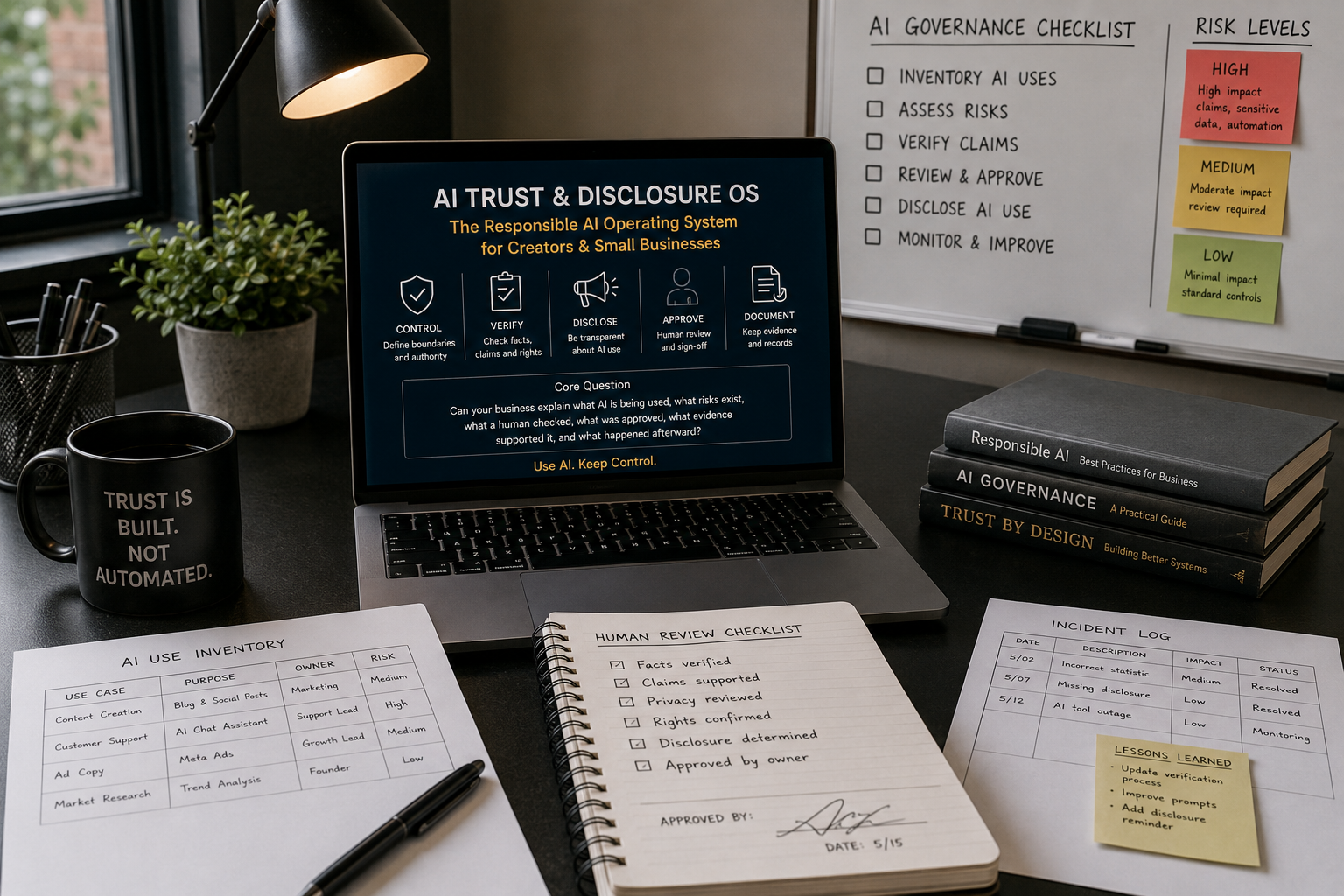
AI can help small businesses work faster, create more and analyze information more efficiently. Responsible AI use requires something more: clear ownership, risk assessment, verified claims, privacy boundaries, disclosure rules, human approval and a record of what happened.
Responsible AI for Small Business: A Practical Trust Framework
Artificial intelligence can help a small business write content, analyze information, respond to customers, generate images, summarize research, prepare reports, brainstorm offers and automate parts of everyday operations.
But as AI becomes more useful, a different question becomes more important:
How do you use AI without losing control of accuracy, privacy, customer trust, intellectual property and human accountability?
That is the purpose of responsible AI governance.
Responsible AI does not require a small business to become a technology company.
It means creating a practical system that can answer questions such as:
- Which AI tools are we using?
- Why are we using them?
- Who owns each use?
- What information enters the system?
- What risks exist?
- What must a human review?
- Which claims require evidence?
- When should AI use be disclosed?
- Which actions require approval?
- What happens if something goes wrong?
The goal is simple:
Use AI productively without allowing convenience to erase responsibility.
1. Start With an AI Inventory
You cannot govern what you do not know exists.
Begin by creating an inventory of meaningful AI use across the business.
For each AI tool or workflow, document:
- Tool or system
- Business purpose
- Human owner
- Risk level
- Data entering the system
- Human review requirement
- Next review date
This can include obvious tools such as AI assistants and image generators, but also less obvious AI features embedded inside marketing, advertising, customer service, productivity and analytics tools.
The objective is not to create paperwork for its own sake.
It is to make AI use visible.
2. Give Every Important AI Use a Human Owner
A workflow should not become more autonomous simply because nobody knows who is responsible for it.
Every important AI use should have a named owner or role.
That person should understand:
- What the AI is expected to do
- What information it receives
- What risks are involved
- What requires verification
- What requires approval
- What happens when the output is wrong
AI can perform work.
A human or organization still owns the consequences.
3. Assess Risk Using Visible Factors
Not every AI use has the same level of risk.
Generating internal brainstorming ideas is different from giving customers financial guidance, publishing realistic synthetic media or automatically making consequential decisions.
A practical AI risk assessment can examine factors such as:
- Customer impact
- Financial impact
- Reputation impact
- Privacy or sensitivity
- Intellectual property exposure
- Accuracy requirements
- Automation level
- Human oversight
- External publication
- Vulnerable audiences
- Synthetic media or deception risk
- Contract obligations
- Vendor uncertainty
The important principle is that risk should be explainable.
A mysterious score is less useful than a visible explanation of why a particular use deserves stronger controls.
4. Translate Risk Into Required Controls
Risk classification should lead to action.
Depending on the use case, required controls may include:
- Human review
- Claim verification
- Disclosure review
- Rights review
- Privacy review
- Vendor review
- Final approval
- Agent authority review
Higher-risk work should receive stronger controls before publication or execution.
Do not label something low risk simply because it is convenient to automate.
5. Treat AI Output as Draft Material Until Verified
AI can generate confident-sounding information that is incomplete, outdated or incorrect.
Before important work is used, review areas such as:
- Accuracy
- Unsupported claims
- Hallucinations
- Tone and brand fit
- Privacy
- Confidentiality
- Copyright and intellectual property
- Disclosure
- Bias or fairness
- Customer harm
The right question is not:
Does this sound good?
It is:
Is this accurate, appropriate and safe enough for us to stand behind?
6. Build a Claim Verification Process
Material business claims should not become true merely because an AI system generated them.
Create a verification register for important statements.
Track:
- Material claim
- Source or evidence
- Verification status
- Reviewer
- Date
- Notes
If a claim has not been supported, mark it UNVERIFIED rather than filling the gap with confidence.
This is especially important for:
- Statistics
- Product performance claims
- Financial claims
- Health claims
- Legal claims
- Customer outcomes
- Comparative advertising
- Testimonials
- Research summaries
Responsible AI means allowing uncertainty to remain visible until evidence resolves it.
7. Make 'Unknown' an Acceptable Answer
One of the most useful governance habits is refusing to manufacture certainty.
If you do not know:
- How a vendor handles data
- Whether a claim is accurate
- Whether a right has been secured
- Whether disclosure is required
- Whether a platform rule applies
then record the status as NOT VERIFIED or UNRESOLVED.
The business can then investigate.
False certainty creates more risk than visible uncertainty.
8. Create an AI Disclosure Decision Process
Not every use of AI requires the same type of disclosure.
But the decision should be intentional.
Ask questions such as:
- Was AI materially involved?
- Is the output customer-facing?
- Was a realistic person, voice, image or event altered?
- Could the origin be misunderstood?
- Is the content sponsored?
- Does a contract require disclosure?
- Does organization policy require disclosure?
- Does the current platform require disclosure?
- Is AI interacting directly with a customer?
- Is the AI giving a consequential recommendation?
Then record the decision and the basis for it.
The goal is not adding the same disclaimer to everything.
It is creating a repeatable way to decide what disclosure is appropriate.
9. Build Reusable Disclosure Templates
Once disclosure rules are defined, create organization-approved language for common situations.
Examples can include:
- AI-assisted article
- AI-assisted social post
- AI-generated image
- Synthetic media
- AI-assisted research
- Customer-service AI
- AI-generated advertisement
- Sponsored AI partnership
- Client project
- AI-generated voice or video
Templates should save time without pretending that one sentence fits every situation.
Context still matters.
10. Review Content Authenticity Before Publishing
Before AI-assisted content goes live, run an authenticity check.
Review:
- Sources
- Facts
- Quotes
- Statistics
- Links
- Image authenticity
- AI visual disclosure
- Rights and licensing
- Brand compliance
- Privacy
- Customer claims
- Human approval
If high-risk work still has a mandatory verification or approval outstanding, it should not be marked ready.
Speed does not replace readiness.
11. Track Copyright, Licensing and Rights
AI-assisted creative work can involve multiple layers of rights questions.
Track important assets by documenting:
- Asset
- Source
- Creator
- License
- Commercial-use status
- AI involvement or modification
- Attribution requirements
- Permission evidence
This is especially useful for businesses creating:
- Images
- Video
- Audio
- Advertisements
- Social content
- Client work
- Ebooks
- Digital products
- Marketing campaigns
A finished asset is not automatically a cleared asset.
12. Establish Privacy and Customer Data Rules
Businesses should explicitly decide what kinds of information may be used in AI systems.
Categories may include:
- Personal information
- Customer records
- Financial information
- Health-related information
- Employee information
- Confidential business information
- Credentials and secrets
- Intellectual property
- Client documents
- Children's information
Do not assume that because data exists inside the business, it is appropriate to provide it to every AI tool.
Purpose, authorization and sensitivity matter.
13. Assess AI Vendors Instead of Guessing
Businesses often rely on assumptions about what AI vendors do with information.
A better approach is to document what has actually been verified.
Review areas such as:
- Vendor or product
- Purpose
- Owner
- Data collected
- Data retention
- Training-data policy
- Security documentation
- Subprocessors
- Deletion options
- Export capability
- Contract status
- Privacy documentation
If you have not verified a vendor practice, mark it Not Verified.
Do not invent a privacy or security guarantee simply because the product is widely used.
14. Define AI Agent Authority
As AI moves from generating drafts toward taking actions, authority boundaries become increasingly important.
For every AI agent or automated workflow, define:
- What it may do
- What it may not do
- Which information it may access
- Which actions require approval
- Which actions are prohibited
- Who can change its authority
- Who reviews activity
An AI system should not silently expand its own authority.
If a workflow requires more power, that change should be explicit and human-approved.
15. Keep Consequential Decisions Human
AI can support consequential work without owning the final decision.
Examples can include:
- Contracts
- Legal matters
- Employment decisions
- Financial commitments
- High-impact customer decisions
- Sensitive claims
- Security incidents
- Major public statements
AI may organize information, summarize options or identify open questions.
The human decision-maker remains accountable.
16. Build an Approval System
Important AI-assisted work should have a visible approval path.
Document:
- What requires approval
- Who approves it
- What evidence is required
- What conditions block approval
- What happens after approval
This prevents situations where a draft slowly becomes a final decision simply because nobody stopped it.
17. Record AI Incidents and Near Misses
When something goes wrong, do not simply delete the output and move on.
Record incidents involving:
- Incorrect claims
- Privacy problems
- Unapproved publication
- Customer harm
- Rights issues
- Hallucinated facts
- Vendor problems
- Authority violations
- Disclosure failures
Then ask:
- What happened?
- Why did it happen?
- Which control failed?
- Who was affected?
- What was corrected?
- What policy or workflow should change?
An incident log turns mistakes into operational learning.
18. Monitor What Happens After Publication or Execution
Responsible AI does not end at approval.
After something is published or executed, monitor for:
- Customer complaints
- Unexpected outcomes
- Incorrect information
- Policy violations
- Platform issues
- Rights concerns
- Reputation risk
- Escalation needs
A workflow may appear safe during planning and still create unexpected problems in the real world.
Monitoring closes that gap.
19. Document the Decision Trail
If an important AI-assisted outcome is challenged later, the business should be able to explain:
- What AI was used
- Why it was used
- What data entered the system
- What risks were identified
- What a human reviewed
- What claims were verified
- What evidence supported them
- What disclosure decision was made
- Who approved the work
- What happened afterward
This is not just recordkeeping.
It is operational accountability.
20. Build a Responsible AI Lifecycle
A useful operating lifecycle can follow eleven stages:
INVENTORY → ASSESS → DECIDE → VERIFY → REVIEW → APPROVE → DISCLOSE → PUBLISH / EXECUTE → MONITOR → DOCUMENT → IMPROVE
Each stage answers a different question.
Inventory asks what exists.
Assessment asks what risks exist.
Decision defines the intended use.
Verification checks evidence.
Review examines quality and harm.
Approval establishes human authorization.
Disclosure addresses transparency.
Publication or execution puts the work into the real world.
Monitoring watches what happens afterward.
Documentation creates accountability.
Improvement updates the system based on what was learned.
The Core Question Every AI-Using Business Should Be Able to Answer
A responsible business should eventually be able to answer one simple question:
Can we explain what AI is being used, what risks exist, what a human checked, what was approved, what evidence supported it and what happened afterward?
If the answer is no, the issue may not be that the business uses too much AI.
The issue may be that AI use has grown faster than the operating controls around it.
Responsible AI Is Not the Same as Maximum Restriction
Responsible AI is not about refusing to use useful technology.
It is about building enough structure around the technology that the business can use it confidently.
That means:
- Visibility instead of hidden use
- Evidence instead of assumptions
- Human review instead of blind trust
- Defined authority instead of silent autonomy
- Disclosure decisions instead of guesswork
- Privacy rules instead of unrestricted data sharing
- Incident learning instead of forgotten mistakes
The objective is not to slow the business down unnecessarily.
It is to prevent speed from creating avoidable risk.
Build a Practical AI Trust System
The AI Trust & Disclosure OS — Creators & Small Business Edition is designed as a practical operating system for businesses that want stronger controls around AI use without turning governance into an enterprise compliance project.
The system helps organize:
- Executive AI trust assessment
- AI use inventory
- Explainable risk assessment
- Required controls
- Human review
- Claim and fact verification
- Disclosure decisions
- Disclosure templates
- Content authenticity review
- Copyright, licensing and rights
- Privacy and customer data
- AI vendor assessment
- Human approval
- AI agent authority
- Incident tracking
- Evidence and documentation
Its philosophy is straightforward:
Control. Verify. Disclose. Approve. Document.
Because AI can accelerate the work.
It should not erase ownership, judgment, evidence or accountability.
Educational notice: This article provides operational and educational guidance only. It does not provide legal advice, certification or a guarantee of compliance. Laws, contracts, platform rules, vendor practices and AI capabilities can change, so businesses should verify current requirements for their organization, jurisdiction and use case.
Enjoying the Academy?
Join AurumVault Insider for new practical guides, digital tools, and marketplace releases.
No spam. Unsubscribe anytime. Privacy
By subscribing, you agree to receive AurumVault Insider emails. You can unsubscribe at any time.
Continue your journey
Keep reading
EU Packaging Compliance 2026: PPWR Checklist for Small Brands and Ecommerce
EU packaging compliance can involve far more than choosing recyclable packaging. Small brands selling into European markets may need to understand their economic role, map packaging components, collect supplier evidence, document material data, review recyclability and labeling, track country-level EPR actions and maintain technical records. This guide provides an evidence-first framework for organizing that work.
AI Governance for Small Business: The Complete 2026 Checklist
Small businesses are adopting AI faster than many are creating rules for it. This practical 2026 checklist shows business owners how to inventory AI tools, protect sensitive information, define employee and AI-agent authority, require human approval for consequential actions, evaluate vendors, document incidents and create a manageable AI governance system.
AI Governance in Banking: A Practical Operations Framework
Banking AI governance should go beyond documenting models. This practical framework shows how financial institutions can inventory AI use, classify customer and financial impact, establish authority limits, validate material systems, preserve transaction-level evidence and review complaints, incidents and controls.