
WHEN TO SUE Your Legal Options Against Credit Bureaus and Debt Collectors
Disputing an error and suing over one are different steps. This guide covers what actually qualifies as a legal claim under the FCRA and FDCPA, the difference between statutory and actual damages, and how to build a case worth pursuing.
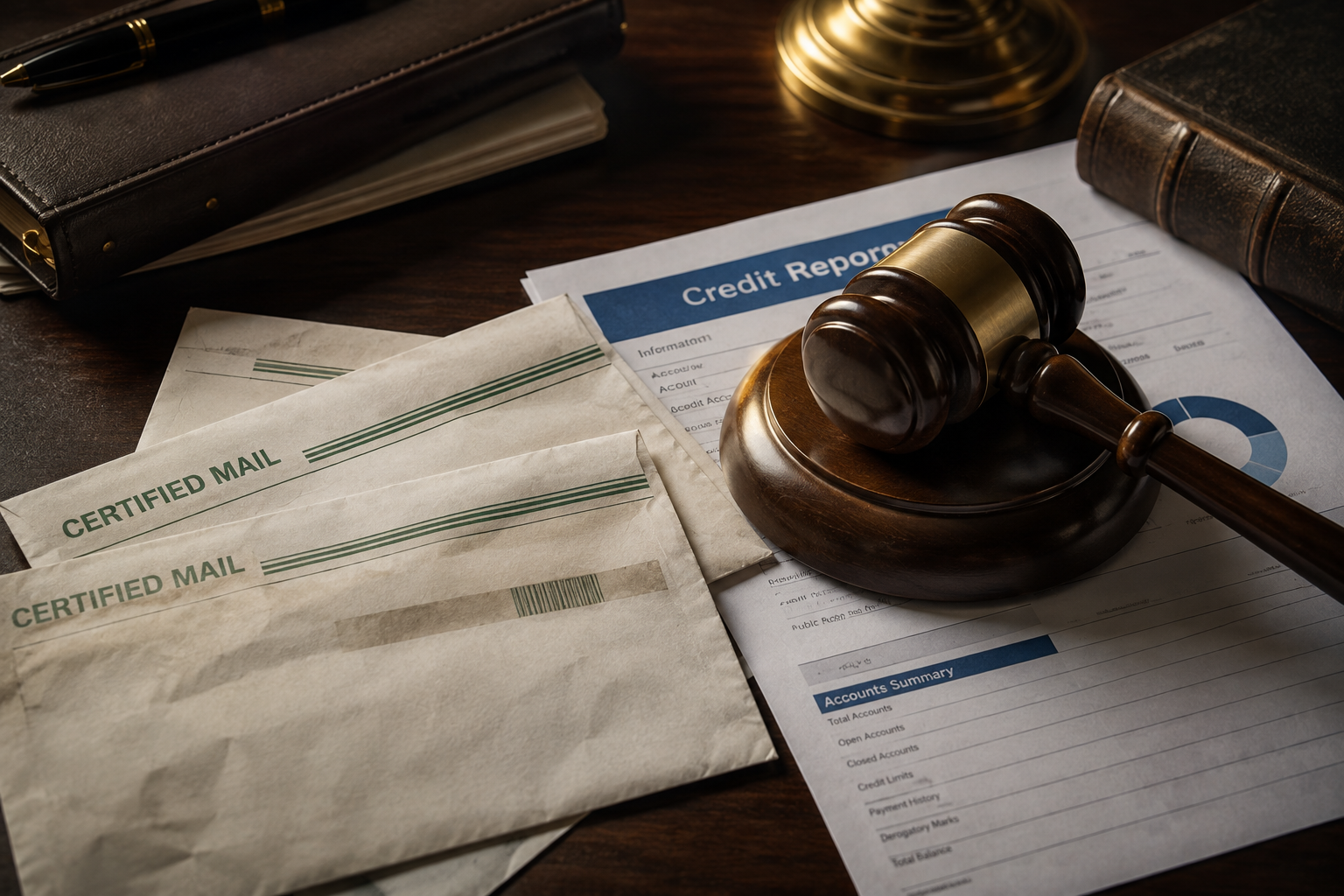
Suing The Credit Bureaus & Collection Agencies
Introduction
Disputing an error and suing over one are two very different steps, and most consumers never learn where the line between them actually sits. A dispute asks a bureau or collector to fix something. A lawsuit says they had a legal duty to get it right, they failed, and the failure caused real, compensable harm. Most credit and collection problems resolve at the dispute stage. But some don't — and when a bureau verifies information it never actually investigated, or a collector keeps calling after a documented cease request, the law doesn't just offer another form letter. It offers a courtroom.
This guide is about that second stage: the point where documentation stops being a paper trail and starts being evidence. It covers what actually qualifies as a legal claim under the FCRA and FDCPA, what damages look like, and how the process differs from the dispute letters covered in earlier guides in this series.
This is educational content, not legal advice for any individual situation. Consumer protection litigation involves real deadlines, real procedural rules, and real consequences for getting it wrong, so anyone considering this path should read this as a map, not a substitute for a licensed attorney's judgment on their specific facts.
Chapter 1: When Disputing Isn't Enough
A dispute is designed to fix a mistake. A lawsuit is designed to hold someone accountable for a legal violation. The two overlap, but they aren't the same tool, and treating every frustrating interaction as a lawsuit waiting to happen usually leads nowhere. What actually separates the two is whether a specific, identifiable legal duty was violated — not just whether the outcome was annoying or unfair.
A credit bureau that takes thirty-one days instead of thirty to respond to a dispute has technically missed a deadline, but that alone rarely becomes a strong case. A bureau that receives a detailed, documented dispute and comes back "verified" without any real investigation — reusing the same data the consumer already proved was wrong — has crossed into a different category entirely. The difference is not the inconvenience to the consumer; it's whether the process itself was followed in good faith.
Chapter 2: FCRA Claims Against Credit Bureaus
The Fair Credit Reporting Act requires credit bureaus to follow "reasonable procedures to assure maximum possible accuracy" and to conduct a genuine investigation once a dispute is filed. A viable FCRA claim generally centers on one of a few patterns: reporting information the bureau knew or should have known was inaccurate, failing to conduct a real investigation after a proper dispute, continuing to report information after receiving clear proof it was wrong, or failing to correct an error across all bureaus after it was proven false with one.
What separates a strong claim from a weak one is almost always documentation. A consumer who disputed once, got a form-letter denial, and gave up has a thin record. A consumer who disputed in writing, included supporting evidence, received a hollow "verified" response, followed up requesting the method of verification, and kept every piece of correspondence has built something that looks very different to an attorney evaluating the case.
Chapter 3: FDCPA Claims Against Debt Collectors
The Fair Debt Collection Practices Act creates liability for specific collector behavior: harassment, misrepresentation of the debt, contacting third parties inappropriately, continuing contact after a documented cease request, or threatening action the collector has no real intention or legal ability to take. Unlike ordinary rudeness, these are defined violations with a real legal remedy attached.
The strongest FDCPA claims tend to share a pattern: the violation is specific and provable, not a matter of tone or interpretation. "They were rude on the phone" is hard to litigate. "They called fourteen times in six days after receiving a written cease request on this date, and here are the phone records" is a fundamentally different, and far stronger, starting point.
Chapter 4: Statutory Damages vs. Actual Damages
Actual damages cover real, provable financial harm — a loan denial, a higher interest rate, lost time, documented emotional distress. These require evidence connecting the violation directly to a specific loss.
Statutory damages are damages the law itself sets, without requiring proof of a specific dollar loss. Both the FCRA and FDCPA allow for statutory damages in qualifying cases, which is a significant reason these claims are viable even when a consumer can't point to an exact financial number they lost.
This distinction matters enormously for a consumer deciding whether pursuing a claim is worth it. Many people assume they need to prove they were denied a loan or paid a higher rate to have a case. Statutory damages exist precisely because Congress recognized that violations of these laws cause real harm that's often difficult to quantify precisely — and built a remedy that doesn't require it.
Chapter 5: Building the Case Before You File
Courts and attorneys both respond to the same thing: a clear, documented timeline. Before pursuing legal action, the strongest position comes from having exhausted the standard remedies first — disputes sent in writing, certified mail receipts kept, responses saved, and a method-of-verification request made where a dispute came back "verified" without explanation.
This isn't just a formality. Exhausting these steps does two things: it gives the bureau or collector every reasonable opportunity to correct the problem without litigation, which strengthens the case that they failed to meet their legal duty when they didn't — and it builds the exact evidentiary record an attorney needs to evaluate whether a claim is worth pursuing in the first place.
Chapter 6: Small Claims Court vs. Federal Court
Not every claim needs a federal lawsuit. Many FDCPA and some FCRA-adjacent claims can be pursued in small claims court, without an attorney, for a filing fee that's often under a hundred dollars. This route works best for clear-cut, well-documented violations where the consumer is comfortable presenting their own evidence and the potential recovery fits within the small claims dollar limit in their state.
Larger or more complex claims — particularly FCRA cases involving multiple bureaus, ongoing harm, or a pattern of violations — are typically better suited to federal court with an attorney, both because of procedural complexity and because these statutes include fee-shifting provisions that can make attorney representation more accessible than most people assume.
Chapter 7: Do You Need an Attorney?
Both the FCRA and FDCPA include fee-shifting provisions, meaning a successful consumer can recover attorney's fees from the violating party. This is a significant, often-overlooked detail: it means many consumer protection attorneys take these cases on contingency, with no upfront cost to the consumer, because the fee-shifting structure allows them to be paid by the losing party rather than out of the consumer's recovery.
This changes the calculus considerably. A consumer with a well-documented violation often has real access to legal representation without needing significant savings to pursue it — which is precisely why the documentation habits covered earlier in this guide, and throughout this series, matter so much. A strong paper trail is often the difference between an attorney taking a case and passing on it.
Examples
A consumer who disputed a collections account three times, each time receiving a form "verified" response with no real explanation, eventually consulted an attorney who took the case on contingency and secured removal of the item plus statutory damages. Another consumer, after documenting fourteen calls following a written cease request, filed in small claims court without an attorney and won a judgment based primarily on phone records and the certified mail receipt for the original cease letter. A third consumer's case was declined by an attorney specifically because the dispute history was thin — a reminder that the legal option often depends entirely on the documentation habits built well before a lawsuit is ever considered.
Best Practices
Exhaust the standard dispute and cease-contact process first, in writing, before considering legal action.
Keep every piece of documentation — dispute letters, certified mail receipts, responses, call logs — even for a dispute that seems resolved.
Request the specific method of verification when a dispute is denied without real explanation; the response itself can become part of your case.
Understand that statutory damages mean you may have a claim even without a specific, provable dollar loss.
Consult a consumer protection attorney before filing anything formally — many work on contingency due to fee-shifting provisions, so a consultation often costs nothing.
Frequently Asked Questions
Do I need to prove a specific financial loss to sue?
Not necessarily. Statutory damages under the FCRA and FDCPA allow for recovery in qualifying cases without proving an exact dollar loss.
Can I really get an attorney without paying upfront?
Often, yes. Both statutes include fee-shifting provisions that let attorneys recover fees from the violating party, which is why many consumer protection attorneys take strong cases on contingency.
Is small claims court a real option for these cases?
For clear-cut, well-documented violations within your state's small claims dollar limit, yes — many consumers pursue FDCPA claims this way without an attorney.
How much documentation do I really need before this is worth pursuing?
As much as possible. A single dispute with a vague denial is a weak starting point; a full written record — dispute, response, follow-up, and any method-of-verification request — is what makes a claim worth an attorney's time or a small claims filing.
Key Takeaways
A lawsuit becomes viable when a specific legal duty under the FCRA or FDCPA was violated, not simply when an interaction was frustrating.
Statutory damages mean a claim can be worth pursuing even without a specific, provable financial loss.
Documentation built during the dispute process becomes the evidence a legal claim depends on later.
Small claims court is a real, attorney-free option for many clear-cut FDCPA violations.
Fee-shifting provisions in both statutes mean contingency representation is more accessible than most consumers assume.
Final Thoughts
The gap between disputing an error and holding someone legally accountable for it is real, but it isn't as wide — or as expensive — as most people assume. The law built statutory damages and fee-shifting into these statutes specifically because Congress understood that consumers rarely have the resources to fight large institutions on equal footing without that structural help. Understanding where that gap sits, and building the documentation habit that lets you cross it if you need to, is one of the most concrete forms of financial freedom available to you.
For a deeper, step-by-step walkthrough of building and pursuing these claims — including drafting complaints, calculating damages, and citing the specific statutes covered here — AurumVault's Method of Verification series covers this process in full.
This guide is provided for general educational purposes and is not legal advice. Consumer protection litigation involves specific procedural rules and deadlines that vary by jurisdiction, so for any specific situation, consulting a licensed attorney is strongly recommended.
Published by AurumVault Academy — an Illustrious Capital™ publication.
Enjoying the Academy?
Join AurumVault Insider for new practical guides, digital tools, and marketplace releases.
No spam. Unsubscribe anytime. Privacy
By subscribing, you agree to receive AurumVault Insider emails. You can unsubscribe at any time.
Continue your journey
Keep reading
Financial Literacy for Kids: What Everybody's Rich Except Me Teaches About Money
Everybody's Rich Except Me follows eleven-year-old Mateo Rivera as he becomes convinced that everyone around him is richer than he is. Through sneakers, social media, a small snack business, debt, saving and everyday financial choices, Mateo discovers that looking wealthy and being financially secure are very different things.
Best Digital Products to Sell in 2026: 25 High-Demand Ideas
Digital products remain one of the most accessible ways to build an online income stream because they can be created once, improved over time and sold repeatedly without physical inventory. These 25 ideas focus on practical, useful products buyers are actively seeking across business, personal finance, content creation, planning, AI, education and lifestyle markets.
Film Distribution Deliverables Checklist: Get Buyer-Ready
Finishing your edit does not automatically mean your film is ready for distribution. Learn how to assess rights, picture masters, audio, captions, music, metadata, sales assets and diligence documents before entering serious buyer conversations.